Brazil’s Seized Crypto Rules: A Tectonic Shift for the Nation’s Financial System

A stark warning from Brazil's financial regulators signals a potential 10% correction in digital asset markets as the Lula administration moves decisively to seize control of the crypto narrative. The government is drafting strict new rules targeting seized cryptocurrency, aiming to choke off illegal money flows and fundamentally reshape the country's financial safety framework amid a sharp rise in online fraud and digital asset scams.
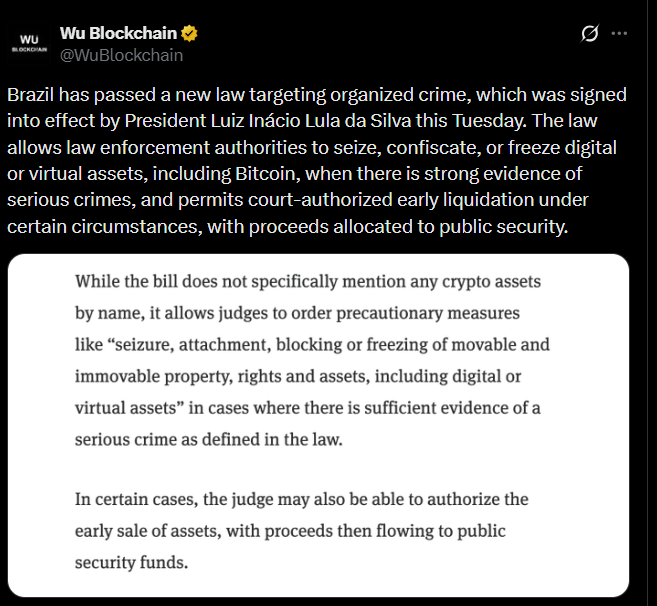
Source: X Official
Authorities believe that tracking Seized Crypto can help reduce criminal networks.
The plan responds to both local scams and global digital threats.
Strong Measures to Control Digital Assets
The proposed Seized Crypto bill introduces tough steps against illegal wealth stored in virtual form. It allows law enforcement to seize and even sell cryptocurrencies like Bitcoin if linked to serious crimes.
Assets can be liquidated before a final court judgment, similar to cash or stocks.
This early action ensures that criminals cannot move or hide funds during long trials.
This approach is seen as a major shift in how governments treat virtual wealth tied to unlawful activity.
Purpose Behind the Law
The main goal of the Seized Crypto proposal is to weaken organized crime by targeting finances directly. By cutting off money sources, authorities aim to reduce the power of illegal groups.
Stop criminals from hiding wealth in virtual formats
Redirect money from seized assets into public safety programs
The broader framework signed by Luiz Inácio Lula da Silva also includes stricter penalties and expanded police powers. While crypto-related liquidation rules come from earlier discussions in 2025, full details are still developing.
Legal Foundation and Market Growth
In 2025, Brazil’s Superior Court of Justice made a key decision. It ruled that digital currencies are financial assets with real value and can be legally seized. Courts also allowed:
Tracking of digital wallets
Orders for exchanges to share user information
At the same time, Brazil became the largest market for digital assets in Latin America. With around $318 billion in activity in 2024, growth has been rapid.
Higher adoption brings more attention from law enforcement
Criminal groups also see new opportunities in this space
Global Impact and Future Outlook
Around the world, similar cases have drawn attention. In the UK, police seized 61,000 Bitcoin linked to a massive fraud case affecting thousands of victims. Meanwhile, INTERPOL led a global operation involving 40 countries, recovering millions in both traditional and virtual funds.
These actions show that financial crime is becoming more global
Governments are learning to work together more closely
Looking ahead, Brazil’s approach could influence other nations. If applied worldwide, such measures may reduce illegal financial flows. However, for global adoption, countries would need:
Clear legal systems for handling virtual assets
Strong cooperation between international agencies
Rules adapted to local laws and economies
Each nation would need to balance security with user rights to ensure fairness.
Conclusion:
Brazil’s evolving strategy highlights how governments are adapting to modern financial risks. By focusing on Seized Crypto, authorities aim to disrupt illegal networks and improve safety. If carefully implemented and adapted, this model could help shape a more secure global financial system while addressing the challenges of digital crime.
