Ethereum Foundation Issues Critical Vision: L1 & L2 Ecosystem Future Redefined Amid Market Warning

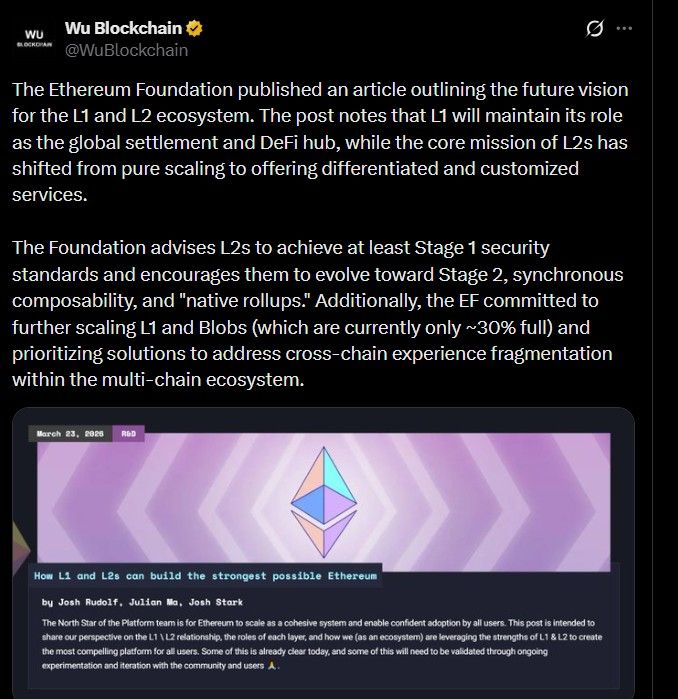
The Ethereum Foundation has issued a stark warning for the Layer 2 ecosystem, signaling a potential 10% correction for non-compliant networks as it unveils a major strategic pivot. In a definitive update to the Ethereum Vision, the Foundation declared that Layer 1 will cement its role as the global settlement and DeFi hub, while Layer 2's core mission has radically shifted from pure scaling to offering differentiated, customized services. The EF is mandating that all L2s achieve at least Stage 1 security standards immediately, with a clear directive to evolve toward Stage 2, synchronous composability, and becoming 'native rollups.' Concurrently, the Foundation committed to aggressively scaling Layer 1 and its underutilized Blobs capacity—currently only ~30% full—while prioritizing solutions to fix the fragmented cross-chain user experience, a move seen as critical for mainstream adoption.
Source: X Official
L1 remains the main settlement layer
L2s focus on new services and flexibility
Strong Push Toward L2 Development
The Foundation is focusing on L2 systems to evolve further. These layers are no longer only about reducing fees or increasing speed. They are now being designed to offer better user-friendly tools and advanced features.
The goal is to combine strong protection with ease of use. Developers can build customized applications with optimized environments suited for different needs such as finance, gaming, or data services. This shift shows how the Ethereum Vision is expanding beyond simple scaling.
Easy-to-use platforms with strong protection
Customized tools for different industries
Clear Security Stages Defined
Security remains a top priority for the network’s future. The Foundation is guiding projects to improve safety step by step. This ensures stability while allowing growth.
They are aiming firstly to reach security level 1 and then moving toward level 2. These stages are defined as:
Stage 1: Strong, reliable security with some decentralization
Stage 2: Fully trust-minimized and decentralized systems
This gradual process helps maintain trust while supporting innovation. It also allows projects to mature without sudden risks to users.
Solving Cross-Chain Challenges
Another key issue is interoperability. Today’s multi-chain ecosystem feels fragmented. Users often find it hard to move between platforms.
Ethereum wants smoother cross-chain UX, so users don’t feel like they’re jumping between isolated networks. The plan is to make interaction simple and seamless across systems.
Their future direction is to push toward:
Synchronous composability (apps interacting instantly across L2s)
Native rollups (deep integration with Ethereum L1)
These improvements aim to create a more connected environment and better overall experience for users.
Roadmap and Long-Term Plans
Researcher Justin Drake has also shared details about a “strawman roadmap.” This roadmap explains the long-term goals for the next five years. It focuses on steady and consistent upgrades across the network.
According to this plan, updates will take place every six months. These upgrades will include improvements to both L1 and L2 systems. This structured timeline shows a clear path forward and signals the first six-month move toward broader upgrades.
Updates planned every six months
Long-term growth strategy over five years
Conclusion:
The Ethereum Vision presents a clear direction for the future of blockchain technology. By focusing on security, flexibility, and better connectivity, the Foundation is working to build a more efficient and user-friendly ecosystem.
