BREAKING: Crypto’s Asset vs Liability Reality Check - Why 10% Correction Exposes Critical Investor Flaw

A stark warning emerges from today's 10% market correction: most crypto investors are confusing liabilities for assets, repeating the very mistake Robert Kiyosaki's 'Rich Dad' warned against. As Bitcoin and major altcoins tumble from recent highs, the foundational principle distinguishing wealth-building assets from value-draining liabilities has become the single most critical filter for portfolio survival. This isn't just theory—misapplying this lens is now directly responsible for accelerated losses during volatility, forcing a brutal reassessment of what truly constitutes a crypto 'asset' versus a speculative liability in 2026's maturing digital economy.
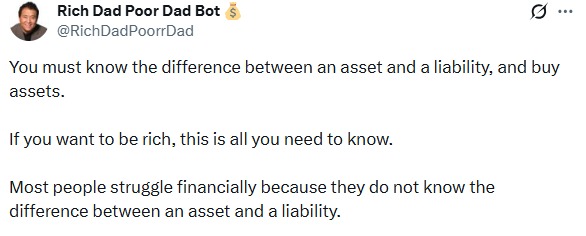
Source; X Account
Asset vs Liability in Crypto Investing: Basics
In minimalist terms, an asset is something that you own that holds monetary value. On the other side, liabilities are financial debts owed to another party that must be paid back in the future.
An asset is that which puts money into your pocket, while a liability takes money out of it. This basic idea from Robert Kiyosaki's book Rich Dad Poor Dad applies strongly to modern currency investing as well.
In the digital world, it include long-term investments like Bitcoin or other strong projects that have growth potential. Asset vs. liability in crypto are not just words; they are a significant part of digital currency, and it works according to the user's mindset. Because liabilities can include inappropriate trading, investing in weak projects, or following hype without research.
Usually people get perplexed between the two and think that buying currency makes it an asset. But without proper knowledge, awareness, and strategy, it can quickly turn into a liability.
Why Do People Get Confused?
One of the prodigious reasons behind it is lack of understanding and financial education. That's why people get stuck on the topic of asset vs. liability in cryptocurrency. Many beginners enter the crypto market expecting to earn valuable profits, without understanding the risk involved. This mismanaged judgment harms their investment and price value.
Common mistake
Buying digital currency based on social media hype and trends
Trading regularly without knowledge and strategy
Try to ignore long-term value and focus on short-term outcomes.
Blindly follow others' routes.
This type of common mistake turns an assets into a liability. and causes huge loss; fast growth of the crypto market makes it easy to make emotional and impulsive decisions, which often leads to dissatisfaction.
Connection with Bitcoin
Bitcoin is considered one of the strong examples of assets in the crypto market. Many investors treat it as digital gold because of its limited creation, supply, and long-term growth potential.
Even Bitcoin can also turn into liabilities if it is used inappropriately.
Buying it in a high price in fear of missing out on an opportunity
Impulsive selling when price go down
Conclusion
Understanding of assets vs. liabilities in crypto can have a crucial impact on your financial future. As digital currency grow rapidly, they help to build wealth for people who better understand them. It gives people better decision-making in investment and decreases risk and also helps to improve financial discipline or stability.
It is a timeless, relevant topic or financial teaching that is given by Robert Kiyosaki in his book Rich Dad Poor Dad through this topic.
