BREAKING: SEC Officially Classifies SOL as Digital Commodity in Historic Regulatory Framework

The U.S. Securities and Exchange Commission (SEC) and Commodity Futures Trading Commission (CFTC) have jointly released a landmark 68-page regulatory framework that formally classifies Solana's SOL token as a digital commodity, ending years of regulatory uncertainty and potentially triggering a major market realignment as institutional capital flows toward newly clarified assets.
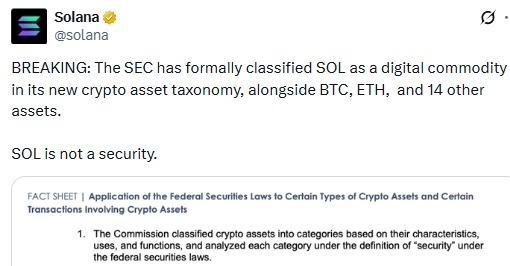
Source: X (formerly Twitter)
This announcement marks a total shift from the "regulation by enforcement" era. For years, the industry operated in a gray area, but the new guidance led by SEC Chairman Paul S. Atkins and CFTC Chairman Michael S. Selig provides a clear roadmap for builders and investors alike.
A New Era for Solana and Major Altcoins
The joint document explicitly names 16 major assets as digital commodities.
Alongside Bitcoin and Ether, the list includes Solana, XRP, ADA, AVAX, BCH, LINK, HBAR, APT, LTC, DOT, SHIB, XLM, XTZ, and DOGE.
By moving away from the "security" label, the SEC acknowledges that these assets operate through decentralized systems rather than the management efforts of a single company.
For Solana specifically, this is a massive win. Previously, the asset was caught in legal limbo, which made some big institutional investors nervous. Now that the SEC does not view it as a security, the doors are wide open for venture funds and asset managers to participate in the ecosystem without fearing legal blowbacks.
Breaking Down the Five Crypto Categories
The new regulatory framework divides the crypto world into five simple buckets to help everyone understand the rules:
Digital Commodities: Functional systems like SOL and other major altcoins, where value comes from supply and demand.
Digital Securities: Tokens that represent corporate ownership or dividends.
Payment Stablecoins: Regulated tools used for daily transactions.
Digital Tools: Tokens used only for specific services or access.
Digital Collectibles: Items like NFTs (music, art, and memes) that are generally not seen as securities.
Staking, Mining, and Airdrops
One of the most exciting parts of the update is how it handles daily crypto activities. The SEC clarified that mining and staking are "administrative" tasks, not securities offerings. This means that if you are staking your Solana to help secure the network, you aren't breaking any investment laws.
The agencies also gave a green light to crypto airdrops. As long as users aren't paying money or providing services like marketing in exchange for the tokens, these "free" distributions are no longer a legal headache.
Why Does This Matters for the Future?
This 2026 ruling is a "binding final rule," meaning it carries the full weight of the law and cannot be easily changed by future administrations. By defining SOL as a digital commodity, the U.S. is positioning itself as a leader in global finance again. This clarity reduces costs for startups and encourages innovation to stay on American soil. For the average person, it simply means a safer, more transparent way to explore the world of crypto finance.
