AI & Quantum Computing Disruption: Why Bitcoin Is Surging as Future Security Debates Intensify

Bitcoin faces a critical security warning as artificial intelligence and quantum computing advancements trigger investor concerns about the cryptocurrency's long-term resilience, potentially threatening its dominance. The debate escalated following a high-profile exchange between Michael Saylor and Chamath Palihapitiya, which highlighted AI-driven market disruption and sparked fears of a significant valuation correction. At stake is whether BTC can maintain its security and market position amidst rapid technological transformation that is reshaping investor strategies and financial markets globally.
How AI Disruption Could Reshape Global Markets: What It Means For Bitcoin?
Former Facebook executive and venture capitalist Chamath Palihapitiya argues on AI’s ability to rapidly disrupt traditional businesses.

According to Chamath's thesis, if AI makes business disruption faster and more frequent, investors may lose confidence in long-term earnings. Instead of valuing companies based on profits expected many years into the future, markets could focus only on short-term cash flows.
This shift would push valuations down to around 2–7 times free cash flow, much lower than current levels. As a result, stock prices could fall sharply, leading to a broad market correction as investors reprice companies based on shorter and more uncertain lifespans.
In such a scenario, investors may shift capital toward assets that are resistant to disruption. This is where Bitcoin becomes critical, because it is increasingly being viewed as one of those alternative assets, due to:
Its fixed supply
Decentralized structure
Independence from corporate performance
This evolving narrative is strengthening the digital asset’s role as a hedge against uncertainty.
Bitcoin Gains as Markets Struggle: Saylor Supported the View
Michael Saylor strongly supported the asset and described BTC as “Digital Capital”—a scarce, neutral asset that is not affected by technological disruption in the same way companies are.
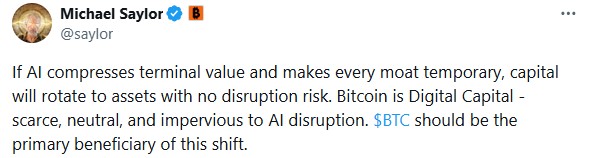
Over the AI-generated disruption, his argument is simple: if AI weakens every traditional investment structure, capital will naturally flow into BTC. This idea is gaining traction as institutional players continue accumulating Bitcoins at scale.
MicroStrategy, now Strategy, itself added over 22,000 Bitcoins the same day, pushing total holdings above 760,000 coins, reinforcing confidence in the asset’s long-term role.
Quantum Computing: A Real Risk or Distant Threat?
Along with his positive view on the digital asset, Chamath also raised concerns about Bitcoin quantum threats. He pointed out that the asset must become quantum-resistant to remain secure in the long run as advanced computers could theoretically break the asset’s cryptographic system (ECDSA) using advanced algorithms.
Saylor responded by arguing that quantum computing would not target BTC alone. If quantum technology becomes powerful enough, it would impact:
Internet encryption (TLS/HTTPS)
Banking systems
Cloud infrastructure
AI platforms
In other words, the entire digital ecosystem would need to upgrade simultaneously. This makes BTC no more vulnerable than any other system.
However, this quantum computing risk debate remains a long-term scenario rather than an immediate threat.
AI and Bitcoin: A Complementary Relationship
Another important angle in the Bitcoin quantum risk debate is the relationship between AI and Bitcoin itself. While AI disrupts traditional sectors, it also increases reliance on digital infrastructure and decentralized systems.
BTC, as a borderless and censorship-resistant asset, aligns well with a future where digital systems dominate. It provides a neutral financial layer that operates independently of centralized control.
This combination of AI-driven disruption and decentralized finance could redefine how value is stored and transferred globally.
This article is for informational purposes only and does not constitute financial or investment advice.
