MiCA Unleashes Wave: European Banks Accelerate Crypto Adoption at Breakneck Pace

Major European financial institutions are now racing to offer digital asset services, marking a dramatic reversal from just years ago when banks broadly restricted crypto transactions. The implementation of the Markets in Crypto-Assets (MiCA) regulation is the key catalyst, opening regulatory doors and providing the clarity needed for traditional banks to enter the digital asset space at an unprecedented scale and speed.

Reports suggest that many of Europe’s largest banks are now moving into the cryptocurrency sector, offering services such as trading, custody, and investment access. The shift comes largely after the introduction of the European Union’s Markets in Crypto-Assets (MiCA) regulation, which provided a clear legal framework for virtual assets.
The transition highlights how institutional attitudes toward cryptocurrencies are evolving, especially as client demand continues to grow.
What Assisted Europe Banks Crypto Adoption: MiCA and Stablecoin Plans
The rise in European bank virtual asset adoption became more visible after MiCA regulations took full effect in 2024 for stablecoins and expanded further in 2026.
The new rules give banking sector a regulated pathway to provide crypto services while ensuring stronger investor protection.
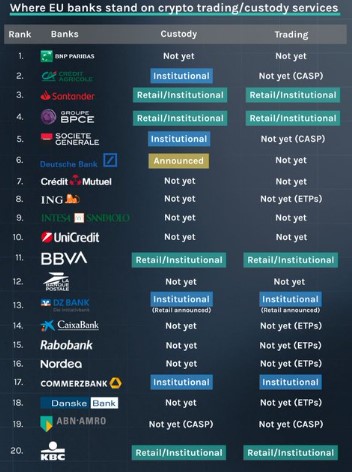
The recent data shared by Backstories shows that 9 of Europe’s top 20 banks already offer or plan to offer digital asset custody or trading services for institutional clients.
Some banks have gone further by enabling retail access to virtual assets.
For example, BBVA and KBC Group have already introduced cryptocurrency access for retail customers. Other traditional monetary groups are preparing similar offerings as demand increases.
Euro Stablecoin Project Adds more Momentum
Alongside growing banking crypto adoption, several institutions have joined forces to launch a MiCa-compliant euro-backed stablecoin project.
The initiative is led by an Amsterdam-based joint venture called Qivalis, which plans to launch the digital euro stablecoin in the second half of 2026.
Many significant banking firms are participating in the consortium and showing their support for the initiative. Some of the major names involved in the project include ING Group, UniCredit, CaixaBank, and Danske.
The stablecoin, expected to be 1:1 pegged to the euro, with reserves partly held in bank deposits and partly in short-term government bonds, will be fully compliant with MiCA and supervised by the Dutch Central Bank.
From Restrictions to Institutional Adoption
The rise of Europe bank crypto adoption marks a sharp change from the situation in 2022. After the collapse of the digital asset exchange FTX, many traditional monetary institutions restricted or blocked digital asset transactions due to concerns about risk and regulation.
However, the combination of clearer regulations and growing client demand has changed the landscape. While retail investors often faced criticism for early cryptocurrency enthusiasm, institutional investors quietly continued accumulating digital assets.
Now traditional banks are beginning to follow the same trend. Analysts say regulated infrastructure, better custody solutions, and clearer compliance rules have made cryptocurrency integration easier for financial institutions.
This article is for informational purposes only and does not constitute financial advice.
