Aave $27 Million Liquidation Crisis: Oracle Glitch Triggers Massive DeFi Shock

A critical oracle failure has triggered a $27 million liquidation event on the Aave protocol, sending shockwaves through the decentralized finance sector. The technical glitch, which struck the platform's Ethereum Core and Prime versions on March 10, 2026, forced rapid, automated liquidations unrelated to underlying market movements—exposing systemic vulnerabilities in DeFi's risk management infrastructure during a period of otherwise bullish sentiment for digital assets.
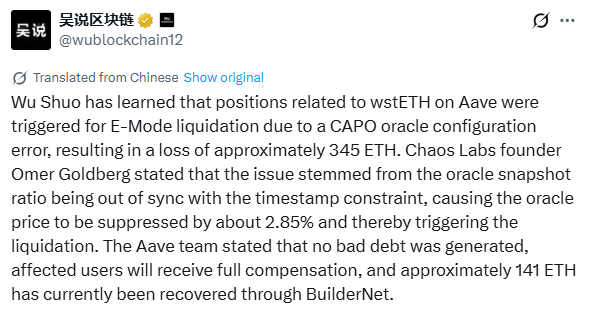
During this event, about 34 accounts were affected. This led to more than 10,900 loan positions being closed automatically. Most of these were high-leverage "E-Mode" positions tied to a token called wstETH, which is a staked version of Ethereum. Stani Kulechov, the founder of Aave Labs, quickly told the community that while some users were affected, the protocol itself remained safe and no "bad debt" was created.
Market Performance and AAVE Price Stability
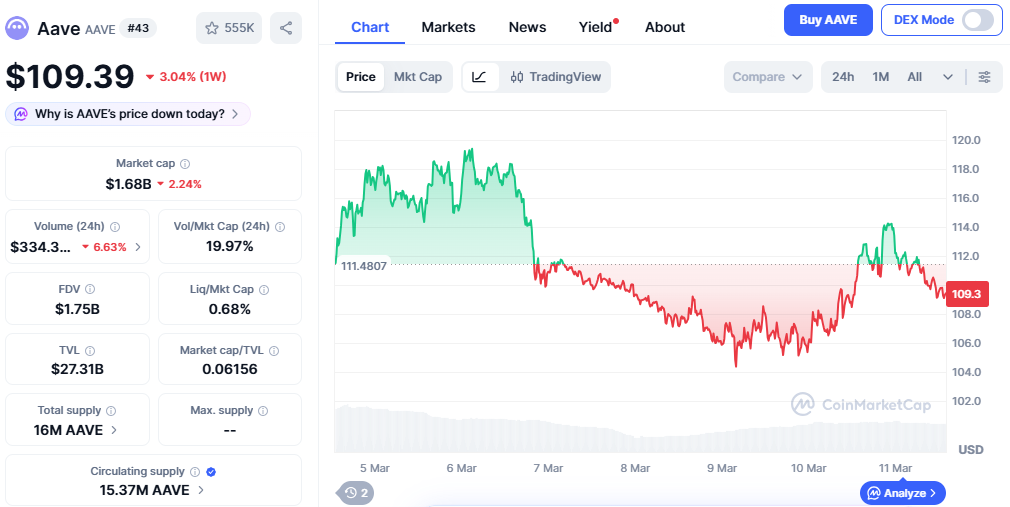
Despite the scale of the $27 Million Liquidation, the market’s reaction to the protocol’s native token has remained remarkably steady. As of March 11, 2026, AAVE is trading at $109.39, showing a minor 3.04% dip over the past week as investors process the technical news. The platform continues to hold a massive $27.31 billion in Total Value Locked (TVL), proving that large-scale liquidity remains within the ecosystem. With a 24-hour trading volume of approximately $334 million.
Technical Causes of the Aave $27 Million Liquidation Incident
The Liquidation was traced back to a mistake in an internal security tool known as CAPO (Capped Asset Price Oracle). Think of CAPO as a digital "guardian." Its job is to set limits on how fast the price of certain tokens can rise. This stops people from faking a price increase to borrow more money than they should.
The problem happened because two internal settings a "price snapshot" and a "time snapshot" fell out of sync. Because these two settings were not updated at the same time, the system thought wstETH was worth about 2.85% less than it actually was.
In the DeFi world, lending apps use this price data to decide if a loan is still safe. Because the system reported a lower price, it mistakenly thought many safe loans were now too risky. This triggered "liquidation bots" to automatically sell the collateral belonging to users. While the users lost money, the bots that stepped in to close the loans made roughly 499 ETH in profits.
Expert Analysis: The Path to Recovery
The response to this protocol $27 Million Liquidation has been fast and transparent. Chaos Labs, which manages risk for the protocol, has taken full responsibility for the error. Their CEO, Omer Goldberg, promised that "every affected user will be fully reimbursed." The recovery plan is already working. So far, over 141 ETH has been recovered through BuilderNet, and the rest will come from the Aave DAO treasury. The total payment to users is expected to be around 345 ETH.
This event is a wake-up call for the entire DeFi sector. It shows that even the safety tools meant to protect us can sometimes fail if they are set up incorrectly. While the phrase "Code is Law" is popular in crypto, this incident proves that human settings still play a huge role. For most investors, the fact that Aave remained stable and is paying people back is a good sign. It shows that the protocol is strong enough to handle technical hiccups without falling apart.
This article is for informational purposes and is not financial advice. DeFi lending carries technical risks. Always maintain high collateral levels to stay safe from unexpected price glitches.
