Starknet STRK20 Launch Revolutionizes DeFi with Native Privacy Tokens

Starknet has shattered blockchain's transparency paradigm with the launch of its STRK20 token standard, introducing native privacy directly into DeFi assets. The new framework enables confidential ERC-20 style tokens within its ecosystem, eliminating reliance on external privacy layers and integrating security features directly into token architecture—potentially transforming how businesses and individuals manage financial confidentiality on public ledgers.
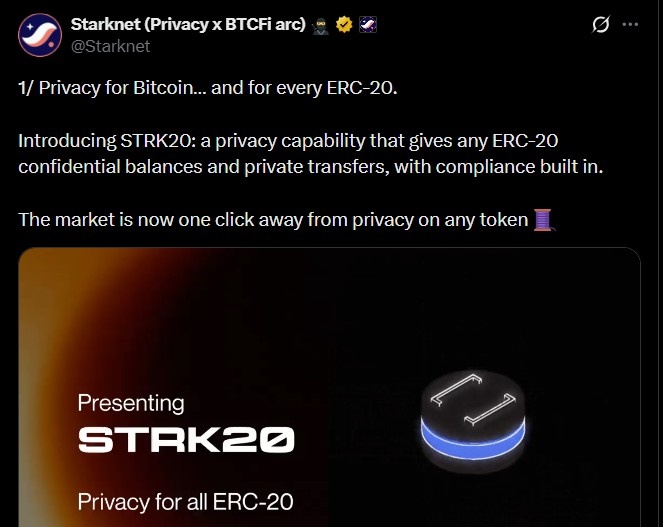
Source: X Official
Introduces built-in privacy for ERC-20 assets on the Starknet network
Enables confidential balances and transfers without breaking DeFi compatibility
Core Architecture and Privacy Technology
The technology behind the new standard relies on Starknet’s zero-knowledge rollup architecture, which allows computation to occur off-chain while proofs are verified on-chain. Transactions are processed through the Starknet Privacy Pool, where users deposit assets, conduct confidential transfers, and later withdraw tokens when needed.
Inside this pool, zero-knowledge proofs confirm the validity of every transaction without revealing the details such as sender identity, receiver address, or transfer value. The cryptographic proof ensures the network verifies correctness while keeping transaction data hidden from public view. The system aims to support settlement times below five seconds and transaction costs under twenty cents, making security practical for everyday financial activity.
Transactions executed through Starknet Privacy Pool using zero-knowledge proofs
Target performance of sub-five-second settlement and low transaction fees
Security Protocols and Compliance Design
Security and compliance form an important part of the framework. While transaction details remain hidden on the public blockchain, the system introduces encrypted viewing keys that allow selective disclosure when required. This means financial privacy can exist alongside regulatory oversight.
Users generate encrypted viewing keys linked to their accounts when interacting with the privacy pool. If auditing or regulatory checks become necessary, authorized parties can access the relevant transaction data without exposing activity belonging to other users. This design attempts to balance confidentiality with compliance, which has been a key challenge for security technologies in the digital asset industry.
Hidden sender, receiver, token amount, and balance information on the public ledger
Encrypted viewing keys enabling selective transparency for audits
Initial Launch Integrations and Applications
The launch of the framework will include several early use cases designed to demonstrate how private finance could work within decentralized ecosystems. The initial applications include private swaps on the Ekubo Protocol and anonymous staking options for assets such as Bitcoin (BTC) and STRK.
Through these integrations, users will be able to trade tokens or participate in staking without publicly revealing their wallet addresses or investment positions. Developers are also exploring confidential stablecoins and shielded tokenized assets that maintain interoperability with existing DeFi platforms.
Private swaps supported through Ekubo Protocol integration
Anonymous staking for assets including Bitcoin (BTC) and STRK
Impact on the Crypto Industry and Future Payments
Privacy-enabled token standards could play a major role in expanding blockchain adoption across financial sectors. Companies and institutional investors often hesitate to conduct transactions on transparent ledgers because competitors can monitor treasury movements or trading strategies.
By enabling confidential transfers while maintaining smart contract compatibility, the new framework could allow businesses to process payments, manage digital assets, and conduct decentralized trading without exposing sensitive financial information. Over time, this technology may support new payment infrastructure, enterprise-grade stablecoins, and confidential decentralized markets.
Encourages institutional adoption by protecting financial transaction details
Could support future blockchain payment systems and confidential financial services
Conclusion:
The Starknet STRK20 framework introduces a new approach to blockchain privacy by combining zero-knowledge cryptography, confidential DeFi operations, and selective transparency. If widely adopted, this innovation could reshape digital payments and help bring secure financial activity onto decentralized networks.
