Bhutan’s $11M Bitcoin Move—Routine Treasury Management or Bullish Market Signal?

A Himalayan kingdom just shuffled its digital treasury—and the crypto world is watching.
The Sovereign Sats on the Move
Forget retail traders—nation-states are now the whales in the room. When a government moves eleven million dollars in Bitcoin, it's not just another transaction. It's a statement. Whether it's rebalancing a sovereign wealth fund or positioning ahead of a macro shift, the movement of institutional-sized stacks sends ripples through order books.
Decoding the State-Level Strategy
Governments aren't day-trading. Their moves are glacial, calculated, and often precede policy shifts or economic hedging. A routine treasury operation? Possibly. But in an asset class hypersensitive to sentiment, any large outflow or inflow from a verified state entity gets parsed for hidden meaning. It's the ultimate 'smart money' signal—assuming you believe bureaucrats can time the market better than your average degen.
The New Frontier of National Reserves
Bitcoin's narrative has evolved from digital cash to institutional safe-haven, and now, to potential central bank asset. Every sovereign move, whether from El Salvador or Bhutan, normalizes the idea of national Bitcoin treasuries. It chips away at the old guard's skepticism, one multi-million-dollar block at a time.
So, routine move or coded signal? In crypto, perception often becomes reality—and a state's cold wallet suddenly looks a lot hotter.
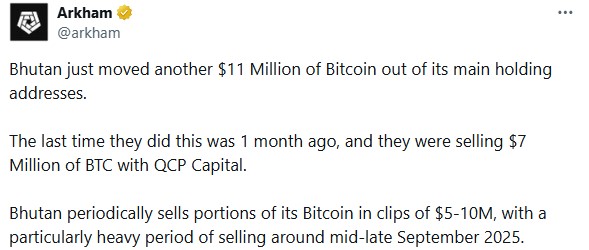
However, as the asset remains stuck in the $60k–$70k range, the frequent selling move from one of the biggest Bitcoin mining nations, raises questions in the market: Is Bhutan losing confidence in the golden asset, or is this simply a strategic treasury move?
Bhutan Bitcoin Reserve: A Planned Source For Earning
The Himalayan nation began Bitcoin mining around 2019, taking advantage of extremely cheap hydropower electricity that costs less than $0.02 per kilowatt hour. This allowed the country to mine Bitcoins at one of the lowest costs in the world.
Over the years, the country accumulated a large BTC reserve, which at one point reached around 13,000 BTCs. At peak market prices, this stash was worth more than $1.3 billion, representing nearly 40–50% of the country’s $2.8 billion GDP.
However, recent data shows the country has been gradually selling portions of its holdings. In February 2026 alone, the country reportedly sold more than $30 million worth of BTC, leaving its current holdings at around 5,700 BTC.
Why Bhutan Increased Selling: Trust Issue Or Supply Issue
Recent on-chain data shows that the digital asset reserves are gradually being managed rather than making large, sudden liquidations, which could also disrupt broader markets. However, the increment in the selling of the asset is seen after the 2024 halving.
The April 2024 Bitcoin halving significantly reduced mining rewards, cutting block rewards in half and increasing the cost of producing new coins. As a result, mining profitability declined globally.
For Bhutan, this meant shifting from aggressive accumulation to careful treasury management. Instead of continuously mining and holding, the country began selling small portions of its digital asset holding to fund national initiatives.
Other reasons are cited that part of the funds may support projects such as Gelephu Mindfulness City, an ambitious development initiative aimed at boosting the country’s economy and attracting international investment.
Importantly, even after recent sales, the Himalayan nation still holds hundreds of millions of dollars worth of Bitcoins, making it one of the largest sovereign holders of the asset in the world.
BTC Price Move: Does It Panicked From Bhutan News
Interestingly, the news of BTCs selling has not negatively impacted the broader market. Bitcoin price recently climbed above $70,000, rising about 4.3% in 24 hours and outperforming the overall crypto market.
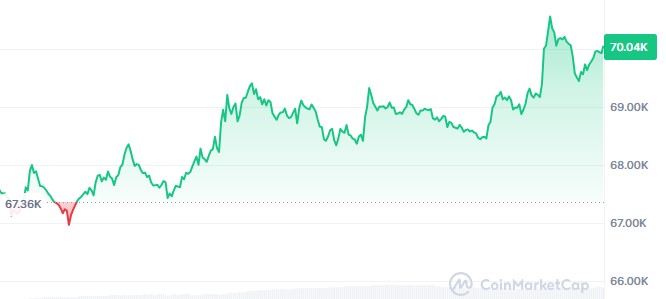
Market analysts say the rally is driven mainly by reduced derivatives sell pressure. Liquidations dropped 49% to around $79 million, while trading volume jumped nearly 39% to over $49 billion, confirming strong buyer interest.
The next major market catalyst will be the U.S. CPI inflation data scheduled for March 12, which could influence risk assets including cryptocurrencies.
Bhutan Bitcoin Reserve: Not a Panic Sale But a Strategic Step
Rather than signaling a loss of faith in cryptocurrency, the country’s Bitcoin activity appears to reflect a long-term national strategy.
By mining BTC with renewable hydropower and selling small portions periodically, Bhutan is effectively treating the digital coin as a commodity-style reserve asset, similar to how some countries manage gold or foreign currency reserves.
For a small economy, holding Bitcoins worth nearly half of its GDP would carry significant risk. Gradual sales help balance national finances while still maintaining a large crypto reserve.
