97.4% Odds Fed Skips March Rate Cut - What It Means for Your Crypto Portfolio

The Federal Reserve looks set to hold the line. Market pricing now shows a near-certain 97.4% probability that policymakers will bypass an interest rate cut at their March conclave.
The Liquidity Lifeline on Pause
For months, traders have eyed the Fed's calendar, betting that cheaper money was just around the corner. That anticipated liquidity injection—a classic tailwind for risk assets like Bitcoin—now seems postponed. The central bank's hesitation signals ongoing wariness about inflation's last stand, choosing stability over stimulus.
Risk Assets in the Crosshairs
When the cost of capital stays high, speculative investments feel the pinch first. Crypto markets, thriving on abundant liquidity and investor appetite for high-growth narratives, often move in inverse correlation to rate expectations. No cut means traditional money-market funds and bonds continue to offer real yield—a seductive, 'risk-free' alternative that pulls capital from the digital frontier.
The Silver Lining for True Believers
This isn't necessarily doom and gloom. A delayed cut reinforces a strong-dollar environment, which can temper rampant inflation fears—the very monster the Fed is fighting. For crypto, it creates a proving ground. Assets with genuine utility and robust ecosystems will demonstrate resilience, separating themselves from the meme-coin froth and leverage-fueled speculation. It's a back-to-basics moment, forcing the industry to build rather than just hype.
The Final Tally
So the Fed's 'higher for longer' mantra gets another verse. While Wall Street analysts recalibrate their glossy projections, the crypto market's response will be a litmus test of its maturity. Sometimes the best bull runs are built on a foundation of discipline, not just cheap money. After all, in finance, the only thing that's truly 'priced in' is the market's capacity to be surprised.
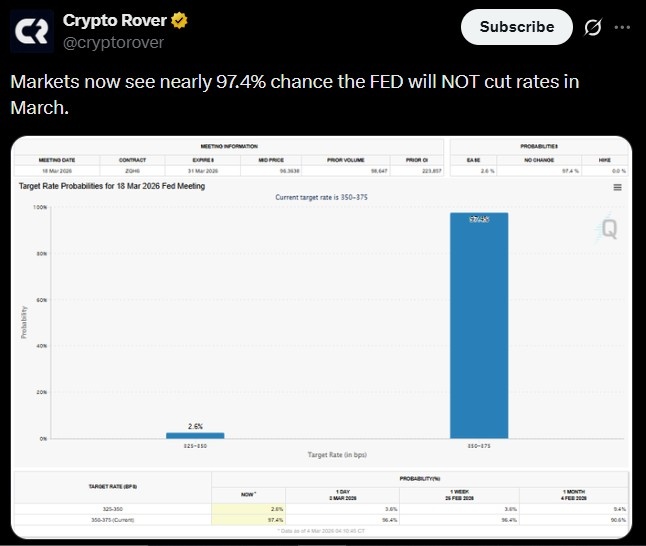
Source: X Official
The numbers indicate that most participants think policymakers will maintain the current range of 3.50%–3.75%. A reduction scenario would move the range down to 3.25%–3.50%, but that outcome currently carries very low probability.
These expectations matter because central bank decisions influence global liquidity, equity valuations, and digital asset demand. When borrowing costs remain high, capital typically moves cautiously across markets.
Why Policymakers May Avoid a Rate Reduction
Several economic factors explain why analysts believe authorities may delay any Fed interest rate cut during the upcoming meeting.
First, inflation remains above the 2% target. Although price growth has slowed compared with earlier peaks, officials still want stronger confirmation that inflation pressures are fully under control. Lower borrowing costs too early could increase spending and push prices upward again.
Second, economic activity in the United States remains relatively strong. Employment conditions remain stable, consumer demand continues to support business activity, and overall economic output still shows growth. In such conditions, policymakers may not see urgency to stimulate the economy.
Additional concerns include:
Rising energy costs linked to geopolitical tensions
Supply chain disruptions that could increase commodity prices
Higher oil prices can feed into inflation, which encourages authorities to keep financial conditions tight.
Another important factor is the central bank’s preference for data-driven decisions. Officials generally review multiple months of inflation reports, wage trends, and economic indicators before changing policy direction.
What This Means for Digital Assets
Interest rate expectations often influence cryptocurrency performance because liquidity conditions shape investor risk appetite.
When borrowing costs remain high:
Liquidity stays tighter across financial systems
Speculative assets often move more slowly
However, if policymakers eventually introduce reductions later in the year, global liquidity could expand. That environment typically supports stronger rallies in risk markets, including digital assets.
Because of this relationship, investors closely track policy signals and economic indicators.
Bitcoin Reaction and Investor Strategy
Bitcoin recently traded near $70,450, showing a decline of roughly 2.5% over the last 24 hours. Analysts suggest the leading cryptocurrency could remain relatively stable in the short term if expectations around the Fed interest rate cut remain unchanged.
Two possible scenarios may shape the future direction:
Stable borrowing costs could keep BTC trading within a consolidation range
Future easing could attract capital flows back into digital assets
Bitcoin also plays a key role in the broader ecosystem. When the largest cryptocurrency gains momentum, other tokens often follow its movement. Conversely, weaker BTC performance usually affects the wider market.
Investors, therefore, often focus on macroeconomic conditions, price trends, and risk management rather than making decisions based only on short-term fluctuations.
Conclusion
Current expectations show most traders anticipate no immediate Fed interest rate cut in March. Persistent inflation, economic resilience, and geopolitical risks support cautious policymaking. Until clearer signals appear, financial markets, including Bitcoin, may remain stable while investors monitor economic data.
This content is for informational purposes only and should not be considered financial or investment advice. Cryptocurrency and financial markets involve risk, and readers should conduct their own research before making investment decisions.
