Crypto Wrench Attack: The Brutal Reality Replacing Address Poisoning Scams

Forget sophisticated code exploits—the latest threat in crypto security doesn't need a keyboard. It needs a crowbar.
The 'Crypto Wrench Attack' is exactly what it sounds like: physical coercion to force victims to surrender their private keys or seed phrases. It's a grim, low-tech escalation that makes digital scams like address poisoning look quaint by comparison. Scammers are bypassing firewalls and going straight for the person holding the phone.
From Digital Deception to Physical Threat
The playbook is terrifyingly simple. Attackers identify a high-value target—often through social media boasts about NFT wins or trading success—and then apply direct, in-person pressure. It's extortion with a side of hardware wallet. This shift from psychological manipulation to blunt-force trauma reveals a chilling evolution in crypto crime, where anonymity cuts both ways.
Security experts are scrambling. Cold storage and two-factor authentication are useless against a threat that arrives at your doorstep. The only defense is operational security: absolute silence about holdings and a paranoid approach to personal digital footprints. Your biggest vulnerability isn't your wallet's software; it's your own online bragging.
It’s a stark reminder that in the wild west of decentralized finance, the most reliable oracle is still human fear—and some traders are learning that lesson the hard way, one wrench swing at a time. Just another day where the 'security' in your asset is only as strong as your door frame. Talk about a bearish signal for personal safety.
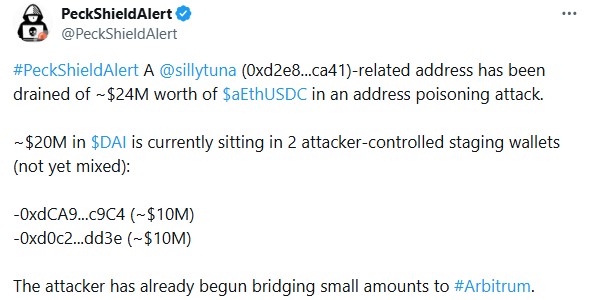
According to the alert, around $20 million in DAI was sitting in two attacker-controlled staging wallets:
0xdCA9...c9C4 (~$10M)
0xd0c2...dd3e (~$10M)
PeckShield also noted that the attacker had already begun bridging small amounts of funds to Arbitrum.
At first glance, it appeared to be another technical blockchain scam, but reality is different.
Not Address Poisoning – A Violent Crypto Wrench Attack
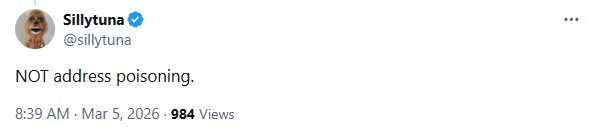
Shortly after the report circulated, Sillytuna publicly rejected the address poisoning claim. He clearly stated: “NOT address poisoning.”
Instead, he revealed that the $24 million theft of AUSD from address 0x6f…0322 resulted from a violent physical assault.
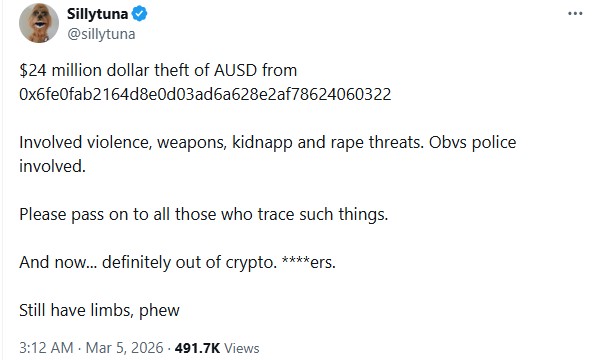
According to his official statement, the attackers used weapons, kidnapping threats, and direct physical coercion. Police are now involved in the investigation.
This means the incident was not a technical blockchain exploit but a crypto wrench attack – a term used in cryptocurrency to describe real-world violence or intimidation used to force victims to hand over private keys, seed phrases, or directly transfer funds.
Point of Concern
For roughly the first 8–10 years of cryptocurrencies adoption (2014–2022), such attacks were rare. Reports appeared only occasionally, and many were not even labeled as wrench attacks.
That changed during the market escalation phase of 2023–2024.
Wrench Attack Cases Jump 75% in 2025
As Bitcoin and other digital asset prices surged, wealthy holders became more attractive targets. In 2024, around 40–41 documented cases were recorded, based on long-running public tracking by security researchers.
However, the real spike came in 2025. According to CertiK’s Skynet report:
72 verified crypto wrench attack cases worldwide
75% increase compared to 2024
Confirmed losses exceeded $40–41 million
Physical assaults jumped 250% year-over-year
Kidnapping was the #1 method (~25 cases)
Europe accounted for over 40% of global incidents
High-profile brutality cases included the kidnapping of David Balland and his wife in France, as well as a violent Vancouver home invasion to steal roughly $1.5 million in BTC. A chilling case also reported from Ukraine, where the 21 years old son of a Ukrainian deputy mayor was brutally beaten and burned alive in his car for his digital amount.
Multiple family hostage situations were also reported in the United States.
Security experts believe losses are significantly underreported. Many victims avoid publicity, police reports, or disclose only partial information due to fear or private settlements.
Trend on rise: 2026 Already Showing Acceleration
The trend is continuing in 2026 with more potential. As of early March, at least 11 reported cases occurred in January and February alone. Experts say the surge strongly, as criminals target individuals perceived to have become “newly rich” during bull markets.
Crypto Wrench Attack Changes the Conversation: New Safety Measures
The Sillytuna case shows how crypto crime has evolved. Cold wallets, hardware security devices, two-factor authentication, and advanced blockchain protections cannot stop a wrench attack. These crimes bypass digital security entirely by targeting the person, not the system.
Security professionals say a few simple steps can help crypto holders stay safer:
Stay low-profile: Avoid posting about crypto wealth or gains online, use separate emails or phone numbers for cryptocurrency activity.
Use multisig wallets: Set up multi-signature wallets with keys stored in different locations. This prevents a single person from moving large funds.
Add transaction delays: Time-lock tools and features can delay transfers by hours or days, giving victims time to react or contact authorities.
Keep decoy wallets: Maintain a small visible wallet while hiding larger funds in hidden wallets protected by passphrases.
Have a safety plan: Personal and family safety should always come first. If threatened, comply if necessary and report the incident immediately.
As crypto adoption grows, personal security is becoming as important as seed phrase protection. What started as a dark meme in the early 2010s has now evolved into a mainstream physical security threat in 2025–2026.
By understanding the safety measures and taking precautions, users can limit these attacks and protect themselves from becoming a physical attack victim for digital assets.
