Tether USDT News: $4.2B Freeze Ignites Fiery Compliance Debate in Crypto

Regulators just dropped a $4.2 billion ice cube on the crypto market—and the meltdown is all about trust.
The Compliance Hammer Swings
Forget subtle nudges. This move is a full-force regulatory takedown, freezing assets on a scale that sends a shockwave through every trading desk and DeFi protocol. It's not just about one stablecoin; it's a direct challenge to the entire ecosystem's 'move fast and break things' ethos. Suddenly, compliance isn't a back-office chore—it's the main event.
Stablecoin Stability Under the Microscope
The core promise of a stablecoin is right there in the name: stability. But what happens when the peg isn't just to the dollar, but to regulatory scrutiny? This action forces a brutal audit of the real-world assets and legal frameworks backing every major digital dollar. The market is left asking—whose reserves are truly bulletproof, and whose are just legal fiction? (A question traditional finance has been politely ignoring for decades, by the way.)
The Ripple Effect Beyond the Freeze
This isn't an isolated incident. It's a precedent. Exchanges are now scrambling to review their own token listings and partnerships. Institutional investors are double-checking their on-ramps. The message is clear: the era of operating in gray areas is over. The cost of non-compliance just got a $4.2 billion price tag.
A Turning Point for Digital Finance
Love it or hate it, this moment forces growth. It pushes builders toward transparent, auditable, and regulatorily-sound designs. The path forward isn't around the system, but through it—building infrastructure so robust it turns regulatory scrutiny from a threat into a stamp of approval. The alternative? Getting left out in the cold.
The debate is no longer about if crypto will comply, but how. And for an industry built on bypassing gatekeepers, that's the most provocative question of all.
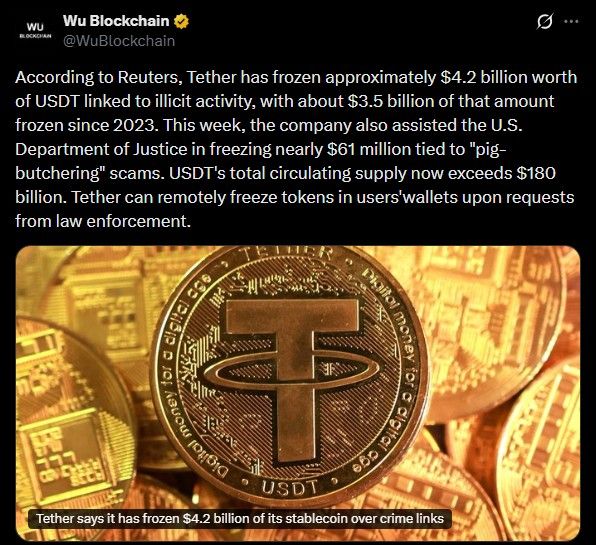
Source: X Official
Global Enforcement Actions and Past Wallet Blocks
The issuer previously blocked wallets linked to human trafficking, terrorism funding, and conflict-related transactions in Israel and Ukraine.
Russian exchange Garantex also reported last year that funds on its platform were restricted following sanctions pressure.
Authorities worldwide have increasingly warned about the role of digital assets in illicit finance. The Financial Action Task Force (FATF) urged countries to strengthen oversight of crypto markets, which still operate under lighter regulation compared to traditional finance.
Blockchain researchers reported that money laundering using digital assets reached at least $82 billion last year, a sharp rise from about $10 billion in 2020. Growth among Chinese-speaking scam networks has been identified as a major driver. Stablecoins remain widely used in trading, cross-border transfers, and settlement, which explains their rising transaction volumes.
How the Company Identifies Suspicious Activity
Blockchain tracking tools analyze wallet behavior, transaction clusters, and links to known scam addresses.
Collaboration with exchanges, analytics firms, and regulators helps confirm high-risk activity before restrictions.
Through on-chain monitoring, suspicious wallets are flagged when patterns match known fraud operations such as phishing rings, ransomware networks, or pig-butchering schemes. Intelligence often comes from law enforcement alerts, exchange reports, and analytics platforms that map fund movement across chains.
This process allows quick intervention, which is why recent Tether USDT News shows a rapid response to major scam networks.
Long-Term Solutions and Market Impact
Freezing is a reactive measure; stronger compliance, identity checks, and exchange monitoring act as preventive tools.
International cooperation between the U.S., European nations, parts of Asia, and sanctioned jurisdictions plays a critical role.
Experts say freezing alone cannot eliminate misuse. Permanent solutions include stricter KYC standards, better cross-chain monitoring, faster reporting frameworks, and improved global regulatory coordination. Countries often linked to large scam operations include regions in Southeast Asia, Eastern Europe, and networks targeting users globally rather than one specific market.
The deeper impact on market share appears mixed. Enforcement strengthens trust among regulators and institutions, potentially supporting adoption. However, critics argue that the ability to freeze funds highlights centralization risks within stablecoins. In the long term, transparency and compliance may help maintain dominance despite competition from new regulated stablecoin projects.
Conclusion:
This Tether USDT News shows stronger enforcement shaping the stablecoin sector, balancing crime prevention with decentralization concerns while influencing future regulation and investor confidence.
