Ripple Throws Open the Gates: XRP Ledger Goes Fully Permissionless for Developers in 2026

Ripple just pulled the trigger on its biggest decentralization play yet. The XRP Ledger—the blockchain powering billions in cross-border payments—is now a public sandbox. No more waiting for invites or corporate approvals. If you can code, you can build.
The Permissionless Shift
This isn't a minor update; it's a foundational rewrite of the rulebook. For years, Ripple maintained significant influence over the ledger's development and validator set. That era ends now. The core protocol is open for modification, and the validator network is truly decentralized—anyone with sufficient XRP can run a node and vote on the network's future.
Developers are flooding in, testing limits Ripple itself never pushed. We're seeing early experiments in decentralized identity, tokenized real-world assets, and DeFi mechanisms that operate at the ledger's native speed—settling in 3-5 seconds with fees under a penny. The old guard of slow, expensive smart contract platforms is officially on notice.
A New Calculus for XRP
What does this mean for the XRP token? Everything. Its utility explodes beyond just a bridge currency. It's now the mandatory fuel for transaction fees, the stake for validator authority, and the potential collateral for new financial primitives being built on-chain. Demand vectors are multiplying overnight.
Of course, the crypto cynics are already circling. They'll call it a desperate pivot from a company whose regulatory battles made Wall Street skittish—a move to finally appease the 'decentralization' purists. Let them talk. While they debate ideology, builders are deploying. Ripple isn't just opening its ledger; it's inviting the world to rewrite the next chapter of global finance. The race to build the future of value starts now, and the starting gun just fired.
Source: X Official
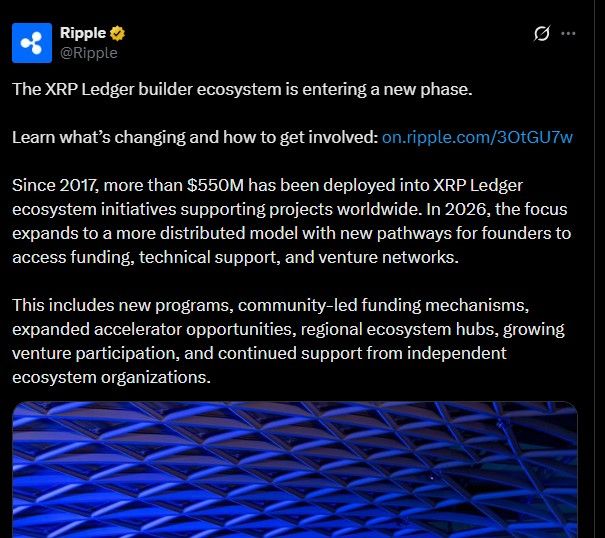
What Ripple’s Statement Means
Previously, Ripple played the primary role in funding and guiding projects, making the ecosystem more centralized. The new direction changes that approach by encouraging multiple contributors to participate.
The earlier model relied mainly on direct company funding and direction
Future guidance will come from several sources across the ecosystem
In practical terms, developers and startups building on the ledger will receive broader opportunities.
More funding programs provide additional capital access
Community funding allows groups and contributors to assist ideas
Accelerators help startups grow faster with mentorship
Regional hubs create local developer support worldwide
Venture capital participation brings institutional investment
Independent organizations assist builders beyond company involvement
This shift represents a structural change from a narrow support system to a broader innovation network.
Market Position and Growth Outlook
The strategy could reshape market positioning by expanding utility and attracting new builders. Ripple’s recent MOVE to allocate $5 million to t54 Labs, a startup focused on infrastructure for AI agents, highlights its ambition to extend ledger usage into emerging technologies such as artificial intelligence.
This initiative reflects the second phase of XRP Ecosystem Expansion, where blockchain infrastructure moves beyond payments toward developer platforms, automation tools, and digital applications.
Broader developer activity can increase real-world use cases
Integration with AI may strengthen long-term technology relevance
Such developments can shift growth perception from a payments-focused network to a multi-sector innovation layer.
Token Outlook and Current Market Data
At the time of writing, the token is trading NEAR $1.41, down around 1.38% in the past 24 hours. Short-term movement reflects normal market volatility rather than structural weakness.
Future price direction depends on whether ecosystem expansion translates into measurable adoption.
More applications may increase demand for network usage
Strong builder activity often assists long-term value narratives
While ecosystem growth does not guarantee price appreciation, expanding developer participation historically strengthens network fundamentals.
Ripple’s broader strategy suggests the company wants progress without relying solely on its own involvement. By distributing support across investors, accelerators, and independent groups, the platform aims to create a self-sustaining innovation environment.
Conclusion:
The announcement highlights a clear strategic transition toward XRP Ecosystem Expansion, signaling a move from centralized support to community-driven growth. As more investors and organizations participate, application development may rise, technology could advance, adoption may improve, and the network can strengthen over time.
