Wikipedia Co-Founder Predicts Bitcoin Price Could Plummet Below $10K – Here’s Why

Bitcoin's next big move might be a nosedive, according to a surprising source. Wikipedia co-founder Jimmy Wales just dropped a bearish bomb that's rattling crypto circles.
The Prediction That's Making Waves
Forget the moon—Wales sees Bitcoin crashing back to Earth. He's not just talking a dip; he's forecasting a plunge below the psychological $10,000 barrier. That's a gut punch for anyone who bought the recent hype.
Why a Tech Titan's Voice Matters
Wales built one of the web's most trusted resources. When he talks tech and information, people listen. His skepticism cuts through the usual crypto echo chamber, forcing even bulls to reconsider their positions. It's a reminder that outside the bubble, adoption narratives can look fragile.
The Market's Delicate Dance
This call highlights crypto's eternal tension: revolutionary potential versus speculative excess. Every cycle has its prophets of doom, but credentials like Wales's give this warning extra weight. It's the classic clash between disruptive innovation and good old-fashioned market gravity.
The Bottom Line for Your Portfolio
Is this the smart money calling the top, or just another celebrity opinion? Either way, it's a stark counter-narrative to the relentless 'number go up' ethos. Sometimes the most valuable insight in finance is a simple reminder that what goes up must come down—especially when the rally's been fueled more by memes than fundamentals.
Source: X Official
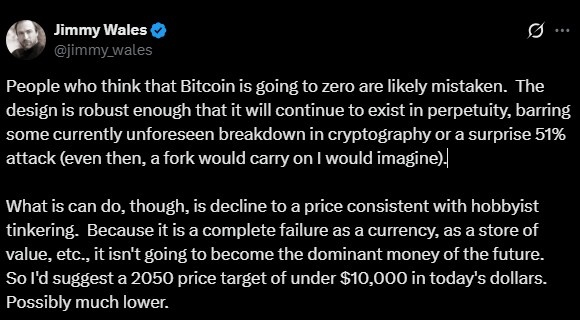
What Jimmy Wales Wanted To Express
His statement presents two contrasting ideas: technical strength but uncertain economic success.
The network’s architecture makes long-term survival likely
Real-world usage as money and a dominant financial asset remains doubtful
In simple terms, he believes the technology works, but adoption as everyday money has not matched expectations. Wales sees the asset more as a speculative instrument rather than a widely used payment system. He also added that it may remain suitable for hobbyists and enthusiasts, while traditional safe-haven assets such as gold, silver, jewelry, real estate, and fine art are likely to continue dominating store-of-value demand.
Are His Views Practical?
From a market perspective, some elements of his view align with data while others remain debated.
Payment usage remains smaller compared with speculation and trading activity
Volatility still challenges the narrative of stable long-term value
At the same time, institutional involvement has grown significantly. Large investment products, exchange-traded funds, futures markets, and indices show rising participation from traditional finance. These intermediaries generate revenue by serving investor demand, indicating ongoing interest even during market cycles.
The Wikipedia co-founder also suggested that such products can continue to exist even if public interest weakens. Smaller ETFs can survive for years while trading volumes gradually decline, reflecting market resilience without strong growth. His preference for physical safe-haven assets highlights a broader investor mindset that values scarcity, tangible ownership, and long historical trust.
Current Market Context And Price Outlook
At the time of writing, bitcoin price is trading near $67,734, down around 1% in the last 24 hours. The short-term movement reflects typical volatility rather than a structural shift.
Wales believes price pressure could emerge if innovation slows and public curiosity fades.
He argues that many buyers are motivated by potential gains rather than daily utility
He notes AI systems and automation tools have not adopted crypto at scale, which he views as limited real-world integration
These factors support his view that valuation may depend more on sentiment than usage.
Could Price Really Fall Toward $10K?
A long-term drop to $10,000 WOULD require major changes in market dynamics.
Reduced institutional flows and weaker retail demand could push valuations lower
Slower technological progress or regulatory pressure may impact confidence
However, strong network effects, global recognition, and infrastructure expansion provide counterarguments. Even if digital assets face slower growth, traditional safe-haven markets like precious metals and property could continue attracting conservative capital, reinforcing Wales’ argument about long-term dominance.
Conclusion:
The debate highlights a key tension — strong technology versus uncertain monetary role. While predictions differ, the discussion from the Wikipedia Co-Founder reinforces that future value will depend on adoption, innovation, and competition from traditional safe-haven assets.
