WLFI Proposes Revolutionary Governance Staking System: Community Vote Is Live Now

WLFI just dropped a governance bombshell—and it's putting the power directly in token holders' hands. The proposal? A staking system that ties voting weight directly to locked commitment. Forget one-token, one-vote platitudes; this is skin-in-the-game democracy.
The Mechanics: Lock, Vote, Govern
The core is simple: stake your WLFI tokens to earn governance rights. The longer you lock, the heavier your vote. It's a direct incentive for long-term alignment—bypassing the mercenary capital that often derails decentralized projects. No more vague promises; influence is now a function of conviction.
Why This Vote Matters
This isn't a minor protocol tweak. It's a foundational shift in how WLFI is steered. A 'yes' vote codifies a stakeholder aristocracy—where the most committed call the shots. A 'no' reverts to a more fluid, and arguably more chaotic, status quo. The community has 48 hours to decide which future it wants.
The finance cynic's take? It's another elegant mechanism to temporarily reduce sell-side pressure—dressed up as high-minded governance. But sometimes, the suits need a little theater to make the numbers work.
The ballot is open. The clock is ticking. Will WLFI holders choose structured commitment or pure liquidity? The chain awaits its verdict.
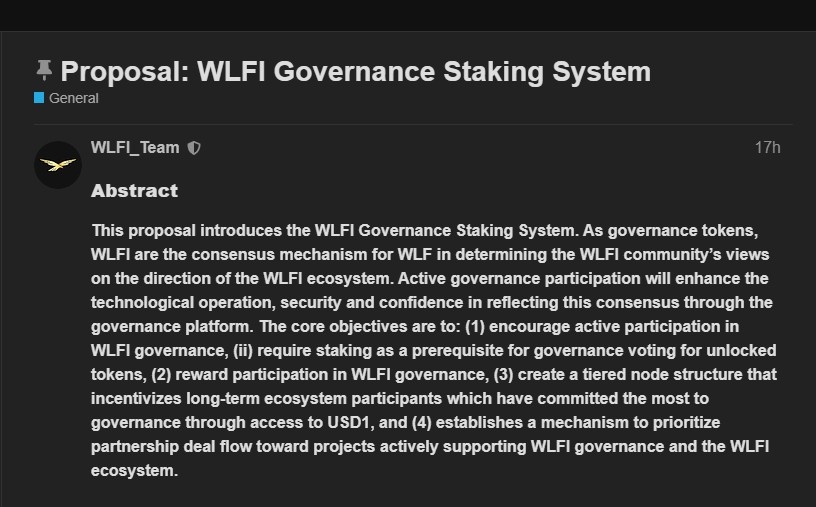
Source: WLFI Official
What Is WLFI And Its Utility
Governance-focused digital asset
Built to guide ecosystem direction and stablecoin growth
WLFI works as a governance token that allows holders to influence platform direction, upgrades, and strategic plans. Beyond voting, utility includes holding incentives, ecosystem rewards, and advantages linked to USD1 — the project’s stablecoin initiative.
This asset plays a key role in shaping development priorities, making it more than a tradable instrument. With the new governance staking approach, utility expands toward active involvement instead of passive holding.
Why Staking Is Being Introduced
Promotes long-term alignment
Links incentives with governance activity
The proposal outlines several objectives behind the model. These include encouraging active participation, requiring holding before voting with unlocked balances, rewarding engagement, and introducing a tiered node framework for committed participants.
Through this structure, larger contributors gain improved access to USD1 opportunities, while projects supporting ecosystem direction may receive partnership priority. The framework ensures decision power remains with committed participants rather than short-term traders.
The design also introduces Node and Super Node tiers that provide additional privileges, deeper ecosystem access, and collaboration potential.
Community Benefits And Market Impact
Stronger participation incentives
Possible influence on long-term demand
For community members, the proposal provides rewards tied to voting involvement, stronger influence in decision processes, and new opportunities connected to USD1 adoption. Tiered access may encourage holding behavior while improving engagement.
Price impact remains uncertain. Governance staking can reduce available supply, which may support sentiment, but reaction depends on adoption levels, broader crypto trends, and execution quality.
During the last 24 hours, the asset recorded a 3.29% rise, trading NEAR $0.1181, reflecting early attention around the update. While short-term movement does not guarantee sustained growth, governance developments often act as sentiment drivers.
The initiative also highlights rising focus on stablecoins. USD1 aims to compete within a market currently led by USDT and USDC, which control significant share across trading activity. Expanding incentives around USD1 usage suggests stronger emphasis on stablecoin distribution and ecosystem growth.
Attention now shifts toward whether holding demand can support USD1 expansion and broader adoption.
Conclusion
The governance staking initiative signals movement toward stronger community influence, expanded utility, and stablecoin strategy. If approved, the model may enhance engagement, support USD1 growth, and shape long-term ecosystem development while influencing market sentiment.
