Token Unlocks This Week Signal $317M Liquidity Expansion - Here’s What It Means for Your Portfolio

Get ready for a liquidity tsunami. A wave of token unlocks is about to hit the market, signaling a potential $317 million injection into the crypto ecosystem. This isn't just scheduled supply inflation—it's a critical stress test for asset valuations and market depth.
The Unlock Calendar: A Mix of Opportunity and Overhang
Projects across major Layer 1s and DeFi protocols are releasing tokens from their vesting cliffs. While some fear immediate sell pressure, history shows unlocks can be a catalyst for renewed developer activity and ecosystem incentives—if managed transparently. The key is watching where the liquidity flows: into staking, DeFi pools, or straight to OTC desks.
Market Mechanics: Absorption vs. Dilution
Does the market have the appetite to absorb $317 million in new supply? Current open interest and exchange reserves suggest a mixed picture. High-Frequency Trading (HFT) algos are already positioning for volatility, while long-term holders assess the fundamental impact on tokenomics. One cynical take? It's another round of 'VCs cashing out while retail provides the exit liquidity.'
Strategic Implications for Bullish Practitioners
For the savvy investor, unlocks create asymmetric opportunities. Look for projects with clear, post-unlock treasury deployment plans and strong community governance. The real signal isn't the unlock itself, but the market's reaction—a price hold above key levels post-unlock often indicates robust underlying demand. Ignore the noise, watch the order books.
This week separates the robust token economies from the poorly designed ones. The $317 million question: Will this liquidity expand the pie for everyone, or simply dilute existing holders? The market votes with every trade.
Unlock Schedule Overview:
One-time major releases: SUI, JUP, H, GRASS, XPL, EIGEN, KMNO, SVL
Linear daily distributions: RAIN, CC, TRUMP, WLD, RIVER, DOGE, ASTER
Large single releases usually involve early investors, ecosystem funds, or team allocations. Linear distribution tends to support long-term incentives such as staking rewards, grants, or contributor compensation. Because these releases exceed $317 million collectively, analysts expect noticeable liquidity expansion across several ecosystems.
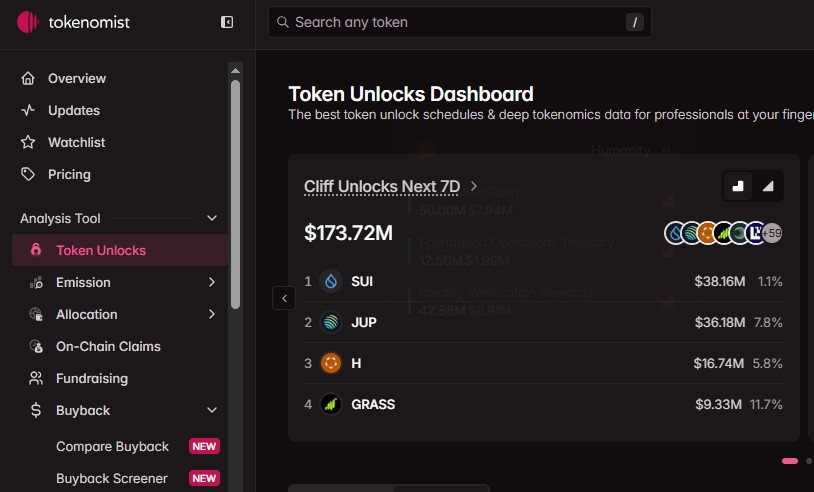
Source: Tokenomist.ai official
Token Profiles, Use Cases, and Chains
Infrastructure and DeFi projects dominate upcoming supply events
Each asset supports different ecosystem narratives
SUI ($0.8868) operates on its own Layer-1 network built for high-speed applications and is known for gaming and consumer-focused blockchain experiences. JUP ($0.1453), native to Solana, powers a leading decentralized exchange aggregator widely used for routing swaps. EIGEN ($0.1784) is associated with ethereum restaking infrastructure, enabling shared security across protocols.
KMNO ($0.02576) runs within Solana’s DeFi lending environment, supporting liquidity strategies. WLD ($0.3747) focuses on identity verification infrastructure built around global digital identity concepts on an Ethereum-based architecture. DOGE ($0.09457), the well-known meme asset, continues to operate on its independent blockchain with strong community influence.
GRASS ($0.1705) supports data-sharing infrastructure narratives, while XPL ($0.08442) and SVL ($0.01615) contribute to emerging ecosystem development initiatives. Recent price levels referenced from CoinMarketCap indicate these assets remain sensitive to liquidity changes, with infrastructure tokens typically showing higher volatility around scheduled releases.
Market Impact and Liquidity Effects
Increased circulating supply may create short-term price pressure
Higher liquidity can improve trading efficiency and participation
Token Unlocks this Week may influence market capitalization if new supply enters exchanges quickly. When large allocations become liquid, early holders sometimes take profits, leading to temporary selling pressure. However, broader Flow can attract institutional participation, reduce spreads, and support ecosystem expansion. Investors often monitor unlock ratios, distribution recipients, and historical price behavior to estimate potential volatility. Infrastructure tokens frequently experience short-term dips followed by stabilization once markets absorb additional supply.
Why Scheduled Unlocks Matter for Investors
Releases are pre-defined through smart contracts
Teams typically cannot alter timing once deployed
Most digital asset distribution schedules are coded into smart contracts during launch, meaning upcoming releases are automated and transparent. This ensures predictability but limits project control over timing. Token Unlocks this Week therefore represent planned liquidity events rather than unexpected supply shocks. Understanding these timelines helps investors prepare positioning strategies, evaluate dilution risk, and identify accumulation opportunities during volatility phases.
Conclusion:
Token Unlocks this Week highlights how scheduled supply expansion influences liquidity, volatility, and investor positioning. While short-term pressure may appear, transparent distribution supports long-term ecosystem growth, making Token Unlocks this Week an essential indicator for tracking market structure and opportunity.
