Blackrock’s ETHB ETF Nears Launch: Is Ethereum Staking About to Go Mainstream?

Wall Street's trillion-dollar gatekeeper just placed its chips on Ethereum's most lucrative feature. BlackRock's ETHB ETF—a fund built to stake Ether and harvest yield—clears its final regulatory hurdles. The launch pad is lit.
The Staking Playbook
Forget mining rigs and complex node operations. This ETF cuts the technical cord. It buys Ether, stakes it directly on the blockchain, and passes the rewards—minus a hefty management fee, of course—to shareholders. It's passive income, repackaged for pension funds and your uncle's IRA. Traditional finance finally found the 'on' switch for crypto's native yield engine.
What Unfolds Next?
Market watchers brace for a liquidity quake. A green light could funnel institutional billions directly into Ethereum's consensus layer, tightening supply and potentially juicing the staking yield for everyone. It also throws a regulatory gauntlet—how the SEC squares a staking-derived income ETF with its past skepticism is a spectacle in itself. Meanwhile, crypto natives watch with a mix of triumph and cynicism: the very establishment that called it a scam now aims to profit from its core mechanics. A classic finance pivot—from condemnation to commodification.
The final move rests with regulators. Approval doesn't just list a new ticker; it legitimizes an entire economic layer of Web3. Rejection? Another delay in the inevitable marriage of TradFi infrastructure and crypto-native yield. Either way, the game changed. The question is no longer if institutional capital arrives, but on whose terms.
BlackRock Moves Toward Staked Ethereum ETF
The ETHB ETF comes after the success of BlackRock’s spot Ethereum ETF, ETHA, which has already crossed $6 billion in assets. A filing in December showed that a seed investor bought 4,000 shares at $0.25 to help start the fund.

Source: X (formerly Twitter)
There is no official launch date yet, but the ETF is expected in the first half of 2026. This is possible because regulators are now more open to ETFs that include staking rewards, something that was not allowed before.
How ETHB Could Change Ethereum Investing?
It aims to turn cryptocurrency's into a yield-generating asset. Based on filings, the fund plans to stake around 70% to 95% of the ETH it holds. A small portion will remain unstaked so the fund can manage withdrawals and liquidity.
Investors could receive about 82% of staking rewards, while the rest will go to BlackRock and execution partner Coinbase. The ETF will also charge a 0.25% sponsor fee.
This model introduces institutional yield to Ethereum investing and strengthens the connection between traditional finance and blockchain.
Institutional Activity Adds Support
The Blackrock new ETHB ETF narrative is growing alongside institutional buying. BitMine recently bought 17,722 ETH worth about $34.7 million. Large purchases like this can help support price and improve sentiment.
Investors can track ETF-related wallet activity through platforms like Arkham, although on-chain movements usually appear a day later because of traditional finance settlement timelines.
Market Context and Technical Outlook
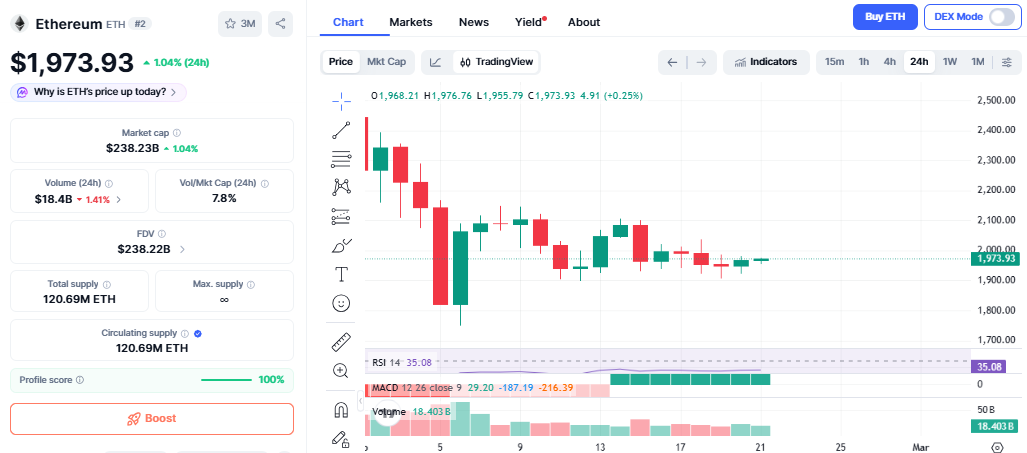
It is trading NEAR $1,973 after a small rebound. The chart shows ETH recovering from oversold conditions, with RSI previously near the mid-30s. Volume remains important; stronger volume is needed to confirm the bounce.
Source: CoinMarketCap
The Blackrock new ETHB ETF story adds a long-term catalyst, but short-term price still depends on technical levels and overall market sentiment.
Resistance sits near $2,025 and the psychological $2,000 level. Support is around $1,900, with deeper support near $1,748. For now, ETH appears to be moving within a range.
Ethereum Price Prediction
If it holds above $1,900, the price could test the $2,000–$2,025 area. A breakout may push ETH toward $2,100. However, if $1,900 breaks, the price could revisit the $1,748 level before stabilizing.
Why ETHB Matters for Institutional Adoption?
This shows a clear shift toward yield-focused crypto products. Instead of simply buying ETH, institutions may start targeting staking returns through regulated investment vehicles.
This suggests deeper integration between traditional finance and decentralized infrastructure. If it launches successfully, it could influence how future crypto ETFs are designed.
Conclusion
The Blackrock new ETHB ETF represents an important step for Ethereum’s institutional story. While price recovery is not guaranteed, staking-based ETFs highlight how the market is evolving.
In the short term, ETH may remain range-bound unless more institutional demand appears. Over the long term, products like this could change how investors view this cryptocurrency from a passive asset to a yield-generating one.
