Robert Kiyosaki’s Bold Bitcoin Bet: Why He’s Buying During the Bear Market

Robert Kiyosaki just doubled down on Bitcoin—and he's doing it while everyone else is running for the exits.
The Contrarian Playbook
Forget the panic selling. Kiyosaki's latest move flips conventional wisdom on its head, scooping up BTC precisely when sentiment hits rock bottom. It's the classic 'be greedy when others are fearful' maneuver, executed with textbook timing.
Decoding the Signal
This isn't some random trade. When a figure like Kiyosaki makes a public buy during a downturn, it sends a deliberate signal—one that cuts through the noise of daily price fluctuations. It suggests a long-game perspective that most retail investors lack.
The Institutional Whisper
Behind the scenes, similar accumulation patterns are playing out among sophisticated players. They're not tweeting about it, but the on-chain data doesn't lie—strategic positions are being built while the mainstream media peddles doom narratives.
Timing vs. Time-in
Kiyosaki's move highlights the eternal crypto dilemma: trying to time the exact bottom versus simply ensuring you're positioned before the next cycle begins. One approach requires luck; the other requires conviction.
Meanwhile, traditional finance keeps trying to value digital scarcity using spreadsheets designed for dividend stocks—a fitting metaphor for an industry that's been wrong about Bitcoin at every turn.
Whether this marks the absolute bottom remains to be seen. But when seasoned investors start acting against the herd, it's usually worth paying attention. The real question isn't why Kiyosaki bought now—it's why more aren't following his lead.
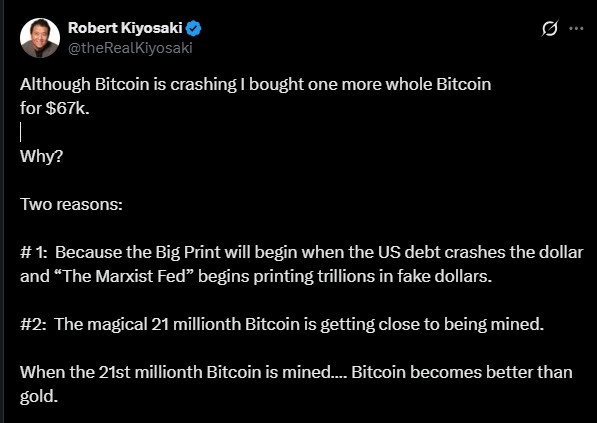
Official Statement And Brief Explanation
Kiyosaki explained that he bought more BTC because governments can print unlimited money while Bitcoin supply remains fixed. He warned that excessive debt may trigger large-scale currency creation, reducing the purchasing power of traditional money. He believes limited digital assets protect wealth during inflation cycles.
That difference is why he sees Bitcoin as “digital gold.” His argument is based on scarcity, monetary policy concerns, and long-term investment thinking rather than short-term price action.
Bitcoin Supply, Network Size And Demand
Bitcoin’s total maximum supply is capped at 21 million coins. Currently, over 19 million have already been mined, leaving a smaller portion available over the coming years. This predictable supply model is one of the main reasons investors view BTC as a scarce asset.
The network has grown into the largest blockchain ecosystem by market value. It supports global transactions, institutional custody, exchange trading, and integration into payment infrastructure. Demand remains driven by several factors, including institutional adoption, ETF flows, and macroeconomic uncertainty.
Recent interest shows mixed signals. Long-term holders continue accumulation while short-term traders react to volatility. Large asset managers still allocate exposure, suggesting structural demand remains intact even during price declines.
Why Price Is Falling And Market Trends
Despite strong fundamentals, bitcoin price often drops due to liquidity shifts, profit-taking, and macro pressure such as interest rate expectations. When capital moves toward safer assets, crypto markets typically experience short-term weakness.
Recent trends shaping digital money adoption include:
Expansion of stablecoin use for payments and settlements
Increasing regulatory clarity supporting institutional entry
These developments indicate broader integration of blockchain technology, even when price momentum slows.
History Of Major Drops And Recovery Cycles
Bitcoin has experienced several sharp corrections before. Major declines occurred in 2018 after the previous bull cycle and again in 2022 during tightening monetary conditions. In both cases, prices later recovered as adoption increased, infrastructure improved, and institutional participation expanded.
Recovery patterns historically followed innovation waves such as exchange growth, ETF approvals, and corporate treasury adoption. Analysts often note that previous downturns created accumulation phases before new upward cycles.
Whether a similar rebound happens now depends on liquidity conditions, regulatory progress, and continued investor demand. Market participants watch macro indicators closely to understand the timing of potential recovery.
The narrative behind Robert Kiyosaki Buys BTC reflects a broader belief that scarcity combined with global adoption may support long-term value even when volatility persists.
Conclusion:
The Robert Kiyosaki Buys BTC narrative highlights confidence in scarcity-driven value despite market weakness. BTC history shows repeated recovery after major declines, but future direction depends on macro trends, institutional demand, and continued expansion of digital asset adoption.
