US SEC’s Bold Stablecoin Adoption Move Radically Reshapes Wall Street Capital Rules

Wall Street's rulebook just got a crypto-powered rewrite. The SEC's landmark decision to greenlight stablecoin integration is tearing up decades-old capital frameworks, forcing a trillion-dollar industry to adapt overnight.
The Liquidity Revolution
Forget slow-moving settlement times and capital buffers that tie up funds for days. Regulated stablecoins now offer near-instant settlement, slashing counterparty risk and unlocking capital efficiency that traditional systems can't match. Banks are scrambling to reconfigure their balance sheets—this isn't an upgrade; it's a complete operational overhaul.
New Rules, New Risks
The regulatory pivot brings a fresh set of challenges. Compliance teams now face the intricate task of monitoring blockchain transactions in real-time, while risk models must account for smart contract vulnerabilities and the stability of underlying reserves. It's a high-stakes tech pivot for an industry built on legacy mainframes.
Market Domino Effect
Early adopters gain a massive competitive edge—faster transactions, lower costs, and access to the 24/7 crypto economy. Laggards risk getting squeezed out as client expectations shift. The move effectively forces every major player to build a digital asset strategy, whether they like it or not. A cynical observer might note Wall Street only embraces innovation once it's been thoroughly sanitized and stamped by regulators.
The final verdict? The SEC didn't just tweak the rules—it flipped the board. Traditional finance now runs on crypto rails, proving that even the most entrenched systems can't ignore the efficiency of blockchain. The race to adapt is already leaving slower-moving institutions behind.
Official Guidance From The SEC
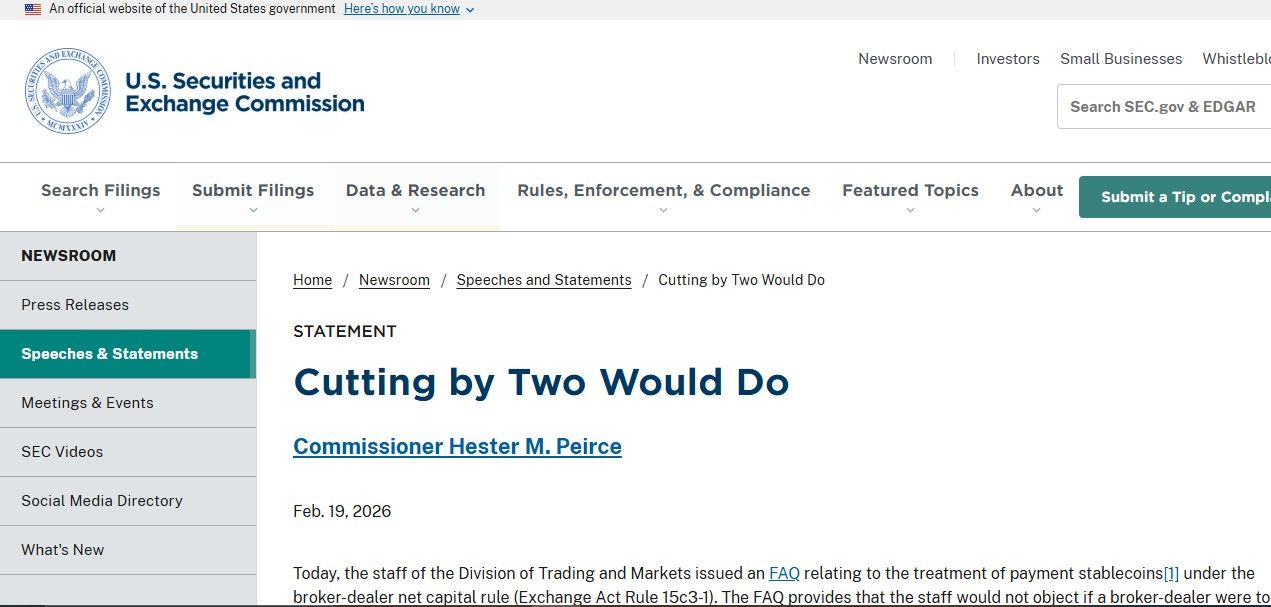
According to the official release, the FAQ clarifies the treatment of payment stablecoins within capital calculations. The guidance indicates regulators accept limited recognition of these assets instead of excluding them entirely.
Key policy highlights:
Broker-dealers may apply a 2% haircut on virtual assets holdings
The FAQ reflects staff thinking on emerging digital asset issues
The statement also emphasised that stablecoins enable firms to expand business connected to tokenized securities and other blockchain-based products. Commission leadership signaled interest in exploring how Rule 15c3-1 could eventually be updated to formally account for payment stablecoins. Regulators invited feedback from market participants on rule adjustments and broader regulatory changes required for SEC-registered entities using these assets.
Source: US SEC Official
Brief Explanation Of The Change
Previously, companies such as broker-dealers were unable to count stable tokens as official capital because regulators viewed them as high risk. A 100% haircut meant the asset value was treated as zero for safety calculations.
Example under the old approach:
If a firm held $1 million in USDC, regulators counted $0 toward holdings.
Under the new framework, firms can include stable tokens with a small discount called a 2% haircut. That means institutions can recognise roughly 98% of their value.
Example under the new approach:
If a firm holds $1 million in stablecoins, about $980,000 may count toward regulatory holdings.
This shift shows growing comfort with blockchain-based payment instruments inside regulated financial infrastructure.
Connection To Recent Regulatory Meetings
The US SEC Stablecoin MOVE aligns with recent U.S. policy discussions focused on digital assets adoption, banking participation, and yield structures. Meetings held in February explored how payment stablecoins could operate within traditional financial systems without increasing systemic risk.
Those discussions examined several themes:
Role of banks in digital asset issuance and custody
Yield treatment and consumer safeguards
Capital requirements for institutions holding digital dollars
The FAQ represents a practical step following these conversations, signalling that regulators are moving from theory toward implementation. Analysts view this change as early evidence of controlled integration rather than restriction.
Stablecoin Growth And Market Impact
Increasing acceptance inside regulatory capital frameworks suggests stronger institutional use ahead. Tokens such as USDC issued by Circle and USDT issued by Tether were specifically referenced, highlighting their importance as widely used payment assets.
Stablecoins support liquidity, settlement efficiency, and cross-border transfers, making them critical infrastructure for tokenized finance. As firms gain the ability to include them in capital calculations, adoption across broker-dealers, trading platforms, and financial intermediaries may accelerate.
Market observers say recognition within holdings rules can expand stablecoin market share, strengthen trust, and encourage new financial products built on blockchain rails. The update also reinforces stable tokens as a bridge between digital asset markets and traditional financial systems.
Conclusion:
The US SEC Stablecoin guidance signals a major step toward institutional acceptance of digital dollars. Allowing capital recognition supports adoption, regulatory clarity, and tokenized finance growth. This shift may influence how financial firms integrate stablecoins into mainstream operations.
