Goldman Sachs CEO Declares Bitcoin Is Part of Finance’s Future

Wall Street's old guard finally admits the inevitable—digital assets aren't going anywhere.
The Institutional Shift
When the CEO of Goldman Sachs publicly acknowledges Bitcoin's role in finance's future, you know the tectonic plates are shifting. This isn't fringe tech talk; it's a mainstream financial giant conceding that decentralized digital currency will share the stage with traditional stocks and bonds. The statement signals a profound change in how major institutions view asset classes—no longer dismissing crypto as a speculative toy, but recognizing it as a legitimate component of a modern portfolio.
Beyond the Buzzwords
Forget the hype cycles and the noise. This endorsement cuts through the clutter, focusing on infrastructure, regulation, and integration. It's about building bridges between the crypto-native world and legacy finance, creating systems where digital assets can be traded, custodied, and utilized alongside everything else. The focus moves from price speculation to practical utility—how Bitcoin functions within the broader machinery of global capital.
A Future Forged, Not Imagined
The future isn't predicted; it's built by those willing to adapt. This stance from one of finance's most influential leaders suggests the blueprints are already being drawn. We're looking at a coming era of hybrid finance—where blockchain's efficiency meets institutional heft. Sure, some bankers might still be figuring it out between martini lunches, but the direction is clear. Resistance is becoming a cost-center. The question is no longer *if* Bitcoin belongs, but *how* deeply it will be woven into the fabric of everything that comes next.
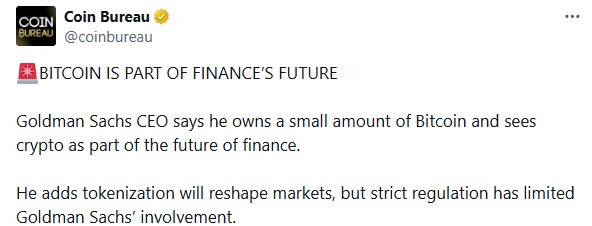
This becomes important because Solomon once dismissed Bitcoin years ago. Today, his tone has clearly changed. At the same time, he pointed out that strict regulations have limited Goldman Sachs’ ability to fully participate in the crypto sector for now.
Catalyst of Crypto Industry: How BTC Achieved That Stage
Bitcoin, who’s known as the pioneers of the sector, its story is one of the most unusual success stories in modern finance.
In 2008, Satoshi Nakamoto introduced Bitcoin as a response to the global banking crisis, offering a FORM of money that worked without banks or governments.
At that time it was just an idea shared by a small online community and treated as a speculative token. In 2010, a person used 10,000 BTC just to buy two pizzas. Now, in 2026, the same coin is a trillion dollar asset discussed by banks, governments, and asset managers.
Over the years, Bitcoin has survived exchange collapse, bans, market crashes, and endless criticism, each cycle looked different. What started as a digital coin is now often described as “digital gold.”
At the moment, BTC is trading around the mid-$60,000 range, moving sideways after earlier highs. There’s no big surge today, but long-term holders continue to accumulate quietly.
Today’s Bitcoin: Increasing Steps into Financial Infrastructure
Solomon’s view describing Bitcoin as a major part of the financial system in upcoming times is proved with the current trends. The asset, today, is increasingly becoming a section of traditional finance.
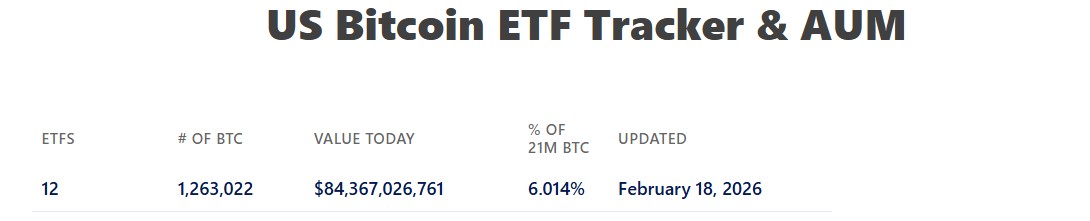
Exchange Traded Funds (ETFs): Bitcoin ETFs allow investors to gain exposure without handling wallets or private keys, making access earlier. Since U.S. spot BTC ETFs were approved in 2024, there are a total 12 issuers and the total value stands at $84.37 till date as per Bitbo.
Banks & Institutions: Major firms like Strategy, MARA Inc., Metaplanet, are heavily securing the asset as a reserve fund. Major traditional banks like Intesa Sanapolo, Morgan Stanley, BNY Mellon are increasingly securing BTC-related ETFs.
Payments & TradFi integration: The asset is now used for large-value transfers and cross-border payments where speed and neutrality matter. It now sits alongside stocks, bonds, and gold in many modern portfolios.
Safety Reserve: The asset is seen as a hedge or inflation-against tool, reserved by many countries, such as El Salvador, Bhutan, United States, as an emergency fund.
Regulation & Policy Direction: A Shift Toward Structure
Governments are no longer asking whether crypto will exist,they’re deciding how to regulate it.
ETF approvals in the U.S. marked a turning point. Compliance rules are bringing legitimacy and attracting cautious institutional capital. At the same time, strict regulations still limit how banks like Goldman Sachs can participate directly.
There are concerns too. Rules differ by country, and sudden policy changes can still shake markets. But overall, regulation is moving from blocking crypto to shaping it.
For now, the bigger picture is clear. BTC’s role has evolved - from pizza payments, to speculation, to a serious financial asset. With institutions, ETFs, and tokenized markets lining up, Bitcoin’s place in the future of finance now looks less like a theory and more like a reality.
The article above is for informational purposes only and does not provide any financial or legal advice. Cryptocurrencies are highly volatile and consist of great risk. DYOR before investing.
