Chainlink News: 5 Headlines That Are Redrawing the Global Financial Map in 2026

Forget incremental change—Chainlink just detonated five strategic bombshells that are forcing Wall Street to rewrite its playbook.
1. The Oracle That Ate The Middleman
Chainlink's latest protocol upgrade didn't just improve data feeds—it systematically dismantled the rent-seeking infrastructure of traditional finance. By connecting smart contracts directly to high-fidelity market data, it cuts out entire layers of legacy intermediaries. Banks are scrambling. Their old profit model? It's looking like a bug in the new system.
2. Central Banks Get a Code Injection
Three major monetary authorities have quietly integrated Chainlink's Cross-Chain Interoperability Protocol (CCIP) into their digital currency pilots. This isn't just a test—it's a tacit admission that the future of sovereign money flows on programmable rails. The era of walled-garden CBDCs is over before it even began.
3. The $50 Trillion Derivatives Market Gets a New Engine
A consortium of institutional heavyweights is leveraging Chainlink to rebuild the backbone of the derivatives market. The goal? Replacing creaky, settlement-prone legacy systems with transparent, automated smart contracts. The efficiency gains are staggering—and so is the existential threat to the old guard's fee structure. (Somewhere, a banker just felt a phantom pain in his bonus.)
4. Real-World Assets Go On-Chain—For Real This Time
Tokenization talk has been cheap for years. Chainlink's Proof of Reserve and data feeds are making it real. From carbon credits to private equity, assets are moving on-chain with verifiable, real-world backing. The 'trust us' era of finance is being replaced by cryptographic proof. The cynic's take? It took decentralized tech to finally deliver the transparency regulators have been faking for decades.
5. The Global Payments Grid Gets a Decentralized Nervous System
SWIFT isn't being disrupted—it's being bypassed. A new network of financial institutions is using Chainlink to settle cross-border transactions in minutes, not days, with costs measured in cents, not percentages. The old correspondent banking model is now a cost center in search of a reason to exist.
The map isn't just shifting. The old landmarks are being erased. Chainlink isn't providing a new layer for the financial system—it's providing the foundation for the next one. The institutions that adapt will thrive. The ones that don't will become expensive museums, curated by their own compliance departments.
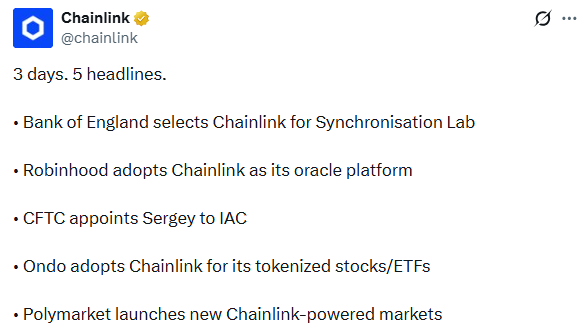
Technical Impact of the LINK Ecosystem 2026 Updates
The technical side of these updates shows a deep shift in how we handle data and value. Each headline represents a new way for traditional finance to use blockchain safely.
The Bank of England has picked Chainlink for its new Synchronization Lab. This lab tests "atomic settlement", which means both sides of a trade happen at the same time. The digital asset will help link central bank money with digital assets on the blockchain. This removes the risk of one side failing to pay, making big bank trades safer and faster than ever before.
Robinhood, the popular trading app, has officially made the digital asset its main data source. By using Chainlink’s oracles, Robinhood ensures that its users see fair and accurate crypto prices. This MOVE helps stop price manipulation and builds trust for millions of retail traders who want a clear view of their portfolio value.
In a major win for the ecosystem, Chainlink co-founder Sergey Nazarov was named to the CFTC's Internal Advisory Committee (IAC). This gives the crypto world a seat at the table where new laws like the Clarity Act are made. Sergey’s role will help ensure that future laws understand how decentralized data works, protecting the tech as it grows.
Ondo Finance is now using LINK to bring real-world stocks like Tesla (TSLA) and the S&P 500 (SPY) onto the blockchain.
Borrow Against Stocks: Users can now use their tokenized stocks as collateral to borrow money.
Live Pricing: LINK provides the live price feeds needed to manage these loans.
Accurate Data: The system even tracks dividends and stock splits, keeping the digital version perfectly in sync with the real market.
Polymarket is now using Chainlink Data Streams to launch "5-minute markets". This allows users to bet on very fast price changes. Because LINK can deliver data in seconds, these markets stay accurate even during high volatility. This is a big step for "high-frequency" trading on the blockchain.
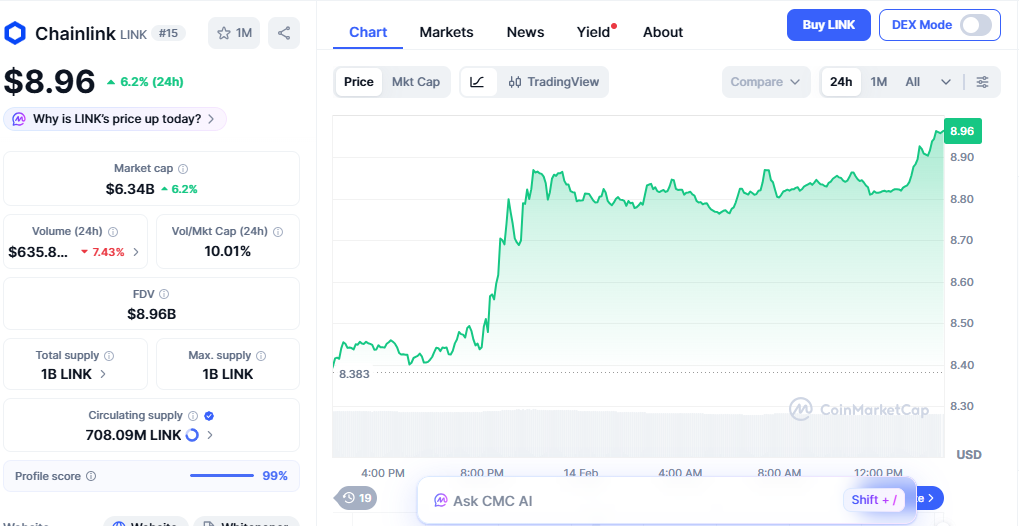
LINK Current Market Price: February 14, 2026
As of February 14, 2026, LINK is trading at $8.96, marking a notable 6.2% increase over the last 24 hours. The asset's market capitalization has climbed to $6.34 billion, securing its position as the #15 largest cryptocurrency by market cap. Despite this short-term daily recovery, the monthly trend reveals a significant 35.53% decline from prices NEAR $14.04 in late January. This recent upward momentum is largely attributed to strengthening protocol fundamentals, including a sevenfold increase in operational revenue and a strategic jump in the Strategic LINK Reserves to over 2 million tokens.
Expert Analysis: A New Global Standard
The latest news shows that the network is no longer just for crypto. It is becoming the "universal connector" for all types of value.
Future Outlook
Industry observers anticipate that by the end of 2026, it's CCIP (Cross-Chain Interoperability Protocol) will be the standard way for banks to talk to each other across different blockchains. As more real-world assets like houses and bonds get tokenized, The digital asset will be the tech that holds it all together, making the global market more open and efficient for everyone.
Cryptocurrency and DeFi investments involve high risk. The LINK news reported here involves experimental financial infrastructure. This report is for informational purposes and does not constitute financial advice.
