Binance SAFU Fund Hits $1 Billion Milestone: Did It Propel Bitcoin’s Surge?

Binance's emergency reserve just crossed the ten-figure threshold—what does that mean for crypto's flagship asset?
The SAFU Shield: More Than Just Insurance
When Binance announced its Secure Asset Fund for Users back in 2018, skeptics dismissed it as a PR move. Fast forward to 2026, and that fund now holds over $1 billion in cold storage—a tangible war chest designed to protect users during black-swan events. It’s the kind of backstop traditional finance institutions love to talk about but rarely materialize with actual, verifiable assets.
Bitcoin's Reaction: Confidence or Coincidence?
Market analysts are split. Some point to the timing correlation—BTC’s resilience during recent volatility spikes coincided with the SAFU milestone announcement. Others argue Bitcoin marches to its own drum, driven by macro liquidity and adoption cycles, not exchange balance sheets. Still, you can’t ignore the psychology: a billion-dollar safety net signals institutional-grade risk management, something that whispers ‘legitimacy’ to skittish capital.
The Ripple Effect Across Crypto
This isn’t just about Binance or Bitcoin. The SAFU benchmark pressures every major platform to up their custody and insurance game—or risk looking reckless. We’re seeing a quiet arms race in proof-of-reserves and transparent auditing, a welcome change from the ‘trust us’ era. For once, a finance sector actually competing on who’s more secure, not just who offers the shiniest leverage.
Bottom Line: Trust Built in Billions
Does a $1 billion SAFU fund directly pump Bitcoin’s price? Not like a halving or an ETF approval. But it systematically removes a layer of existential fear—the ‘what if the exchange blows up’ nightmare that haunted early adopters. In a market still wrestling with its wild-west reputation, that’s priceless. Or, more accurately, it’s worth exactly a billion dollars and the cynical sigh of every banker who still thinks crypto insurance is an oxymoron.
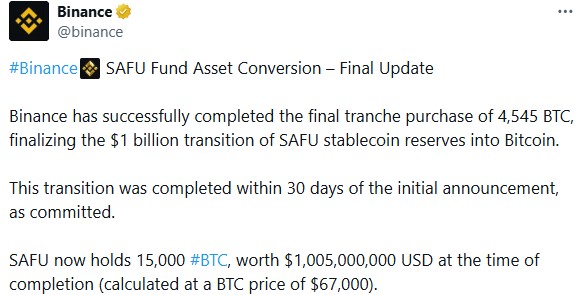
The move was completed within 30 days (From Jan 12 to Feb 12), exactly as promised. At completion, the fund holds 15,000 coins, valued at roughly $1.005 billion based on the current price near $67,000. The exchange described the shift as a long-term decision, reinforcing its belief in bitcoin as a core reserve asset for user protection.
The Binance SAFU program was originally created to protect users in extreme situations. By moving into Bitcoins, the exchange is shifting from stablecoin-based reserves to a more volatile but conviction-driven strategy tied to Bitcoin’s long-term outlook.
Does the Binance SAFU Shift Actually Help BTC Price?
When the fund was first announced, the digital asset was already facing downtrends. Many investors and traders hoped that this large accumulation will help the price restoration, however, in terms of direct price impact, the answer is mixed.
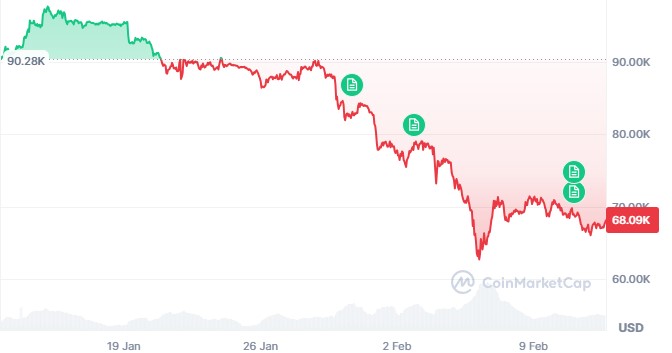
During the reserve conversion period, BTC fell around 25–26%, sliding from the $90,000–$96,000 range in late January to the $66,000–$70,000 zone in February and currently trading at $68,000. The exchange executed it buys in multiple tranches, with larger purchases happening during price dips.
Despite the size of the $1B allocation, the Binance-SAFU buying did not trigger a sustained rally. Bitcoin’s daily trading volume, often between $40–70 billion, absorbed the inflows with minimal disruption.
Here, instead of acting as a price catalyst, the MOVE functioned more as a confidence signal during market weakness. That said, many in the community view the shift as “smart money average into BTC” rather than chasing highs.
What for Next?
With the transition complete, the exchange says there are no plans to sell the fund’s coin unless a major incident requires user compensation. The exchange also confirmed a dynamic rebalancing plan. If BTC volatility pushes the fund below $800 million, Binance will buy additional Bitcoins to restore the reserve closer to the $1 billion target.
Transparency remains central. The platform is expected to continue sharing on-chain updates if rebalancing occurs, keeping the SAFU-wallet publicly visible.
Bottom Line
The Binance SAFU shift didn’t pump the coin, but it didn’t weaken it either. Instead, it reinforced BTC role as a long-term reserve asset for one of the largest exchanges in the world. Going forward, the focus will be on how SAFU’s Bitcoin holdings are maintained, and whether other exchanges follow a similar path.
