Franklin Templeton & Binance Collateral Unlock: The Institutional Floodgates Are Opening

Forget dipping a toe—the whales are diving in headfirst. A landmark move between a $1.4 trillion asset manager and the world's largest crypto exchange just rewired the plumbing of institutional finance.
The Collateral Revolution
Franklin Templeton didn't just partner with Binance; they bypassed the old guard. By enabling its on-chain money market fund to serve as collateral for margin trading, they cut out the traditional custodial middlemen. This isn't a pilot program—it's a production-ready pipeline. Suddenly, institutional capital can flow between regulated funds and leveraged crypto positions without friction, a process that used to require weeks of paperwork and third-party approvals.
Liquidity on Tap
The mechanism is deceptively simple, yet revolutionary. Holders of Franklin's BENJI token (representing shares in its U.S. Government Money Fund) can now pledge those tokens as collateral directly on Binance. It turns stagnant, yield-generating assets into active trading fuel. No liquidation, no transfer of ownership—just pure, unlocked utility. It answers the prime broker question that has kept many institutions on the sidelines: where's my leverage?
The Ripple Effect
Watch for the dominoes to fall. This model doesn't just work for government funds. Imagine tokenized Treasuries, corporate bond ETFs, or even equity funds becoming cross-platform collateral. It creates a unified financial layer where asset class is irrelevant; only value and yield matter. Other major asset managers are now forced to play catch-up or watch their clients' capital migrate to more utility-rich environments. After all, what's the point of a 4% yield if it's sitting idle while the crypto market rallies 40%?
A cynic might say Wall Street finally found a way to do what it does best—leveraging safe assets to chase risky returns—but now with blockchain efficiency. The gates aren't just unlocked; they've been removed entirely. The institutional trading floor is now global, digital, and open 24/7. The era of compartmentalized capital is over.
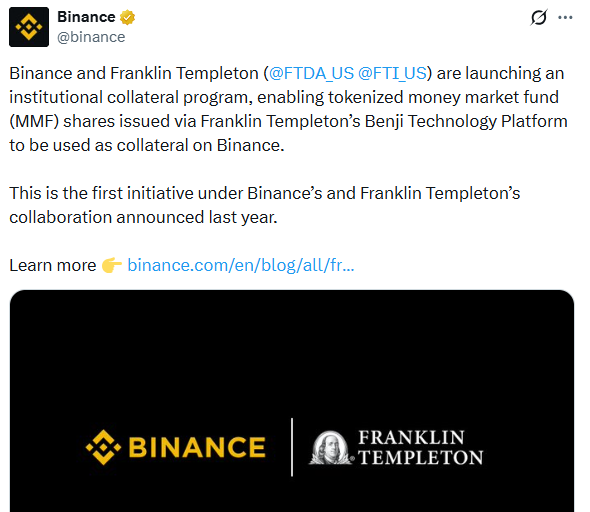
The Franklin Templeton and Binance collateral launch is part of a bigger trend called Real-World Asset (RWA) tokenization. Big banks and hedge funds want to use their "real world" wealth to trade crypto. By making this process easy and safe, this program attracts more professional money into the market. This helps stabilize prices for major coins like bitcoin and Ethereum. It also shows that the walls between Wall Street and crypto are finally falling down.
How the Franklin Templeton and Binance Collateral System Works
The main goal of the Franklin Templeton and Binance collateral setup is to keep money safe. In the past, traders had to send their funds directly to an exchange. This created a lot of risk if the exchange had problems. Now, they can use the "Benji" platform from Franklin Templeton to turn fund shares into digital tokens. These tokens are then used to back their trading activity on the Binance platform.
This new system uses a few key steps to protect investors and their capital:
Your assets stay with a partner named Ceffu. This means Binance does not hold the actual fund shares in their own wallets.
Even though the assets are off the exchange, their value shows up in the Binance account. This allows the firm to open and maintain trading positions.
Since the money stays in a money market fund, investors keep earning interest. Currently, the yield is about 4.5% per year.
If the exchange faces issues, the Core assets remain safe. They are held in a regulated account away from the trading platform.
Why This Matters for the Global Market
Experts believe the Franklin Templeton and Binance collateral initiative is just the start of a new era. As more institutions join, we will likely see other assets like gold and bonds used as collateral too. Franklin Templeton manages over $1.7 trillion in assets globally. Their MOVE into this space gives the whole crypto industry more credibility. It proves that digital finance is becoming a normal part of the global money system.
Furthermore, this program helps solve the problem of "idle capital." In the old days, money sitting as collateral did not earn anything. Now, that same capital can earn a steady yield while still working as a safety net for trades. This double benefit is very appealing to fund managers. It allows them to be more active in the market without losing out on traditional returns. As we move through 2026, more banks are expected to follow this model.
Trading digital assets involves high risk. Tokenized fund shares are subject to market changes. This report is for informational purposes only and is not financial advice.
