Zand Bank and Ripple Forge Blockchain Banking Expansion - The Future of Finance is Here

Ripple's enterprise blockchain just landed a major Middle Eastern beachhead. Zand Bank, the UAE's first digital-only lender, is integrating RippleNet's infrastructure—cutting cross-border settlement times from days to seconds and bypassing traditional correspondent banking entirely.
The Mechanics of Disruption
This isn't a pilot program. Zand is deploying Ripple's On-Demand Liquidity (ODL) solution for real-time, blockchain-based payments between the UAE and key corridors. It leverages XRP as a bridge currency to eliminate pre-funded nostro accounts—freeing up capital and slashing operational costs. The partnership targets institutional and corporate clients first, with plans to scale into retail remittances.
Why This Partnership Cuts Deep
Zand, licensed by the UAE Central Bank, brings regulatory credibility and a clean-slate digital architecture. Ripple delivers battle-tested enterprise rails. Together, they're building a template for blockchain-native banking—a model that leaves legacy systems choking on SWIFT's three-day settlement dust. It's a direct challenge to the old guard's fee-heavy, time-slow monopoly.
Regulatory Tailwinds, Not Headwinds
The UAE's progressive Virtual Assets Regulatory Authority (VARA) framework made this possible. Unlike the regulatory trench warfare in the U.S., the Emirates is actively courting blockchain innovation. Zand's move signals that serious banks, when given clear rules, will sprint toward efficiency—even if it terrifies their more traditional competitors.
The Bottom Line: A New Blueprint
This expansion proves blockchain's value proposition for banking is no longer theoretical. It's operational, regulated, and client-ready. For the finance sector, it's a stark warning: adapt to instant, transparent settlements or become obsolete. The collaboration doesn't just expand blockchain banking—it showcases a viable, profitable future for it, while subtly highlighting how much revenue traditional banks have been extracting from pure friction. Sometimes progress is just cutting out the middleman who added little but cost and delay.
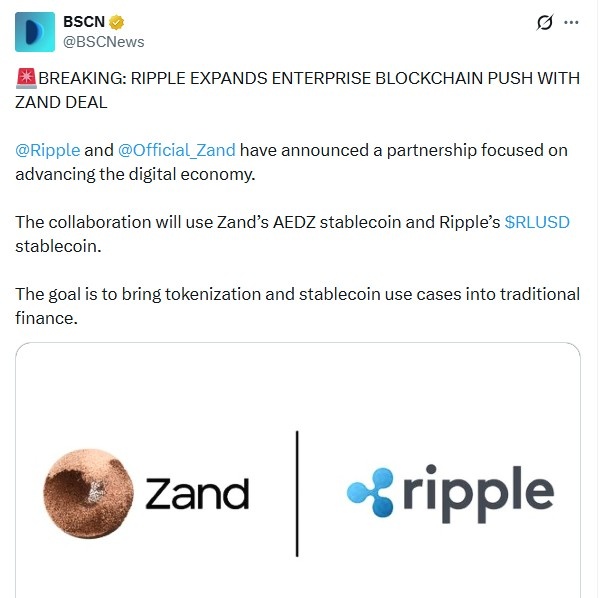
This MOVE combines Ripple’s blockchain strengths with Zand’s regulated banking experience. Official press feeds say the partnership is designed to support crypto currency adoption in payments, settlement, and financial services for institutions and corporations, not just crypto traders.
Short introduction to Ripple and Zand Bank
Ripple – Blockchain Payments Leader:
Major blockchain payments company: Ripple builds tools for fast and cheap value transfer.
Known for XRP Ledger: A public blockchain designed for speed, low cost, and high throughput.
Institutional focus: Ripple works mainly with banks and large institutions rather than retail trading users.
Zand Bank – Digital Asset Bank in the UAE:
UAE–based digital bank: Zand is one of the first fully digital, licensed banks in the Middle East.
Regulation-friendly: It is structured to comply with strict financial rules, which is crucial for institutional adoption of crypto.
Stablecoin platform: Zand issued AEDZ, a dirham-backed stablecoin designed to work on public blockchains for real payments and settlement.
Together, these two players bring both regulated banking credibility and modern blockchain innovation to the table.
WHAT THIS PARTNERSHIP IS REALLY ABOUT
The key point of this partnership is that it is NOT about trading or speculation. It is about financial infrastructure — building the plumbing that links traditional finance with digital money.
The main aims include:
Tokenization – Turning real assets and currencies into programmable crypto tokens.
Stablecoin payments – Using digital money for everyday cross-border payments.
Faster settlement – Eliminating slow legacy systems that take days to settle transactions.
Cross-border transfers – Allowing near-instant movement of value between countries.
Bank-level custody – Secure storage and management of digital assets that meet regulatory standards.
These features are already gaining traction as banks and institutions seek alternatives to slow, costly legacy rails like SWIFT.
IMPACT ON THE CRYPTO MARKET
This partnership matters because:
Banks usually move slowly. Crypto moves fast.
When a regulated bank adopts blockchain and stablecoin tech, that signals that crypto is entering mainstream finance. This trend is known as institutional adoption, and it is one of the biggest long-term bullish drivers for the broader market.
Bullish Signals for Digital Assets:
Stablecoins getting real-world use: Not just for trading — now for bank settlement and payments.
More institutional trust: Bank involvement reduces the “wild west” perception of crypto.
XRP Ledger utility increases: More usage of the network means stronger ecosystem value.
Tokenization trend accelerating: Many analysts view tokenization as a multi-trillion-dollar future market.
This partnership may also encourage other banks to explore stablecoin settlement and tokenized assets, bringing more capital into digital finance.
RIPPLE’S LONG-TERM STRATEGY:
Partner with banks
Build payment rails
Become a global settlement layer
They are not chasing HYPE — they are building backend financial plumbing.
Some of it's past collaborations include:
MoneyGram (2019–2021) – Shared liquidity experiments with XRP for cross-border transfers; the deal ended, but showed real use cases.
Thomson Reuters (2020) – Integrated pricing data into finance terminals, giving professional markets access to platform data.
RippleX Developer Tools (2020+) – Tools for building on the XRP Ledger, encouraging ecosystem growth.
UAE & Middle East Expansion (2024–2025) – Local bank pilots, consults, and tokenization experiments that set the stage for this Zand partnership.
Conclusion:
This Ripple collaboration with Zand marks a major step toward bridging banking and blockchain. By advancing stablecoins, tokenization, and real-world finance use cases, it strengthens digital finance infrastructure and could play a key role in future crypto market adoption.
