IMF Sounds Alarm: Stablecoins Are Exploding in Growth—Demand Ironclad Regulation Now

Regulators are scrambling to catch up as stablecoins cement their role in the global financial system.
The Speed of Adoption Catches Watchdogs Off Guard
The sheer velocity of stablecoin expansion has outpaced traditional regulatory frameworks. These digital assets, pegged to reserves like the US dollar, are no longer niche tools for crypto traders—they're becoming embedded in payments, remittances, and decentralized finance. Their growth isn't just fast; it's exponential, creating a parallel system that operates 24/7 and bypasses legacy banking channels.
Why 'Strong Rules' Are Non-Negotiable
The call for robust oversight centers on systemic risk. Without clear standards for reserve transparency, operational resilience, and redemption guarantees, the entire premise of 'stability' becomes a liability. A failure in a major stablecoin could trigger contagion, freezing liquidity across both crypto and traditional markets. It's the classic financial playbook: innovate first, ask for permission later—and hope the taxpayer isn't left holding the bag when the music stops.
The Tightrope Walk for Policymakers
Authorities face a delicate balancing act. Overly restrictive rules could stifle innovation and push activity into opaque corners of the internet. Too lenient, and they risk legitimizing a shadow financial system. The goal is to harness the efficiency and inclusion benefits of stablecoins while anchoring them with the same trust expectations we have for regulated money.
The message is clear: the era of viewing stablecoins as an experiment is over. They're here, they're growing, and the market won't wait for bureaucracy to catch up. Getting this wrong isn't an option—the stakes are the integrity of the financial system itself. After all, what's the point of a 'stable' coin if the foundation it's built on is pure sand?
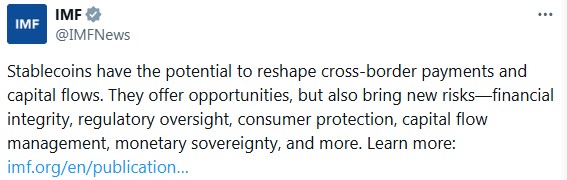
In a recently released report, the IMF said stablecoins can make global payments faster and cheaper, but must be regulated carefully to protect financial stability and national sovereignty.
The discussion comes as stablecoin adoption accelerates worldwide, especially in crypto trading and global transfers.
Stablecoins Giant Market: Growth On High
According to the report “Understanding Stablecoins”, the stablecoin market nearly doubled in two years. Currently the market sits at around $307 billion market cap which was around $130 billion in 2024 as per DefiLlama, making a significant gain in a short time. USD-backed stablecoins dominate the sector, with USDT and USDC controlling about 90% of the market.
The IMF noted that stable coins are already widely used as a bridge between fiat money and crypto assets. In the future, they could play a major role in cross-border payments, remittances, financial inclusion, and asset tokenization,
especially in regions where banking systems are slow or expensive.
However, the international organisation also highlighted serious concerns.
The Cautious Side: Rising Exposure to US Treasuries Raises New Risks
The IMF raised concerns after new audit data from BDO and Deloitte showed that 70–80% of USDT and USDC reserves are now invested in US government bonds.
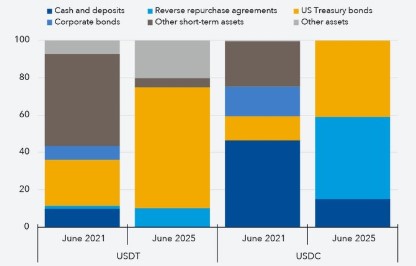
This makes stablecoin more stable, but also tightly links them to the US financial system.
According to the monetary organisation, this could:
Increase financial stress during market shocks
Push sudden capital flows in emerging economies
Reduce control of local central banks over their own currencies
In simple terms, heavy use of dollar-backed stable coins could weaken local currencies and increase dependence on the US dollar.
An Example: Tether’s Profits Show Systemic Impact
The discussions are getting more fueled as new data showed Tether earned nearly $10 billion in profit in the first nine months of 2025. The company invested around $137 billion of USDT reserves into US Treasuries, benefiting from high interest rates while paying users no yield.
If treated like a country, Tether WOULD rank among the largest holders of US government debt, ahead of several major economies. This highlights how big stable coins have become systemically important.
What Happens Next
The IMF is not pushing for a ban on stablecoins. Instead, it wants governments to bring clear and common rules. This includes defining how the digital coins operate, protecting user funds, and applying strict oversight.
Because stable coins MOVE money across borders quickly, the IMF says countries must coordinate globally to avoid risks. It also wants the coins treated like payment systems, with rules similar to banks and payment firms.
In short, stablecoins can support global finance, but only with proper regulation in place.
The article above is for informational purposes only.
