BlackRock and Coinbase Trigger Market Tremors as Billions in Bitcoin and Ethereum Change Hands

Institutional giants just flexed their muscles—and the entire crypto market felt the tremor.
The Whale-Sized Moves
Forget retail traders. When titans like BlackRock and Coinbase execute major transactions, they don't just make waves—they create tsunamis. Billions in Bitcoin and Ethereum shifted in a coordinated dance of capital, bypassing traditional market channels and cutting straight to the core of liquidity.
Why This Shakes the Foundation
It's not the volume alone that rattles cages. It's the signal. These moves telegraph institutional confidence and strategic positioning at a scale that dwarfs typical exchange flows. The market recalibrates in real-time, with algorithms scrambling to price in the new reality.
The Ripple Effect
Volatility spikes. Liquidity pools drain or flood. Every other trader—from the hedge fund to the hobbyist—suddenly plays a game where the board is tilted by unseen hands. It's the ultimate proof that crypto's old 'wild west' narrative is being supplanted by a new era of high-stakes, institutional poker—just with slightly better graphics and the same cynical pursuit of alpha.
So, the next time your portfolio swings wildly on a quiet Tuesday afternoon, remember: someone in a glass-walled office probably just moved a digital mountain. The rest of us are just trading in its shadow.
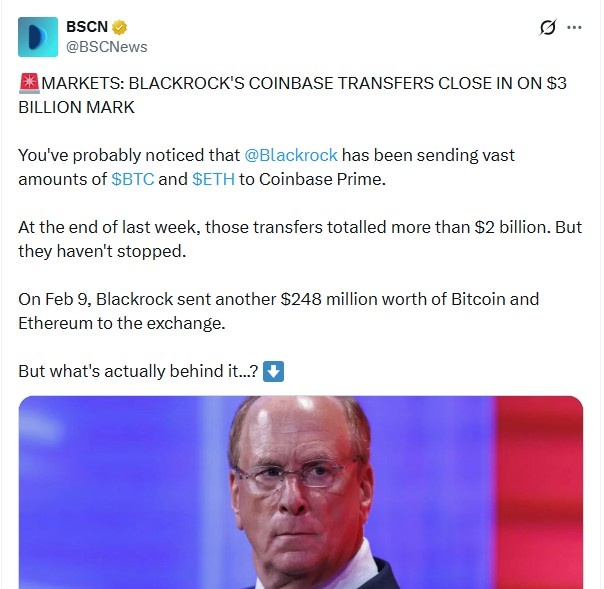
Source: X official
These massive on-chain movements have sparked speculation across digital markets, with traders and commentators watching flows closely for signals of institutional behavior. But what’s behind these headline-grabbing transfers? Let’s break it down with real data
Recent Big Transfer Highlights
Over the past few weeks, multiple large transfers tied to BlackRock’s crypto products were observed on on-chain data, tracked by firms such as Lookonchain, Arkham Intelligence, and Solid Intel:
On Feb 9, BlackRock wallets moved roughly 2,405 BTC and 24,760 ETH to Coinbase Prime, valued at over $248 million — the largest single batch in this series of transfers.
Earlier activity between Jan 22 and Feb 5 showed at least six major shifts amounting to roughly 20,000 BTC and 238,000 ETH, totaling more than $2.2 billion in value.
On Feb 5, data revealed BlackRock-linked addresses sent about 5,080 BTC $358M and 27,196 ETH $57M into Coinbase Prime amid market volatility.
A previous $603 million transfer on Jan 22 involved 3,970 BTC and 82,813 ETH moving on-chain into the exchange.
Going further back, the firm also moved around 3,290 BTC and 5,692 ETH on Jan 13, valued at about $303 million.
These figures show the scale and frequency of recent crypto movements tied to their institutional activity.
What’s Really Behind These Transfers?
So why is BlackRock moving so much digital assets into Coinbase Prime? The short answer: ETF mechanics, not emotional buying or selling.
Reason: ETF Creation & Redemption
BlackRock has launched spot crypto exchange-traded funds — notably iShares Bitcoin Trust (IBIT) and iShares ethereum Trust (ETHA)- which are funds that hold real Bitcoin and Ether so everyday investors can get exposure through stock-like shares. When someone buys or sells shares of these ETFs, the fund often must obtain or release the actual cryptocurrency to match demand.
This process works like this:
Creation: When ETF investors buy shares, the fund may need to source BTC/ETH and hold it on behalf of those shares.
Redemption: When investors sell ETF shares, the fund might release BTC/ETH back into the market or into settlement systems.
These creation/redemption flows are normal operational steps, not BlackRock making directional bets like a trader.
Most recent large movements weren’t necessarily new buying — many analysts say they reflect ETF investor outflows (people selling shares) or required settlement adjustments, where crypto is moved between vaults and trading infrastructure before any market sale occurs.
Actual reason behind the big transfers
It’s important to understand that moving crypto into the exchange doesn’t automatically mean Blackrock is dumping assets or that they’re about to sell them all on the open market. These shifts are simply part of how regulated ETFs operate, using the exchange institutional pathways to manage liquidity and investor demand.
Conclusion:
Blackrock coinbase transfers reflect routine ETF operations, where large Bitcoin and Ethereum movements support investor inflows and outflows, not panic selling, highlighting how deep institutional crypto infrastructure now underpins major digital-asset markets.
