India’s Crypto Revolution: The Push for Legal Status Gains Unstoppable Momentum

Forget the whispers—this is a roar. India's crypto adoption isn't just growing; it's building a legal framework brick by digital brick, forcing the old financial guard to pay attention.
The Groundswell Goes Mainstream
What started as a niche interest has erupted into a national movement. Trading volumes are surging, developer activity is exploding, and a new generation of investors is bypassing traditional gatekeepers entirely. The market isn't asking for permission anymore; it's demonstrating undeniable utility and demand.
Regulation: From Resistance to Roadmap
The regulatory fog is finally lifting. After years of cautious observation and outright skepticism, serious dialogues about a structured legal framework are underway. The conversation has shifted from 'if' to 'how'—focusing on consumer protection, taxation clarity, and fostering innovation without stifling it. It’s a delicate dance, but the music has started.
The Global Stakes for a Digital Bharat
India isn't operating in a vacuum. As a global tech powerhouse, its approach to digital assets sets a precedent for other emerging economies. A clear, forward-thinking legal status could attract billions in capital and talent, positioning the nation as a leader in the next financial era. The alternative? Watching that opportunity flow to more agile jurisdictions—a classic case of legacy bureaucracy losing to digital velocity.
The momentum is now irreversible. The market has spoken, the innovators are building, and the pressure on policymakers is palpable. Legal recognition isn't a matter of goodwill; it's an economic inevitability. The only question left is who will benefit—and who will be left holding the bag of outdated financial instruments.
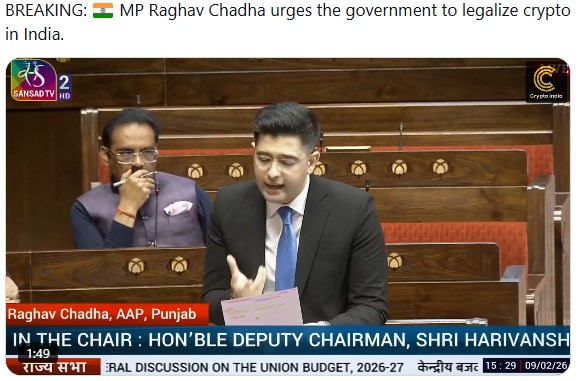
The appeal also became important as it came at the time when India Crypto adoption is setting levels and counted among world’s largest digital asset user bases, yet lacks a proper legal and compliance framework.
What Raghav Chadha is Asking For? And Why?
During his Rajya Sabha speech, Chadha called for recognizing cryptocurrencies and Virtual Digital Assets (VDAs) as a formal asset class in the nation.
Chadha pointed out a major contradiction. He simply put the policy contradiction as a major base. Cryptocurrency investors in India pay 30% tax on profits and 1% TDS on every transaction, yet there is no clear law, no licensing system, and no strong investor protection or AML (anti-money laundering) framework.
Because of this uncertainty, more than ₹4.8 lakh crore worth digital asset trading has moved to foreign platforms, leading to loss of domestic capital, government revenue, data, and innovation as per the AAP leader.
Chadha compared crypto and blockchain reform to India’s UPI revolution. Just like UPI made digital payments easy for everyone (from street vendors to daily workers) he believes cryptocurrency and tokenization can make investment and asset ownership accessible to the middle class.
This became important as right now, most Indians rely on low-return options like savings accounts, fixed deposits, or mutual funds. Here, blockchain-based systems can open new doors.
This is not the first time when Raghav Chadha favoured cryptocurrency, but supports his central idea of “Tokenization Bill”, which he first spoke about in December 2025.
Under this plan, high-value assets can be split into smaller digital units on blockchain. These assets could include:
Real estate and commercial properties
Infrastructure projects like highways and solar plants
Commodities and intellectual property
He said this WOULD allow middle-class investors to buy small stakes, improve liquidity, reduce paperwork, and create new income opportunities through rent or revenue sharing, while operating under strict legal safeguards.
Chadha Is Not the Only Voice That Supports India Crypto Clarity
The crypto debate is not limited to any single party or community. Everyone who understands the need of a sovereign currency and transparent process supports the infrastructure.
BJP National Spokesperson Pradeep Bhandari publicly urged to regulate stablecoins and even explore a strategic Bitcoin reserve for the country in mid-2025.
Finance Minister Nirmala Sitharaman has also acknowledged global shifts and said the country is reviewing its crypto position. While the overall government remains wary, during the G20 discussion, she emphasized on India’s openness to consensus on regulation rather than bans.
Union Minister Piyush Goyal, although he criticized “unbacked cryptos” and supports RBI-backed digital coins, acknowledged blockchain’s potential.
Industry leaders such as CoinCDX’s Sumit Gupta and WazirX’s Nischal Shetty continue to push for fair taxation, banking access, and regulatory sandboxes.
Most importantly, the country already has an estimated 12 crore crypto investors, one of the largest user bases globally, making long-term avoidance increasingly difficult.
Current Situations Making it Difficult
Despite rising advocacy, major hurdles remain. The recent Union Budget of 2026-2027, from which the community is expecting some ease in the crypto area, remained unchanged:
30% tax on crypto income
1% TDS on transactions
No loss set-off or carry-forward
No licensing or legalization framework
Instead, the government introduced stricter penalties for reporting failures, reinforcing an enforcement-first approach.
The Reserve Bank of India (RBI) continues to warn against cryptocurrencies, citing risks like money laundering and financial instability. The government still prefers the RBI-backed e-Rupee (CBDC) over private digital assets.
Bottom Line
For now, India crypto legalization remains a policy debate, not a law. Raghav Chadha’s push has added momentum, and growing investor participation makes reform harder to ignore. However, strong resistance from regulators and the unchanged tax regime suggest that full legalization is unlikely in the immediate future.
