Crypto Market Correction: Decoding the 22-Day Downtrend and What Comes Next

The crypto market bleeds red for 22 straight days—here's why the charts are flashing warning signs.
The Perfect Storm of Pressure
A cascade of factors is driving the sell-off. Regulatory uncertainty continues to spook institutional money, while leveraged positions get liquidated in waves. The typical post-halving consolidation for Bitcoin appears more severe this cycle, dragging altcoins down with it. On-chain data shows significant exchange inflows, signaling a shift from holding to selling pressure.
Technical Breakdown
Key support levels have shattered like glass. Major moving averages—the 50-day and 200-day—have turned from dynamic support into formidable resistance. Trading volume during down days consistently outpaces green days, confirming the bearish sentiment isn't just noise. It's a classic trend reversal pattern playing out in real-time, the kind that makes chartists point and say 'I told you so.'
The Macro Squeeze
Don't ignore the traditional finance backdrop. Rising bond yields and a hawkish central bank stance globally are sucking liquidity from risk assets. Crypto, still viewed as the ultimate risk-on bet by many portfolio managers, gets cut first when capital gets scarce. It's the old game of musical chairs—when the music stops, the most speculative assets are left standing.
Navigating the Downturn
This isn't 2018. The ecosystem now has robust derivatives markets, institutional custody, and real-world utility acting as a buffer. Corrections shake out weak hands and excess leverage, ultimately creating healthier foundations. Savvy investors are using the dip to dollar-cost-average into proven assets, while builders keep building—bear markets are for construction, after all.
The red flags are real, but so is the long-term trajectory. Sometimes the market needs to take a breath—even if it's a 22-day sigh. Just remember, in finance, a 'correction' is often just a fancy word for 'we bought too high.'
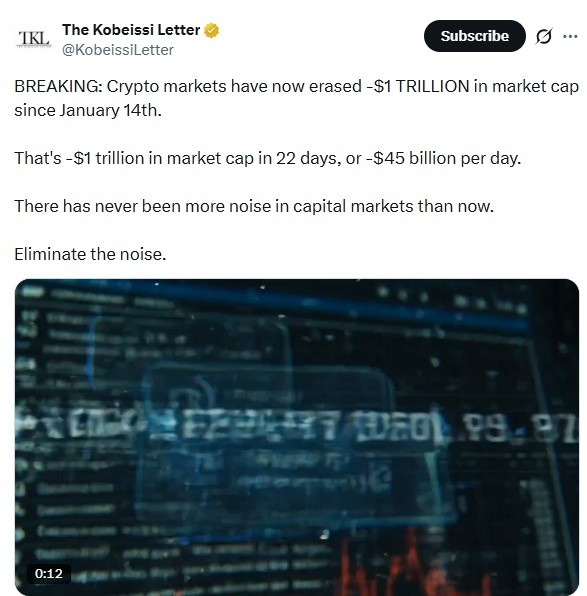
Source: X official
What makes this drop even more alarming is that some datasets indicate the overall decline could approach $2 trillion when measured from the highs recorded in late 2025. That scale of destruction is not just a statistic — it represents vanished liquidity, shaken confidence, and rising uncertainty across trading desks.
Meanwhile, Bitcoin, the sector’s dominant force, is leading the slide with double-digit declines and price levels not witnessed in months. Historically, when the largest asset weakens, the broader ecosystem rarely escapes unhurt. Currently BTC is trading at $65,462.45 down from 8.43% since last 24hrs and hits $60,074 apx lowest since yesterday.
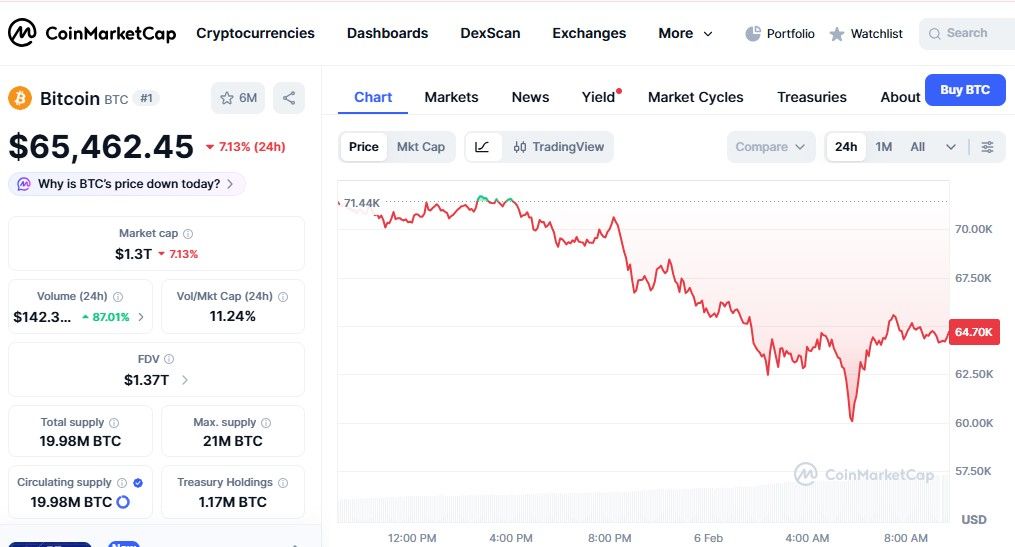
Source: Coinmarketcap official
Market Shock Intensifies — Capital Is Leaving Fast
The speed of this contraction is creating a classic urgency-driven environment. Crypto Market crash often push sidelined participants to reconsider entry points, while others rush to protect portfolios before volatility expands further.
When Crypto marketcap lost $1T, it signaled more than temporary turbulence — it hinted at structural pressure building beneath the surface.
At the index level, major tokens including ethereum (ETH), BNB, and Solana (SOL) have also recorded notable declines, accelerating the wider valuation drop.
Key signals from the market:
Bitcoin has slipped 8.76% over the past month, bringing its valuation to roughly $1.29 trillion.
Since BTC typically represents 40–50% of total sector value, its weakness naturally drags the entire space lower.
Importantly, while bitcoin anchors the downturn, many alternative assets have suffered steeper percentage losses.
Top Market Cap Losers
Several prominent assets highlight how widespread the damage has become.
Stablecoin Sector
Monthly decline: 25.14%
Current valuation: roughly $161 billion
Shrinking supply often reflects capital exiting exchanges, a sign that traders may be reducing exposure.
Official TRUMP Coin
Monthly decline: 19.33%
Current valuation: about $2.1 billion
Political tokens tend to move sharply with sentiment, making them especially vulnerable during uncertain phases.
Jupiter Coin
Monthly decline: 15.2%
Current valuation: near $1.3 billion
High-beta assets usually react faster to risk-off conditions, amplifying downside moves.
These figures reinforce a clear pattern — Bitcoin is central to the decline, yet many networks are falling faster on a relative basis.
Source: Coinmarketcap
What Triggered This Massive Downturn?
Bitcoin Price Fall:BTC has dropped well below prior psychological zones such as $70,000, marking one of the steepest pullbacks in recent months.
Because of its dominance, any sustained fall tends to compress overall valuation quickly.
Once the leader weakens, correlated assets typically accelerate the descent.
Falling prices sparked heavy liquidations across futures and swaps.
Over $2 billion in forced closures were reported in a single day.
This creates a chain reaction — automated selling pushes valuations lower, triggering even more exits.
Weak Risk Sentiment:Global equities have softened amid concerns around slowing growth and rising debt levels.
Technology shares, often viewed as risk proxies, have also struggled.
When appetite for risk declines, speculative instruments usually face deeper corrections.
ETF Outflows & Institutional Retreat:Reduced institutional participation means thinner support at critical price zones.
Together, these elements explain the Crypto Market Downfall.
What Should Investors Focus on Now?
Despite the dramatic headlines, seasoned participants understand that corrections are part of long-term expansion cycles. Moments like these often encourage smarter positioning rather than emotional decisions.
Investors may consider focusing on strong fundamentals, avoiding excessive leverage, and maintaining diversified exposure. Gradual allocation instead of aggressive timing can help reduce stress during volatile periods. Most importantly, staying informed and patient tends to provide clarity when markets appear chaotic.
History repeatedly shows that phases of fear often plant the seeds for future growth.
Conclusion:
Crypto Market Downfall confirms how quickly sentiment can shift in digital finance. With liquidity tightening and volatility rising, Crypto marketcap lost $1T in less than a month, a reminder that preparation matters as much as conviction. While uncertainty dominates the present narrative, disciplined strategies and calm decision-making can help investors navigate turbulence and remain ready for the next expansion cycle.
