Illinois Community Bitcoin Reserve Act Ignites State-Level Adoption Surge

Illinois just rewired the state's financial infrastructure—and Wall Street didn't see it coming.
The Heartland Goes Digital
Forget waiting on federal gridlock. The Illinois Community Bitcoin Reserve Act cuts out the middleman, letting municipalities hold Bitcoin directly on their balance sheets. No more begging for bond approvals or praying for grant renewals. It's a sovereign treasury play, drafted in Springfield.
Local Governments, Global Asset
Think pension funds were bold? This lets towns treat BTC like a strategic reserve. Tax receipts can be converted. Rainy day funds can hedge against dollar debasement. It's a bypass of the traditional municipal finance circus—where the only clowns are the bankers taking their cut on every transaction.
The Ripple Effect
One state's move pressures fifty others. Why should citizens trust a federal monetary policy that prints its way out of trouble when their own community can opt for hard money? It's a quiet revolution, powered by code, not Congress.
Finance's old guard is already scoffing, of course. They'll call it risky—right before they launch their own municipal crypto fund and charge a 2% management fee for the privilege.
Illinois isn't just adopting Bitcoin. It's building an exit ramp from a broken system.
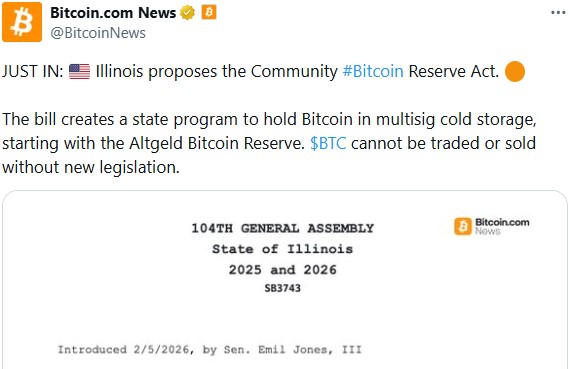
This Bitcoin Reserve Act builds on earlier Illinois efforts, such as the 2025 Strategic Reserve proposal, which failed to advance. This updated version places stronger emphasis on transparency, local engagement, and risk control.
What the New Bill Describes: Rules for State-Owned BTC Storage
The Community Bitcoin Reserve Act proposal, outlines a framework for Illinois to acquire and hold the coin under strict security and governance rules. It establishes a state-managed program to hold BTC in multi-signature cold storage which reduces the hacking or misuse risks.
A key feature of this Reserve Act is its long-term approach. The bill prohibits selling or trading of the coin unless entirely new legislation is passed, signaling caution and commitment rather than short-term speculation.
It also includes provisions for proof-of-reserve reporting, community oversight, and budget-neutral funding, meaning no added burden on taxpayers.
The proposal names the Altgeld Bitcoin Reserve as the first specific place to store Bitcoins, connecting it to local community-focused development in the Altgeld Gardens area of Chicago.
Illinois Joins Growing US Bitcoin Reserve Movement
Illinois is not alone in this initiative to accept the crypto coin at regulated stores of money. More than 16 US states have introduced or advanced BTC reserve-related legislation since 2025. Texas and New Hampshire have already moved forward with Bitcoins exposure, while states like Arizona, Missouri, and Ohio are actively debating similar frameworks.
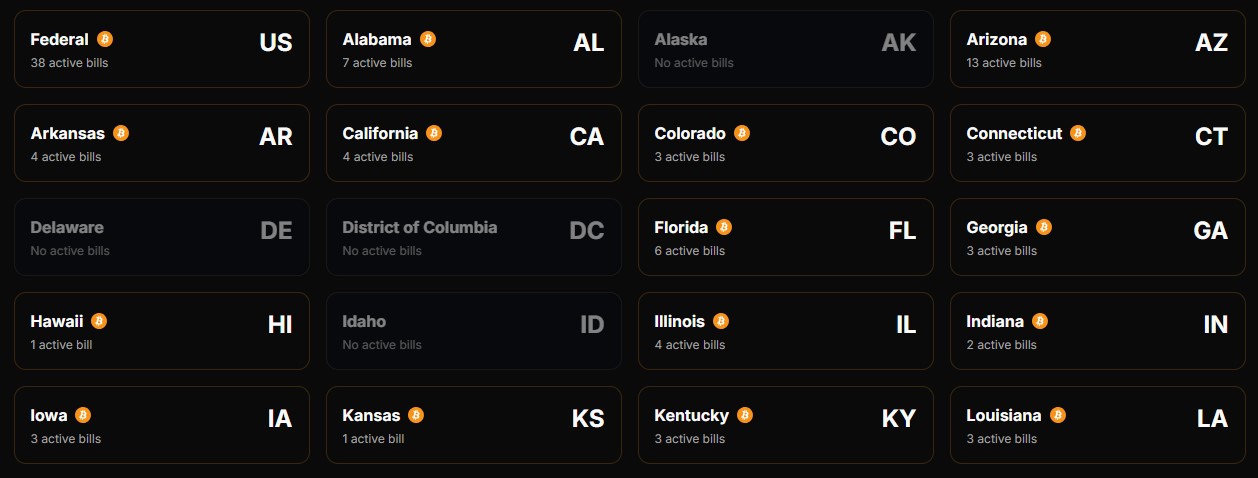
This isn't stopping at state-levels only, the central Federal already established the BTC fund in 2025, which further encourages states’ action.
The Matter Of Timing: Confidence or Strategy
The proposal arrives when BTC is facing heavy downturns since its 2025 all time high. The digital coin slipped below the key level of $65K and is currently trading at NEAR $64,887 with a 8.52% value loss in the last 24-hours.
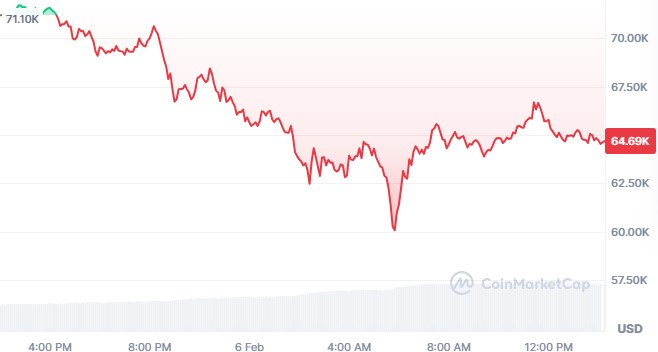
While the BTC is not the only currency falling, but the whole market is turning into red, stating the first crypto market crash of 2026.
The market, around-the-clock, dropped 7.07% to $2.24 trillion cap, where top 100 tokens and altcoins are struggling, and Greed & Fear index showing heavy fear with rating at 5 (extreme).
For now, market experts are portraying this crash as a result of rising geopolitical tensions like tariffs, recessions, sanctions, and war situations.
Here, in this situation, Illinois proposal underscores two possible conditions: Confidence in the currency’s long-run player by taking these downfall as a short-term temporary effect, or a state-level strategy to acquire the asset at the possible lowest price.
In both cases, one thing is clear: The state-based BTC fund.
