How US Recession Signals Are Driving the Crypto Market Crash

Recession fears hit crypto like a wrecking ball.
Traditional markets flinch at inflation data and yield curve inversions—digital assets get thrown out the window. When the Federal Reserve tightens the screws, liquidity vanishes from risk-on plays first. Crypto doesn't just dip; it nosedives.
The Flight to 'Safety'
Institutional money bolts for the hills. That 'digital gold' narrative? It gets tested, and often fails, when Treasury yields start looking juicy. Bitcoin's correlation with tech stocks tightens—suddenly, it's just another risky asset in the portfolio. A brutal reminder that in a panic, everything gets sold.
DeFi's Double-Edged Sword
Decentralized finance amplifies the moves. Leveraged positions get liquidated in cascades, turning a correction into a crash. The very mechanisms designed for efficiency become engines of volatility. It's beautiful and terrifying—finance without a safety net.
The Silver Lining Playbook
This is where conviction gets built. Veteran hands see blood in the streets as a signal, not a siren. They're stacking sats and hunting for protocols with real utility that got tossed out with the bathwater. The cycle hasn't changed; only the weak hands have.
History's clear: every macro-driven crypto winter has thawed into a staggering spring. The smart money isn't watching the recession headlines—it's preparing for the next leg up. After all, Wall Street's fear is crypto's bargain bin.
US Economic Data: What Sparks Recession Debate
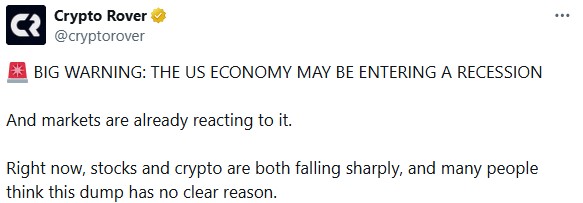
One of the clearest reasons behind economic fear is the job market. In January 2026, companies reported 108,435 job cuts, the highest January figure since 2009, while JOLTS job openings fell to 6.9 million, well below expectations.
When layoffs rise and hiring slows together, it typically leads to weaker consumer spending. This directly hurts economic growth and pushes investors away from risk assets like cryptocurrencies.
Stress in the Tech credit market increases as many companies are struggling to manage debt:
Tech loan distress at 14.5%, the highest since 2022
Tech bond distress near 9.5%, the highest since late 2023
Around $25 billion in software loans are trading at deep discounts
Previously, both markets, crypto and stock, kept their performance separate from each other. But in recent years, they linked closely, and the crypto space reacts deeply in falls of stocks.
Another point strengthening US recession fear is housing data. Home sellers in the nation are now outnumbering buyers by roughly 530,000, the largest gap ever recorded.
Housing plays a major role in the economy. Weak demand affects construction jobs, bank lending, and consumer confidence.
While others are stating concerns, the bond market flashes warning signs. The 2-year vs 10-year Treasury yield spread has moved to around 0.74%, a shift known as bear steeping – long-term yields are rising faster than short-term yields.
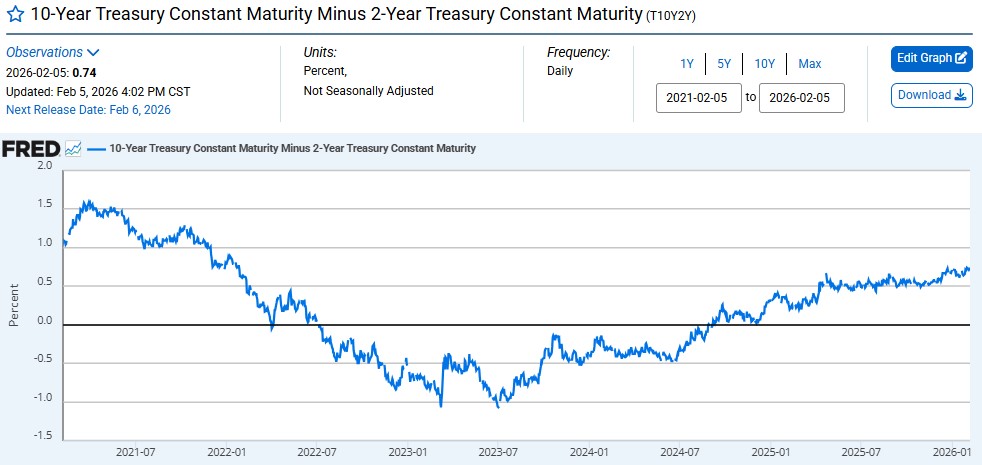
Historically, this pattern has appeared before major recessions.
Currency Situation: Traders Facing Stock & Crypto Market Crash 2026
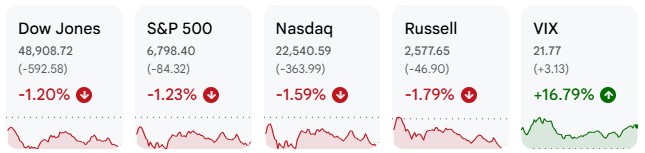
Talking about the U.S. Stock marketplace, it lost nearly $1 trillion. On counting majorly:
S&P 500 lost 84.32 points nearing -1.23%,
Dow & Jones dropped 1.20%,
Nasdaq down with 363.99 (-1.59%), and Russell (-1.79%,)
On the other hand, the crypto market is trading more deeply. In the last 24 hours, the total crypto market cap dropped by about 8%, falling from roughly $2.42 trillion to $2.22 trillion, with an intraday low NEAR $2.2 trillion, confirming the market-wide move, not limited to a single token or sector.
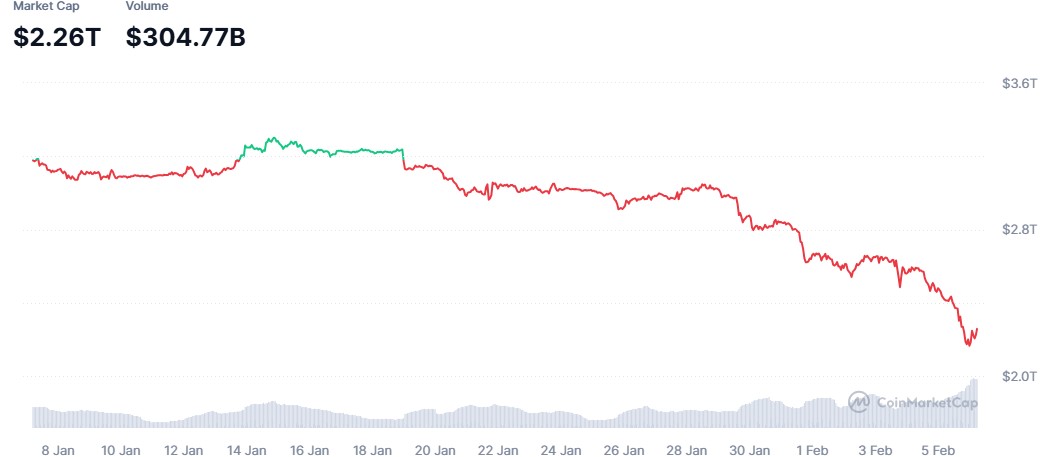
24-hour volumes jumped more than 80%, signaling forced liquidations instead of healthy repositioning. Data shows that over $1.34 billion in bitcoin positions were liquidated in a single day.
Most of the top 100 cryptocurrencies traded in the red, several large altcoins, including XRP and Solana, recorded double-digit intraday losses, highlighting strong panic-driven selling.
Is US Recession Fear Behind Crypto Crash Real? What Could Fix It?
The thing that makes this crash more attention gathering is the crypto’s growing LINK to traditional markets.
During this drop, crypto showed a 92% correlation with the S&P 500 and an 80% correlation with gold, suggesting the selloff was driven by macro factors such as interest rates, the US dollar, and equity weakness rather than crypto-specific news.
Looking at this, US recession fear can be a major reason behind the damage, though not the only one.
With economic data weakening, the Federal Reserve is now expected to break its rate cuts pauses, and give a clearer path toward easing, which could increase liquidity, reduce pressure on risk assets like equities and cryptocurrencies.
Historically, Bitcoin has fallen sharply during early recession phases but has also recovered strongly when central banks later ease policy. What happens next will depend on how deep the slowdown becomes and how the Federal Reserve responds.
