Ripple Shatters Barriers: Diamond Tokenization Marks Major RWA Market Breakthrough

Forget gold and real estate—Ripple just put diamonds on the blockchain.
The move signals a sharp pivot toward high-value, niche asset classes, pushing tokenization beyond theoretical use cases into the realm of ultra-luxury. It's a direct play for the wallets of the ultra-wealthy, traditionally a segment that views crypto with a mix of curiosity and contempt.
Why Diamonds? Liquidity Meets Legacy
Diamonds represent one of the most illiquid, opaque asset classes in existence. Valuation is an art, not a science, and selling a high-value stone often means taking a haircut through traditional channels. Tokenization cuts out the middleman, creating a divisible, tradeable digital certificate of ownership that can move across borders in seconds.
Ripple's infrastructure aims to bring the kind of settlement speed and transparency the diamond industry has never seen. Imagine proving provenance and executing a multi-million dollar trade on the same ledger—without a week of paperwork and bank approvals.
The Bigger Picture: A Run on Real-World Value
This isn't just about pretty rocks. It's a strategic land grab in the exploding Real-World Asset (RWA) market. Every major financial institution is scrambling to figure out how to bring trillions in offline value onto digital rails. Ripple's diamond play is a high-profile proof-of-concept, demonstrating that even the most stubborn traditional assets can be digitized.
It puts pressure on competitors to move beyond tokenizing treasury bills and into more complex, high-margin verticals. The race is no longer about who has the fastest chain, but who can unlock the most valuable real-world vaults.
A Cynical Take for the Finance Crowd
Let's be real—this also creates a brilliant new vehicle for wealth preservation and, let's say, 'flexible' accounting. Nothing satisfies a certain investor class like an asset that's both a store of value and notoriously difficult to price accurately. The blockchain brings auditability, but the underlying asset retains just enough mystery to keep things interesting for the portfolio managers who love a good narrative.
Ripple's bet is clear: the future of finance isn't just digital money, it's digitizing everything money can buy. And they're starting with the hardest assets they can find.

Dubai’s DMCC played a key role in supporting the initiative, reinforcing the city’s position as a global hub where commodities and digital tokens intersect. The project shows growing confidence in blockchain-based infrastructure for real-world assets.
Diamond Tokenization: What It Aims to Achieve
Under the collaboration, Billiton Diamond and Ctrl Alt completed end-to-end digitization of the precious stone, including inventory, certification, custody, and on-chain representation. Each token represents ownership of a real, certified diamond stored securely off-chain. Important details such as origin, grading, certification, and ownership history are embedded on-chain, making them easy to verify.
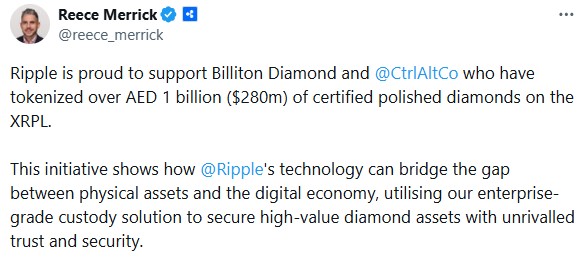
The assets are minted on the XRPL due to its fast settlement speed, low transaction fees, and scalable design. Here, Ripple’s custody solution ensures that the real diamonds backing the tokens remain securely stored and auditable.
Traditionally, diamonds are illiquid and difficult to verify. Tokenization helps reduce these barriers by enabling better transparency, easier access, faster settlement and clearer ownership records.
Billiton plans to expand this model further by launching a tokenized diamond platform, enabling real-time inventory management and preparing the asset for future primary and secondary market listings. These operations will MOVE forward after approval from Dubai’s Virtual Assets Regulatory Authority (VARA).
Growing RWA Market: New Trend in Traditional Systems
Diamond tokenization is part of a much larger trend known as real-world asset (RWA) tokenization. This market includes real estate, private credit, commodities, precious metals and physical products like diamonds.
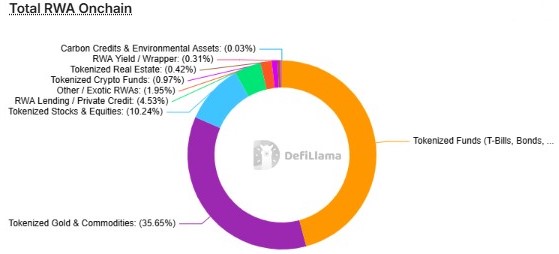
Currently the sector holds around $14.885 billion in onchain value as per DefiLlama, while industry estimates suggest the global RWA market could grow beyond trillion by 2030, as institutions look for more efficient ways to manage and trade physical asset. XRPL has already supported earlier diamond tokenization efforts worth $109 million, showing steady growth in this sector.
Are Tokenized Physical Assets a Threat to Digital Tokens?
As physical asset tokenization continues to grow, a common question is emerging across the crypto industry: could tokenized real-world assets like gold, silver, diamonds, and other commodities reduce demand for purely digital tokens?
Adding on, crypto exchanges like Binance, Coinbase, Bitget, themselves are now actively entering this space, offering tokenized versions of precious metals and commodities alongside traditional cryptocurrencies.
This shows rising interest from investors who prefer resources backed by real-world value, especially during periods of market uncertainty.
However, tokenized physical assets are not replacing digital tokens. Instead, they are expanding the crypto ecosystem. Physical asset tokens attract users looking for stability and real-world backing, while digital tokens continue to drive innovation, network activity, and decentralized finance.
Rather than posing a threat, the rise of tokenized metals and commodities suggests a shift toward a more diversified crypto market, where real-world asset and native digital token coexist and strengthen overall adoption.
This article is for informational purposes only and does not provide financial or investment advice.
