White House Crypto-Bank Deadline Looms: Stablecoin Yield Rules Face Late February Ultimatum

The regulatory hammer drops—Washington just drew its line in the digital sand.
Behind Closed Doors: The Bank-Crypto Truce
For months, whispers circulated about backchannel talks between federal officials and banking heavyweights. Now we know the timeline: a late-February deadline to hash out how traditional finance handles stablecoin yields. No more vague promises—regulators want concrete frameworks before spring.
Why Stablecoin Yield Became the Battleground
Banks see dollar-pegged tokens as a potential revenue stream; regulators see systemic risk. The fight centers on whether yield-generating mechanisms—staking, lending protocols, treasury management—should fall under banking compliance or operate in a regulatory gray zone. The White House wants clarity before the next bull run amplifies the stakes.
The Domino Effect on DeFi
Any bank-friendly framework could legitimize yield-bearing stablecoins—or strangle decentralized protocols that currently dominate the space. Watch for provisions that could force yield activities through licensed intermediaries, effectively sidelining permissionless DeFi platforms. The fine print will determine whether innovation gets a passport or a prison sentence.
Late-February: More Than a Date
This deadline isn't arbitrary. It aligns with quarterly reporting cycles and precedes key congressional hearings. Miss it, and the industry faces extended uncertainty—exactly what markets hate. Hit it, and we might finally see banks launch compliant yield products by Q3.
Wall Street's worst nightmare? A regulated crypto yield that actually competes with their pathetic savings rates. Suddenly, 5% APY on a digital dollar looks better than your bank's 0.01%—no velvet ropes required.
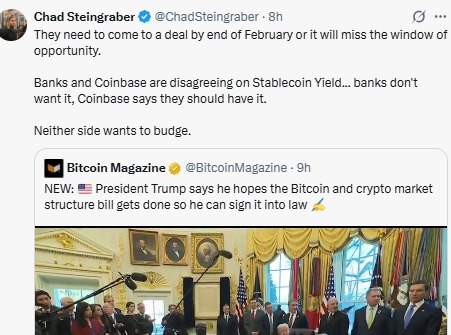
Source: X (formerly Twitter)
The meeting focused on unresolved parts of the Digital Asset Market Clarity (CLARITY) Act, especially whether non-bank platforms like Coinbase should be allowed to offer yield on dollar-backed stablecoins. Officials described the talks as constructive and set an end-of-February deadline to reach a compromise.
Why Does the White House Crypto-Bank Deal Matters?
At the heart of the White House Crypto meeting is a sharp disagreement between banks and crypto companies.
Banking groups argue that stablecoin rewards pull deposits away from banks, reducing funds available for lending to families and small businesses.
Crypto firms counter that users should be able to earn returns on low-risk digital dollars without banks using those funds for lending.
Both sides agree that stablecoins need clear rules, but they disagree on who should be allowed to offer rewards. This dispute has slowed progress on the broader crypto market structure bill.
Who Attended the White House Stablecoin Talks?
The meeting included executives from Coinbase, Ripple, Kraken, Tether, and several payment and finance firms. Major banking groups such as the American Bankers Association and Bank Policy Institute were also present, along with digital assets advocacy organizations.
Sources in the room said the discussion stayed calm and focused. Issues were clearly defined, and both sides understood where the limits are. While no final deal was reached, the tone was described as positive.
White House crypto adviser Patrick Witt called the talks “constructive, fact-based, and solutions-oriented,” adding that he is confident a solution can be reached soon.
February Deadline Raises Stakes
The Deal now comes with a clear timeline. Officials have reportedly set the end of February as the deadline to resolve the stablecoin yield issue. If no agreement is reached, the CLARITY Act could miss its chance to pass in 2026.
President Donald TRUMP has voiced support for moving the bill forward quickly and has indicated he is ready to sign it if Congress can agree on the remaining issues.
Banks vs Crypto on Stablecoin Rewards
Banks remain firm in their position, pushing to close what they call a loophole that allows digital assets platforms to offer rewards on stablecoins. Digital assets companies, especially Coinbase, argue that banning rewards WOULD hurt competition and innovation.
This clash has become the main barrier to progress, making the White House Crypto-Bank Deal a deciding factor for the future of US stablecoin regulation.
What Happens Next?
More meetings are expected, likely with smaller groups, to narrow differences. Lawmakers from Senate committees will also need to align their versions of the market structure bill before it can reach a full vote.
For now, the White House Crypto-Bank Deal remains unresolved, but the February deadline has added urgency. The outcome could shape how stablecoins work in the US for years to come.
