Tether Mining OS Goes Open Source: The Game-Changer Bitcoin Miners Have Been Waiting For

Tether just dropped a bomb on the mining industry—and it's open for everyone. The stablecoin giant's proprietary Mining Operating System is now open source, tearing down the walled gardens that have long dominated Bitcoin mining hardware.
Why This Isn't Just Another Software Update
For years, mining efficiency was locked behind corporate firewalls. Manufacturers guarded their firmware like state secrets, creating a fragmented ecosystem where your ASIC's performance depended entirely on who built it. Tether's move shatters that model. Now, any miner, from a basement hobbyist to a industrial-scale farm, can access, modify, and optimize the same core software driving some of the world's most efficient operations.
The Ripple Effect: Decentralization Beyond the Ledger
This isn't just about better hash rates. It's about redistributing power—literally. Open-source code allows for community-driven innovation, faster bug fixes, and customized optimizations for specific hardware or energy setups. It cuts out the middleman, bypassing the traditional vendor-update cycle that often leaves miners waiting for improvements. The network's security strengthens when more participants can run optimized, transparent software, making the entire Bitcoin ecosystem more resilient and less reliant on a handful of corporate players. (Take that, traditional finance's 'innovation' committees that take six months to approve a PDF.)
The New Mining Playbook
Expect a surge in specialized forks and community-built mods. The collective brainpower of global developers will now hammer away at squeezing every last joule of efficiency from mining rigs. This levels the playing field, reducing the absolute advantage of capital and shifting competitive focus to operational ingenuity and energy sourcing.
Tether didn't just release code—it issued a challenge. The era of proprietary mining black boxes is over. The future is transparent, modular, and built in the open. Whether this forces legacy manufacturers to adapt or opens the door for a new wave of hardware innovators, one thing is clear: the rules of the mining game just got rewritten.
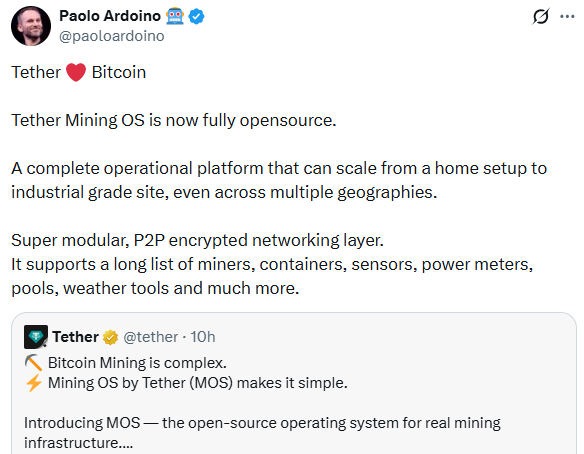
By choosing a Tether Mining OS Open Source path, the firm is using its huge 2025 profits to make the Bitcoin network stronger. This software acts as a single dashboard for miners. It tracks everything from energy use to cooling systems in one place. Unlike other tools that use private servers, this system runs on a secure, peer-to-peer (P2P) network. This keeps your data safe and private at all times.
How Tether Mining OS Open Source Strategy Empowers Global Miners
The OS Open Source launch is built to help real people. For years, small miners had to pay high monthly fees for professional tools. Now, the same high-end software used by giant Digital Asset Extraction farms is available to a person running a few machines at home. This makes the industry much more fair for everyone.
Simple Design and Strong Security
The best part of the Tether Digital Asset Extraction OS Open Source system is how simple and modular it is. You can pick and choose the features you need:
Devices talk directly to each other. This removes the need for a central server that could be hacked.
The system supports a very long list of Digital Asset Extraction machines and sensors.
It is light enough to run on a small Raspberry Pi at home, but strong enough for thousands of machines in a large factory.
Tether and Opera: Real-World Money Access
While the OS Open Source project builds the network, Tether is also helping people use their money. The company recently grew its partnership with Opera’s MiniPay wallet. As of late 2025, MiniPay has over 12 million active accounts. In December alone, users sent over $153 million in USDT and Tether Gold. This helps miners in places like Africa and Latin America save their earnings in digital dollars or gold to protect against local inflation.
The Role of the Mining SDK
To help the Tether Mining OS Publicly Available Code community grow, The Firm also released a Digital Asset Extraction SDK. This is a toolkit for developers to build their own custom apps, like better energy monitors. With over 96,185 BTC in its reserves, The Firm is showing that it cares about more than just holding coins. They are building the actual tools that keep the global mining system running smoothly.
Expert Analysis: A New Future for Mining
The launch of the this platform marks a new era. It moves Digital Asset Extraction software from a paid service to a public good. By making these tools free, The Firm is forcing other companies to lower their prices. The real winner is the Bitcoin network. When the software is open and clear, the risk of "hidden tricks" or central control goes away.
We expect many medium-sized Digital Asset Extraction companies to switch to this system soon to save money. In the coming months, the new Digital Asset Extraction SDK will likely become the top choice for developers building green energy mining solutions.
