PeckShield Reveals $86M Crypto Bleed as Market Downturn Intensifies

Crypto's risk landscape just got a fresh coat of red ink.
PeckShield's latest alert paints a stark picture: a single wave of market weakness washed away a staggering $86 million from digital asset portfolios. It's the kind of headline that makes traditional finance guys nod sagely about 'speculative bubbles' over their martinis.
Where the Money Went
The losses didn't come from one place. They bled out across the ecosystem—protocols, exchanges, and wallets all felt the pinch. It's a system-wide reminder that when volatility spikes, security gaps and leveraged positions turn into emergency exits for capital.
The Sentiment Spiral
This isn't just about the number. It's about momentum. Major losses feed fear, fear triggers sell-offs, and sell-offs deepen the market weakness that caused the problem in the first place. A classic crypto feedback loop, just in the wrong direction.
Looking Beyond the Headline
For the builders? It's a brutal stress test. For regulators? Ammunition for the 'I-told-you-so' files. For long-term believers? Another cycle to weather—history suggests these drawdowns, however painful, have preceded every major leg up. The market doesn't care about your cost basis; it just cuts.
So, is this the canary in the coal mine or just market noise? Either way, $86 million just left the chat. Time to check your own exposure before the next headline hits.
Highlights:
PeckShield reports 16 crypto hacking incidents in January 2026, causing $86M in losses, with phishing scams alone crossing $300M
Crypto losses rise month-on-month from December 2025, worsening sentiment during an already declining market phase
Ongoing hacks and phishing attacks continue to pressure investor confidence and slow overall crypto market recovery
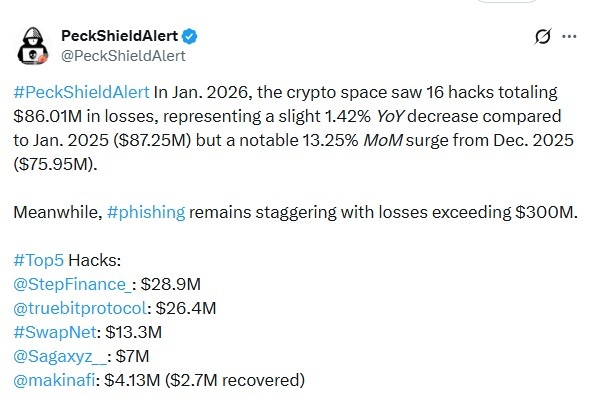
The latest warning on digital asset safety comes from PeckShield reports, shared through its official X account. The report states that January 2026 recorded 16 hacking incidents, with cumulative damage of $86 million. This marks a 1.42% year-on-year decline from January 2025 losses of $87.25M, yet still reflects a month-on-month increase, as December 2025 losses were $75.95M. Alongside these exploits, PeckShield reports highlighted a far bigger concern: phishing attacks crossed $300M, showing how user-focused scams continue to dominate damage figures.
Top 5 Hacks Reported by PeckShield
Step Finance – $28.9M
Truebit Protocol – $26.4M
SwapNet – $13.3M
Saga – $7M
Makina Finance – $4.13M ($2.7M recovered)
These incidents affected different layers of the ecosystem, from analytics tools to protocol infrastructure, proving that attackers are no longer focused on one single segment.
Weak Market Conditions Make the Situation Worse
Falling prices, low volume, fragile sentiment across major tokens
Security losses amplify fear during an already declining phase
The digital asset market is currently moving through a weak cycle, with declining valuations and reduced investor confidence. In such conditions, fresh exploit reports intensify pressure. Loss data released during a downtrend sends a negative signal, as participants LINK falling prices with rising risk. Instead of recovery narratives, the market faces a feedback loop where fear, sell-offs, and security concerns strengthen each other.
Why Are Attacks Still Increasing?
Phishing, social engineering, compromised keys, and rushed integrations
Complex smart-contract logic expanding faster than audits and testing
Despite decentralization, systems still rely on human decisions. Attackers increasingly target users rather than code, exploiting fake links, wallet approvals, and misleading interfaces. Protocol founders and chain maintainers have repeatedly stated that decentralization does not eliminate responsibility; instead, it shifts risk to users, developers, and validators. Many leading blockchain teams argue that security must be treated as continuous infrastructure, not a one-time audit, while exchange operators stress stronger wallet warnings and transaction simulation tools to reduce mistakes.
Why These Hacks Happen and Why They Matter
Root causes: phishing scams, private-key leaks, rushed deployments, unchecked permissions
Industry view: security must evolve continuously, not reactively
Leading exchange operators and blockchain founders often state that decentralization does not equal immunity. They acknowledge that human behavior, wallet approvals, and interface design remain the weakest links. Many chain owners emphasize better user education, transaction simulation, and ongoing audits, while protocol teams argue for slower rollouts with stronger testing.
These incidents matter because trust drives adoption. Repeated losses during a bearish phase delay capital inflow, discourage new users, and raise regulatory attention. For investors, exploiting trends influences risk assessment. For builders, they define credibility. Future progress will depend on phishing-resistant tools, clearer safeguards, and shared responsibility across the ecosystem.
