Jupiter Global On Chain Launches: Scan-to-Pay Crypto Just Got Ridiculously Simple

Forget clunky wallets and confusing addresses—Jupiter just turned your smartphone into a crypto checkout lane.
The 'scan-to-pay' revolution is here
Jupiter Global On Chain cuts through the complexity that's kept digital assets on the sidelines of everyday commerce. No more copying long strings of characters or sweating over network fees at the register. A quick QR scan bypasses the old friction, aiming to make paying with crypto as instinctive as tapping a card.
It’s a direct shot at mainstream adoption
This isn't just another payment app update. It's a foundational shift, betting that simplicity will drive what years of hype couldn't: actual, daily use. The platform sidesteps traditional banking rails entirely, putting blockchain's promise of instant, borderless settlement directly into consumer hands.
Of course, the old guard might scoff—watching from their marble lobbies as a QR code threatens to do what their legacy systems took decades to build. But in a world where finance is increasingly digital-first, Jupiter's move feels less like a feature launch and more like an opening salvo. The race to own the future of spending just got real.
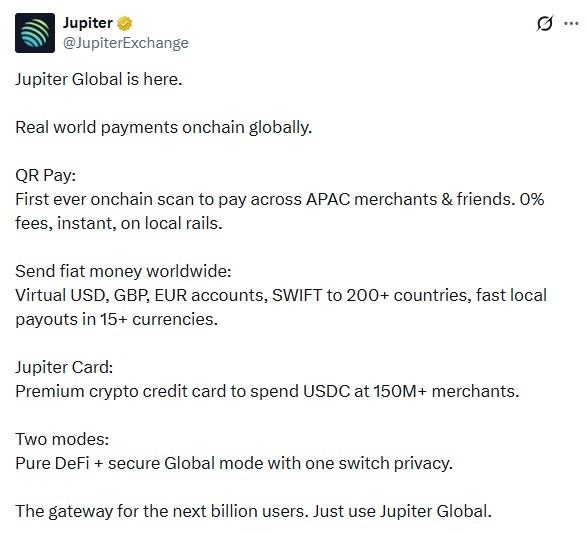
Source: X official
Jupiter DeFi's Structure
The exchange operates as a DeFi liquidity aggregator, finding the best swap routes across multiple Solana-based pools.
It offers fast execution, low slippage, and non-custodial access, meaning users always control their assets.
Because it already handles a large share of Solana’s on-chain activity, it has built strong infrastructure, deep liquidity access, and a large active user base. These advantages make it well-suited to expand into payments without rebuilding from scratch.
Jupiter Global and the Scan-to-Pay Model
The newly announced Jupiter Global platform brings on-chain “scan to pay” functionality to crypto users. The idea is simple and familiar:
A user scans a QR code generated by another person or merchant.
Funds are sent instantly to the recipient’s wallet on-chain.
Unlike traditional payment apps, there is no bank account or card network involved. Transfers settle directly on the blockchain, making payments transparent and final.
This system is powered by Solana’s high speed and very low transaction costs, allowing near-instant settlement at minimal fees. The Global ecosystem is built on its existing trading and wallet infrastructure, ensuring smooth integration with current users.
How the Platform Works and Who Handles the Financial Layer
Payment flow: Scan QR → choose supported asset → approve → funds move directly to the recipient’s wallet.
Settlement: Solana validators confirm transactions, not banks or card networks.
The Platform operates in two modes:
Pure DeFi mode, fully on-chain and self-custodial.
Secure Global mode, designed for fiat features, with a single privacy switch that lets users choose their preferred interaction level.
There is no traditional financial intermediary. Smart contracts, wallets, and the blockchain network handle execution, custody, and settlement.
Why This Matters for The Exchange and Crypto
Jupiter moves from being a trading-focused DeFi app to a real-world payments platform.
Crypto becomes easier to use for daily transactions, not just investing or swapping.
For the broader market, scan-based on-chain payments reduce friction between digital assets and everyday commerce. They also highlight how blockchain can compete with existing QR payment systems while remaining open and permissionless.
Future Impact and Growth Outlook
The Platform could help onboard new users who may never trade but want simple crypto payments. As adoption grows, transaction volume, ecosystem usage, and network activity may all increase.
That creates a positive long-term setup for the JUP token, but the actual price impact will depend on execution, adoption, and how deeply JUP is integrated into future utility.
For crypto overall, seamless scan-to-pay tools bring digital assets closer to real-world utility, supporting long-term growth and mainstream acceptance.
