Kazakhstan Forges National Crypto Reserve from Seized Digital Assets and Gold

Forget mining—Kazakhstan is minting its sovereign wealth from confiscated loot. The Central Asian nation is building a state-backed crypto reserve, stitching together seized digital currencies and physical gold into a novel financial asset. It's a bold experiment in national balance sheet management, straight from the evidence locker.
The Mechanics of the Modern Treasury
The process isn't subtle. Authorities intercept illicit crypto flows and confiscate physical gold from criminal operations. Instead of a fire sale, these assets get funneled into a dedicated state reserve. The strategy effectively converts enforcement actions into treasury operations, creating a sovereign holding that straddles the digital and physical worlds. It’s asset seizure repurposed as macroeconomic policy.
A New Blueprint for National Reserves?
This move challenges the traditional playbook. Central banks typically stack dollars, euros, and bullion. Kazakhstan is adding a volatile, decentralized asset class to the mix, betting its future stability partly on the very tokens it once policed. The reserve could act as a hedge, a strategic commodity holding, or a high-risk gamble—depending on the day’s market sentiment. One financier’s compliance headache becomes another state’s strategic reserve, proving that in global finance, one institution’s trash is another’s trillion-dollar treasury. The ultimate irony? A government leveraging the anti-establishment ethos of crypto to bolster its own establishment. They’ll praise decentralization right up until they need to centralize the profits.
What the Original Announcement Says
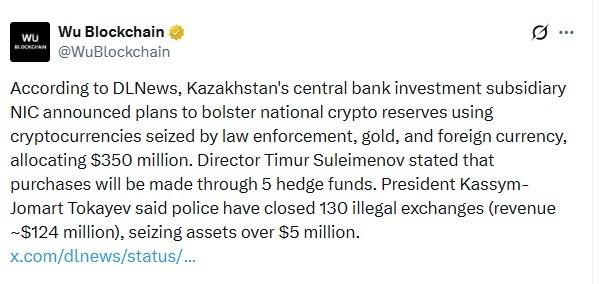
The announcement was made by NIA Director Timur Suleimenov, who stated that the reserve will not be speculative but managed as part of a broader investment strategy. The estimated size of the allocation stands at around $350 million, primarily sourced from gold and foreign currency reserves. In addition, virtual currencies confiscated during law enforcement actions will also be transferred into the reserve framework.
Kazakhstan’s President Kassym-Jomart Tokayev highlighted that authorities have closed nearly 130 illegal crypto exchanges, which generated revenues of roughly $124 million. Assets worth more than $5 million were seized during these operations and will now be repurposed under state control.
Source: WuBlockchain Xofficial
How the Funds Will Be Invested
Instead of buying or holding digital assets directly, NIA plans to route investments through five hedge funds. This structure allows professional risk management, institutional custody, and regulatory oversight. It also reduces operational risk for the central bank while keeping exposure controlled and transparent.
Using hedge funds offers several advantages:
Experienced market execution and compliance systems
Reduced volatility impact through diversified strategies
Why Seized Crypto, Gold, and FX Are Being Used
Seized digital assets are often liquidated or left unused. Kazakhstan is choosing a different path by converting these confiscated funds into productive capital. Gold and foreign exchange reserves provide stability and act as a buffer against price swings. Together, these sources create a balanced approach to entering digital markets without relying on public funds.
Economic Impact and Public Effect
For the national economy, this MOVE supports Kazakhstan's crypto reserve diversification and signals financial modernization. While crypto volatility remains a risk, the limited allocation and professional management reduce systemic threats. The crackdown on illegal platforms also strengthens financial discipline and discourages underground activity.
For local citizens, the impact is indirect but meaningful. Stronger enforcement reduces fraud risk, while regulated participation improves transparency. It also reassures the public that seized criminal assets are being reused for national benefit rather than wasted.
A Strategic Step in a Global Trend
Across the world, governments are experimenting with regulated virtual currency exposure through funds, custody frameworks, and tokenized instruments. Kazakhstan’s strategy reflects this shift, showing an understanding of how to extract value from seized resources while aligning with global financial evolution.
By turning illegal proceeds into a managed investment tool, Kazakhstan presents itself as a proactive and calculated nation—one that knows how to transform financial waste into long-term strategic value for both the state and the emerging digital economy.
