How the DOJ Seized $400 Million from Helix Darknet Mixer - The Inside Story

Justice Department cracks crypto's privacy shield—permanently.
The Takedown Blueprint
Federal investigators didn't just follow the money—they rewired the mixer's entire plumbing. Blockchain forensics traced tainted coins through layered transactions, mapping a network prosecutors called "a criminal concierge service." The $400 million seizure didn't happen overnight; it required tracing funds through thousands of addresses across multiple blockchain layers.
Privacy Tech Meets Subpoena Power
Helix promised anonymity through cryptographic shuffling—mixing clean and dirty coins until origins blurred. But every transaction leaves fingerprints. Investigators exploited timing patterns, fee anomalies, and wallet clustering techniques that turned privacy features into evidence. The mixer's own logs, seized from offshore servers, revealed client lists that read like a darknet who's who.
The New Enforcement Playbook
This wasn't a simple wallet seizure. Prosecutors used centuries-old money transmission statutes against cutting-edge privacy protocols. They argued that converting bitcoin to monero and back constituted financial transmission—a legal theory that could reshape how all mixers operate. The $400 million figure represents years of accumulated fees from clients who paid for privacy they ultimately didn't get.
Aftermath and Implications
Other mixers immediately saw withdrawal spikes as panicked users pulled funds. Privacy coin developers began revising whitepapers. Meanwhile, traditional compliance officers quietly cheered—finally, someone made their job easier by doing the hard part for them. Because nothing helps financial surveillance like seizing the surveillance-evasion tools first.
The message to crypto anarchists? Your privacy stack just got a $400 million stress test—and failed spectacularly. To Wall Street compliance departments? Consider this your new favorite precedent. And to everyone else watching? The rules apply, even when the technology pretends they don't.
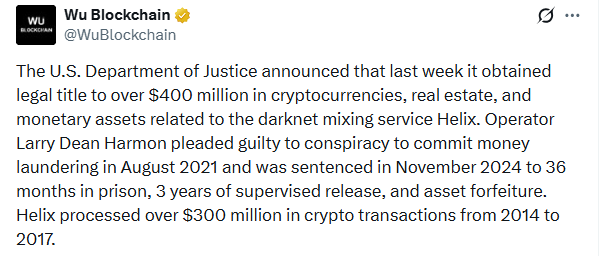
The Helix Darknet Mixer was a go-to "tumbling" service between 2014 and 2017. It served as a primary hub for drug dealers and hackers looking to "clean" their money. According to court records, the service moved at least 354,468 Bitcoin, which was worth about $311 million at the time. However, because the value of digital assets has skyrocketed over the years, the seized property is now worth much more. This makes it one of the largest asset recoveries in the history of the Justice Department.
How the Helix Darknet Mixer Takedown Impacts Crypto Privacy
The man behind this operation, Larry Dean Harmon, pleaded guilty to money laundering back in 2021. After years of legal battles, Harmon was sentenced in November 2024 to 36 months in prison. Along with jail time, he was ordered to give up all the property he bought with his illegal earnings. Investigators found that Harmon actually designed the Helix Darknet Mixer to connect directly with darknet drug markets, making it incredibly easy for criminals to MOVE money without being caught.
How a Darknet Mixer Works
To understand why this forfeiture is such a big deal, you have to look at how a Helix Darknet Mixer actually functions. It wasn't just a simple privacy tool; it was a engine built specifically to hide where money was coming from.
The service took bitcoin from many different people and threw it all into one big digital "pot."
It then sent that money through thousands of small, confusing transactions to make it impossible to follow.
Finally, it sent "clean" coins to the user's new address, taking a 2.5% fee for the service.
Expert Analysis: A New Era for Crypto Law
This case shows a major shift in how the government handles crypto crime in 2026. While officials are becoming more friendly toward legitimate crypto businesses, they are coming down harder than ever on "laundering hubs."
Experts believe the government's ability to track these funds even years after the service closed sends a clear warning to other criminals. By taking legal ownership of these millions, the U.S. removes the "paycheck" for running these illegal services. It also shows that working with international partners, like the government of Belize, means there are fewer places for cybercriminals to hide their wealth.
