SEC’s New Tokenized Securities Framework Rewrites the Rules of Blockchain Finance

The SEC just dropped the rulebook—and is writing a new one. Forget the old guardrails. The freshly minted Tokenized Securities Framework doesn't just tweak the system; it rebuilds the track while the race is already on.
From Regulatory Gray Zone to Green Light
For years, tokenizing real-world assets—think stocks, bonds, or real estate—meant navigating a compliance minefield. The new framework cuts through the ambiguity. It lays out clear, asset-specific pathways for issuance, trading, and custody on-chain. Suddenly, what was a legal headache transforms into a programmable checklist. The era of 'move fast and break things' just got a regulatory stamp of approval—with conditions.
Liquidity Unleashed, But Not for Everyone
The real magic? Fractionalization and 24/7 markets. The framework explicitly blesses the splitting of high-value assets into digital shares, unlocking pools of capital that were previously stagnant. Imagine trading a sliver of a Manhattan skyscraper at 3 a.m. like it's a meme coin. It democratizes access, sure, but let's be real—the first beneficiaries are the institutions with the legal teams deep enough to actually implement this. A cynical finance jab? It's less 'power to the people' and more 'efficiency for the portfolios that already have nine zeroes.'
The New Gatekeepers
Compliance gets baked into the code. The rules mandate specific on-chain verification mechanisms and data oracles for real-world attestation. This doesn't remove intermediaries; it just changes their job description. Lawyers and accountants become smart contract auditors. The trust shifts from paper filings to cryptographic proofs and accredited data feeds. The system becomes more transparent and, ironically, more reliant on a new class of tech-infused fiduciaries.
The framework is a tectonic shift. It validates blockchain's core promise for mainstream finance while imposing its own strict order. It's not a wild west gold rush anymore—it's a surveyed, regulated, and highly efficient gold market. The pioneers who thrive won't be the cowboys, but the architects who can build within the new lines.
For issuers and exchanges racing to bring stocks and bonds on-chain, this guidance may now determine who launches successfully and who faces immediate regulatory risk.
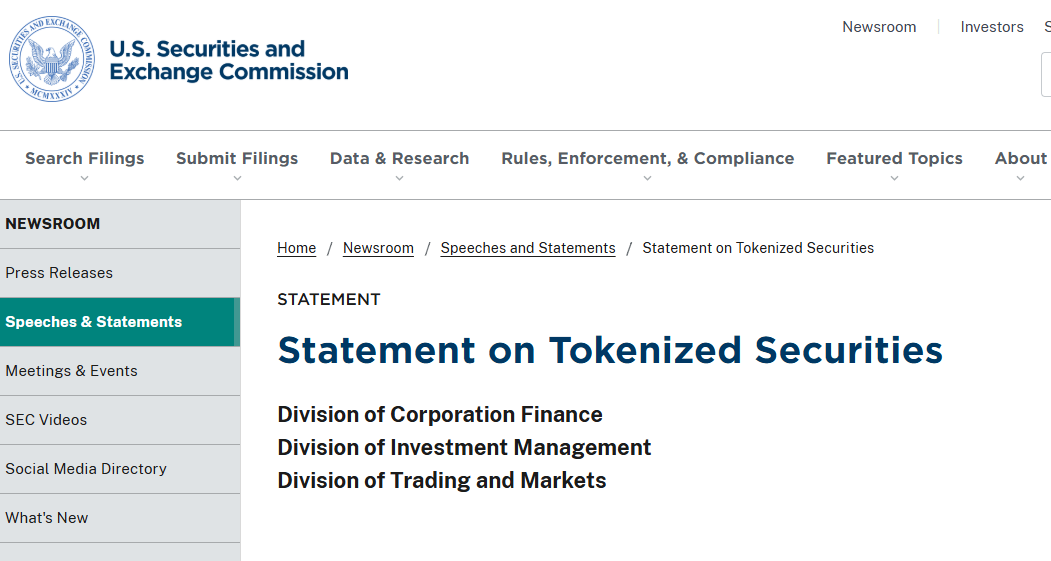
In a joint staff statement released this week by the Divisions of Corporation Finance, Trading and Markets, and Investment Management, the SEC outlined how tokenized securities should be classified, issued, and regulated under existing law. The guidance arrives as major financial institutions accelerate tokenization pilots, following similar regulatory moves in the European Union, Singapore, and the United Kingdom between 2024 and 2025.
The Two Big Categories You Need to Know
The SEC has broken the world of digital securities into two distinct buckets. Understanding which one you fall into is the difference between a smooth launch and a legal nightmare:
This is when a company (like a big tech firm or a bank) decides to issue its own shares directly on a blockchain. Here, the "on-chain" record is the official source of truth for who owns the stock.
This is where things get tricky. This happens when an outside company "wraps" another company's stock into a token. The SEC is keeping a much closer eye here because these tokens often don't give you the same rights, like voting or dividends.
How the Latest SEC Tokenized Securities Framework Affects Issuers
For companies looking to innovate, the SEC tokenized securities framework provides a much-needed "How-To" guide. If you are an issuer, you can now offer your shares in both traditional and tokenized formats. You could have one class of investors holding paper-style digital records and another holding tokens on a blockchain and as long as the rights are the same, the SEC will treat them as the same class of stock.
The Technical "Checklist" for Compliance
To stay on the right side of the law, the SEC tokenized securities framework requires a high level of detail in how you keep your records. You can't just have a list of anonymous wallet addresses.
You must be able to LINK an on-chain wallet (e.g., 0x123...) to a real human address and name off-chain.
Your "Master File" must be auditable and reflect every transfer that happens on the blockchain in real-time.
If you are a third party offering "linked" or "synthetic" tokens, you are likely dealing with security-based swaps. These have much stricter rules and usually can't be sold to regular retail investors without heavy-duty registration.
Expert Analysis: The Strategic Liquidity Pivot
The arrival of this framework serves as a green light for institutional participants who have previously hesitated due to regulatory ambiguity. While the guidance sidesteps the debate regarding when a crypto-native token becomes a security, it provides a clear runway for the tokenization of real-world assets (RWA) such as Treasury bills and corporate bonds.
Future outlook indicates that the 2026 implementation deadline will likely trigger a wave of re-filings from existing projects seeking to align their structures with the custodial and synthetic definitions provided. As the New York Stock Exchange and other major trading venues prepare to launch blockchain-based equity platforms, this framework acts as the foundational manual for the next generation of U.S. capital markets.
