Arthur Hayes’ Bold Bitcoin Prediction: How the Yen Crisis Fuels the Next Crypto Rally

When traditional currencies falter, digital gold stands ready. Arthur Hayes, the outspoken co-founder of BitMEX, sees a direct line between Japan's monetary turmoil and Bitcoin's next explosive chapter. It's not just a prediction—it's a playbook for the coming financial upheaval.
The Domino Effect of a Weakening Yen
Hayes argues that a collapsing yen forces Japan's hand. To defend its currency, the Bank of Japan must hike interest rates, a move that sends shockwaves through the global bond market. As yields on Japanese Government Bonds spike, a massive, hidden risk surfaces: the infamous 'carry trade' unwinds. For years, investors borrowed cheap yen to buy higher-yielding assets abroad. Now, that trade reverses at a violent pace, triggering a global liquidity crunch. Capital flees risky assets—except, Hayes contends, for one.
Bitcoin as the Ultimate Pressure Release Valve
In this scenario, central banks face an impossible choice: let the financial system seize up or flip the switch on the money printers. Hayes bets on the latter. The Federal Reserve and its peers will be forced to launch a coordinated wave of liquidity injections—a modern-day quantitative easing blitz—to prevent a cascade of defaults. This fresh flood of fiat, he posits, won't flow into stagnant economies. It will seek an escape hatch, a hard asset immune to sovereign balance sheet gymnastics. That hatch is Bitcoin.
The Rally Mechanism: Liquidity Seeking Hard Truth
The narrative shifts from 'risk-on' to 'sanctuary-seeking.' Bitcoin's fixed supply and decentralized nature become its prime attraction. It's not about tech adoption or ETF flows in this phase; it's about capital preservation against coordinated currency devaluation. The rally Hayes envisions is macro-driven, fierce, and fueled by the very institutions that once dismissed crypto—now desperate for a lifeline beyond their own printing presses. It's the ultimate irony: the system's fix becomes crypto's rocket fuel.
A Provocative Closing Shot
Hayes's thesis cuts through typical market analysis. It paints Bitcoin not as a speculative tech stock, but as the logical endgame for broken monetary policy. While economists fret over inflation targets and debt-to-GDP ratios, the crypto market simply watches the liquidity taps. The next bull run might not start on a crypto exchange, but in the marbled halls of a central bank—proving once again that in finance, the best trade often involves betting against the experts in suits. After all, their solution to every crisis is to create more of what's causing it.
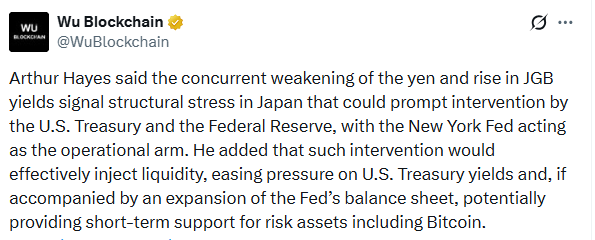
Financial markets in early 2026 are staring at a Japanese "match" that threatens to ignite the global fiat system. As the Japan's currency weakens against the Dollar while bond yields rise a rare and toxic combination Japanese authorities are losing their grip on the long end of the yield curve. Hayes argues that the U.S. Treasury and the Federal Reserve will not sit idly by. Instead, they are likely to deploy an intervention strategy that effectively pumps fresh liquidity into the veins of the global economy, potentially providing the explosive energy needed for bitcoin to exit its current sideways funk.
How Fed Money Printing to Support Japan Impacts Crypto Markets
The mechanics of this intervention are a masterclass in bureaucratic financial engineering. To stabilize the Yen and cap JGB yields, the New York Fed acting as the Treasury's operational arm WOULD initiate a multi-step process. First, the Fed creates new bank reserves (dollars) out of thin air. These dollars are then sold to primary dealers in exchange for Yen. To complete the circuit and suppress Japanese interest rates, the Fed then uses Yen to purchase JGBs.
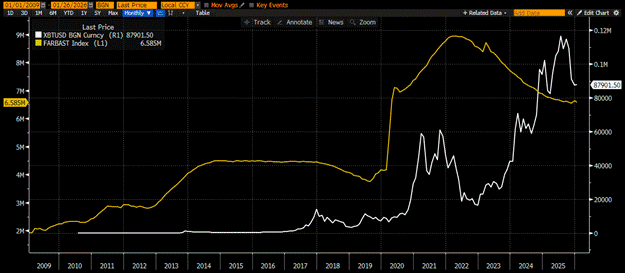
This process is, by definition, an expansion of the Federal Reserve’s balance sheet. While officials may avoid the term "Quantitative Easing," the result is identical: an injection of dollar liquidity into the global system. For crypto enthusiasts, the "Foreign Currency Denominated Assets" line item on the Fed’s weekly H.4.1 report has become the most important data point in the world. A significant rise in this category confirms that Fed money printing is active, creating the monetary tailwinds that historically drive high-beta risk assets like Bitcoin toward new all-time highs.
The Japan Connection: Why Buffalo Bill Bessent Must Act
One might ask why U.S. Treasury Secretary "Buffalo Bill" Bessent or President TRUMP would care about Japan’s internal bond market. The answer lies in the $2.4 trillion foreign debt portfolio held by "Japan Inc." Japanese private investors are among the largest holders of U.S. Treasuries. If JGB yields rise high enough to make domestic investment attractive, Japanese institutions will liquidate their U.S. holdings to repatriate funds.
Such a massive sell-off would send U.S. Treasury yields skyrocketing, making the already ballooning U.S. deficit unaffordable to finance. By intervening to lower JGB yields, the Federal isn't just helping an ally; it is protecting the U.S. government's own ability to borrow. Furthermore, a weak Yen hurts the global competitiveness of American manufacturers, a key political priority for the current administration.
Expert Analysis: The Future Outlook
The current macro setup suggests we are approaching a "volatility smush" phase. While a rapidly strengthening Yen can initially cause a "risk-off" event due to the unwinding of the Yen carry trade, a controlled, Fed-backed intervention aims for stability. The goal is to weaken the Dollar against the Yen, Euro, and Yuan simultaneously, handily chucking European and Chinese exports while providing a liquidity bridge for U.S. stocks and Bitcoin.
In the short term, Bitcoin may face turbulence as high-leverage positions are liquidated during Yen volatility. However, the mechanical reality of an expanding Fed balance sheet is hard to ignore. As the quantity of fiat currency rises to plug the holes in the Japanese bond market, the relative value of Bitcoin is positioned to levitate. Vigilant traders should keep their ears to the ground for the next "Woomph" in the Fed’s H.4.1 report. Once the balance sheet growth is confirmed, the sidelined capital in the crypto markets will likely rush back into quality DeFi assets and Bitcoin proxies.
