Thailand’s Crypto ETF Wave Rides Surging Global Demand Into 2026

Bangkok's financial scene is buzzing—not with tuk-tuks, but with a new kind of traffic. Thailand's crypto ETF momentum is accelerating, catching the updraft from a global surge in exchange-traded fund demand. It's a pivot from niche to mainstream, playing out in real-time.
The Institutional On-Ramp
Forget complicated wallets and private keys. These funds offer a familiar, regulated vehicle—a sleek gateway for institutional capital and cautious retail investors who want crypto exposure without the operational headaches. It's portfolio diversification, wrapped in a recognizable package.
Global Tailwinds, Local Ambition
Thailand isn't operating in a vacuum. Worldwide ETF inflows are creating a powerful narrative of legitimacy and scale. Local regulators, perhaps eyeing regional rivals like Singapore, are leaning into this momentum, shaping frameworks to capture the wave rather than block it. It's a classic case of global finance meeting local ambition.
A Calculated Bet on Digital Finance
This isn't just speculation. It's a strategic move to position the country at a key intersection: traditional finance and the digital asset frontier. The goal? To attract capital, foster innovation, and secure a seat at the table for the next era of finance—before the music stops and someone else takes the chair.
Of course, watching traditional finance scramble to repackage a decentralized asset class into a centralized, fee-generating product is its own special kind of irony. Somewhere, a crypto purist is having a very bad day. But for the market? This convergence signals one thing: the walls between old and new money are getting thinner by the minute.
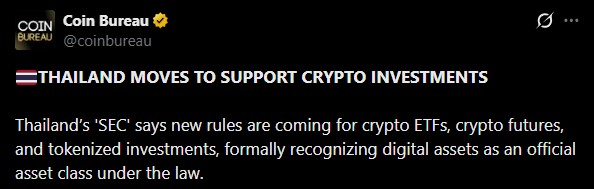
The Thailand crypto ETF guidelines proposal builds on the country’s 2022 digital asset laws, which already regulate exchanges, brokers, custodians, and token issuance. The new framework introduces tokenized investment rules, market-making mechanisms, and clearer oversight for institutional products.
How the New Crypto ETF Framework Will Work
Under the Thailand crypto ETF guidelines, digital assets will be formally recognized as a regulated asset class under the Derivatives Act, enabling crypto-linked products to trade on the Thailand Futures Exchange (TFEX). This MOVE aligns the country with global digital asset adoption trends while maintaining strong investor protections.
This opens up futures-based exposure and regulated ETFs, whereby investors can gain cryptocurrency exposure without taking direct token custody risk and wallet risks. Support from market-making should also continue to improve liquidity, price stability, and trading depth for the approved platforms.
Thailand’s Crypto Adoption and Regulatory Evolution
Thailand is one of the more mature cryptocurrency markets in Southeast Asia, partly due to early and structured regulation.
Since the passage of its landmark Digital Asset Decree in 2018, the country has licensed exchanges, custodians, and token issuers under the purview of the Thai SEC, while maintaining coordination with the Bank of Thailand and the Ministry of Finance.
That is including multiple regulatory refinements such as investor protection rules, standards for custody, approved stablecoins, and tax incentives-have created an environment conducive to steady adoption.
This puts the country in a unique position as a regulated yet highly innovative-friendly digital asset market, where trading activity has scaled up significantly since 2024.
Tokenization Gain Momentum as Investors Seek Regulated Exposure
By mid-January 2026, global crypto ETFs and ETPs held approximately $170–180 billion in AUM, with U.S. spot Bitcoin ETFs holding the pole position with about $117–137 billion in assets, followed by ethereum spot ETFs.
As clarity improves across regulators worldwide, analysts project that tokenized assets could reach $180–220 billion by end-2026.
After the success of cryptocurrency exchange-traded funds in global markets, Thailand's planned ETF framework is expected to attract institutional and risk-conscious retail investors who want exposure without managing private wallets themselves
This article is for informational purposes and does not provide any financial advice.
