Why Crypto Hacks Annihilate 80% of Projects: Immunefi CEO Reveals the Brutal Truth

Code is law—until a hacker rewrites it. The crypto frontier bleeds billions annually, but the real cost isn't just in stolen digital gold. It's in shattered roadmaps and vaporized communities.
The 80% Graveyard
Immunefi's CEO paints a stark picture: four out of five projects hit by a major exploit don't get back up. The breach itself is just the opening salvo. The knockout blow? A total collapse in user trust and developer morale. Liquidity flees, the community scatters, and the project joins the silent majority in the blockchain boneyard.
Beyond the Smart Contract Flaw
While flashy technical exploits grab headlines, the fatal vulnerability is often softer. A lagging crisis response, opaque communication, or a treasury drained without a recovery plan seals the fate. It's a brutal stress test that most nascent protocols simply fail.
The Survival Blueprint
The 20% that survive share key traits: pre-audited code, a war-chest for bug bounties, and a transparent, rapid-response playbook. They treat security not as a cost, but as the core product feature—the only real moat in a space where you're one line of buggy code away from becoming a cautionary tale. After all, in traditional finance, they just slowly bleed you dry with fees; in crypto, they take everything in one spectacular digital heist.
What is this news about?
A recent alert by Immunefi CEO Mitchell Amador tells an ugly truth in the crypto industry: nearly half of crypto projects that are hit with major hacks do not fully recuperate.
Experts say that stolen money is hardly the real cause of the damage. Rather, projects fail because they are operationalized into a state of paralysis, unable to manage the crisis, and lose user confidence at the critical response stage.
The results are against a background of a drastic increase in crypto-related hacks, which have hit a total loss of $3.4 billion in the year 2025, the highest since 2022. Security leaders emphasize that the response to an exploit by a project can usually be the difference between the project and its death.

source: Wu Blockchain
Why don’t hacked crypto projects recover?
The majority of hacked crypto projects are unsuccessful due to the lack of readiness for emergency security situations. Amador states that a significant number of teams do not realize how vulnerable they are to attacks and do not have a clear incident response plan. Once a breach is realized, confusion arises, the process of decision-making becomes slow, and important actions are postponed.
This breakdown leads to:
Prolonged downtime
Loss of user confidence
Liquidity drain
Long-term reputational loss.
Users will not come back once they lose trust.
What happens immediately after hacking?
The initial few hours of a cryptocurrency hack are the most destructive. Teams tend to be reluctant, argue in-house, or even attempt to conceal the problem to prevent social criticism.
Most projects postpone stopping smart contracts, fearing their reputation being damaged, which usually leads to more losses.
There is bad communication, which aggravates the situation.
The silence generates panic among the users, which increases fear instead of containing it. Scholars concur that quick, open communication is essential despite the unavailability of the information.
So what is the significance of trust in crypto?
Any crypto project is based on trust. According to Kerberus CEO Alex Katz, a major exploit is a death sentence to most platforms. When the users lose confidence, they withdraw money, liquidity is lost, and the project is hard to sustain.
Reputational damage is usually irreversible, even when the technical defect is resolved, and it is almost impossible to recover.
Do smart contract bugs still cause hacks?
Not anymore. Although exploits of smart contracts continue to happen, human and operational errors are currently the major contributors to crypto losses. These include:
Sanctioning malicious transactions.
Falling for phishing scams
Revealing personal keys or seed phrases.
A case in point is that of a user who lost more than 282 million after being duped by a fake support agent posing as a hardware wallet vendor.
What was the quality of crypto hacks in the recent past?
Hacks of cryptos increased to 2025, with a total loss of $3.4 billion. Almost 69% of all losses were caused by only three significant events, such as the $1.4 billion Bybit hack. These statistics demonstrate the increasing magnitude and complexity of attacks on both platforms and individual users.
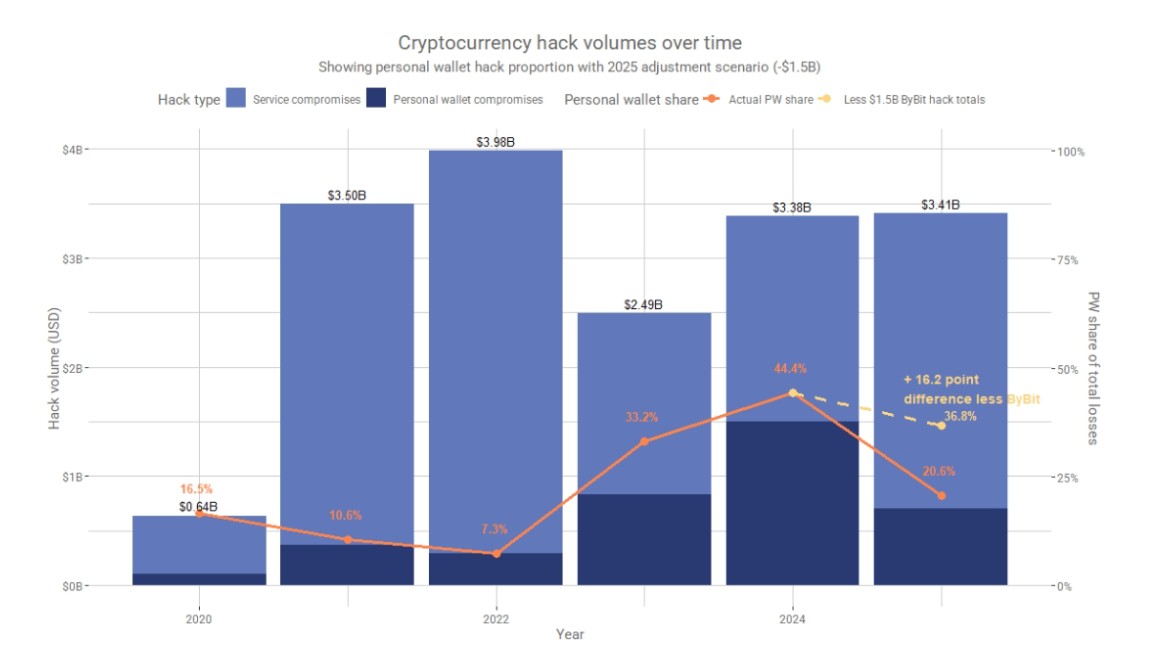
Source: X
What role does AI play?
The use of artificial intelligence has helped to make attacks more efficient. Hackers have adopted AI to execute massive social engineering campaigns, in which they send thousands of personalized phishing messages each day. This has greatly enhanced success rates, particularly for the less-experienced users.
Is there any good news?
Yes. Regardless of increasing threats, the experts are hopeful. Amador thinks that the year 2026 may be the year of crypto security, as it will be powered by:
Better development practices.
Stronger audits
On-chain monitoring tools
Premier threat intelligence and firewalling.
Nevertheless, specialists emphasize that technical security is not sufficient. The projects should also invest in incident response planning and communication strategies.
Disclosure: It is not financial advice. Do Your Own Research before investing. CoinGabbar has no liability for any financial loss. Cryptocurrencies are very unpredictable, and you can lose all your money.
