Cold Wallet Crisis: Hardware Wallet Scams Expose New Vulnerabilities in 2026

Your hardware wallet isn't as safe as you think—new scams bypass physical security entirely.
### The Illusion of Absolute Security
For years, cold storage hardware wallets represented the gold standard in crypto security—air-gapped, offline, and seemingly impenetrable. That narrative shattered this week as sophisticated social engineering attacks targeted users during the setup process, not the devices themselves. The threat doesn't hack the hardware; it hijacks the human.
### Social Engineering 2.0
Attackers now deploy fake customer support channels across social media and search engines. They intercept users experiencing genuine setup difficulties, offering 'assistance' that leads to secret recovery phrase extraction. The hardware remains untouched while the keys get stolen—a brutal reminder that the strongest lock can't protect keys handed to strangers.
### Supply Chain Subterfuge
Secondary market purchases carry additional risks. Pre-configured devices arriving with 'convenient' pre-generated seeds represent the ultimate Trojan horse. Users unknowingly adopt wallets where attackers already hold duplicate keys, waiting for deposits like financial vultures circling prey.
### The Verification Imperative
Legitimate manufacturers never request recovery phrases—ever. Device authenticity checks through official apps provide the first defense layer. Generating seeds independently during initial setup creates the second. Together, they form what security experts call 'the verification imperative' in an increasingly deceptive landscape.
### Finance's Ironic Twist
Here's the cynical finance jab: The same industry that champions 'be your own bank' now discovers that being your own security department, customer service rep, and fraud detection unit might be asking too much of people who still click 'I agree' without reading terms of service. The ultimate vulnerability might not be in the hardware, but in the human tendency to seek convenience over security—a flaw no firmware update can patch.
Cold wallets remain essential tools, but their security depends entirely on user behavior. In 2026's threat landscape, the hardware protects against remote attacks while users must defend against psychological ones. The arms race moved from silicon to social dynamics—and that's a battlefield where even the most expensive hardware offers zero protection.
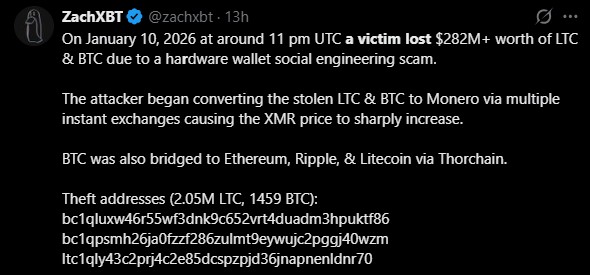
On January 10, blockchain investigator ZachXBT reported that scammers impersonated official wallet or exchange support. They manipulated the user to unveil their sensitive recovery (seed) phrase, in other words authorize malicious transactions. As long as the seed phrase was exposed, the scammers took full control of the funds.
Here the question arises – If physical wallets are designed for safety, how did this happen?
How the Hardware Wallet Scam Drained Bitcoin and Litecoin
According to ZachXBT, the victim lost 1,459 BTC and 2.05 million LTC through the hardware wallet scam. The wallet itself was not hacked. Instead, the attacker exploited human trust – the most common weak point in crypto security.
After stealing the funds, the scammers moved quickly. Much of the Bitcoin and Litecoin was swapped into Monero (XMR) using instant, no-KYC exchanges. This sudden activity caused Monero’s price to spike sharply, with reports showing gains of 60% to 74% before prices cooled back to the $640–$670 range.
Investigators also traced cross-chain transfers using THORChain, where stolen bitcoin was bridged to Ethereum, XRP, and additional Litecoin. ZachXBT shared suspected theft addresses publicly to help track the movement of funds.
This scam is now considered the largest individual crypto theft of 2026, surpassing several major social-engineering cases from previous years.
What This Physical Storage Scams Tells
In the emerging digitalized markets, safety is becoming more crucial, but how much is enough? Analyzing the recent incident, the indicent took place despite the strong device securities.
So, for now, taking measures on-devices is not enough to stay SAFE in the rapidly growing infrastructure but mentally readiness is equally important.
On-chain security firms’ data underscores how social engineering is still leading as a major crypto loss cause, calculating billions in stolen amounts in recent years.
User Responsibility Is the Final Line of Defense
As we understand that nothing is safe in this era without general self-awareness, even the strongest methods. While hardware wallets are often seen as one of the safest options, users are equally responsible for protecting their assets.
Never share your recovery phrase, no real support team will ever ask for it. Store seed phrases offline, verify every transaction on the wallet’s screen, and ignore unsolicited messages claiming “urgent security issues.”
Security experts also recommend using multisig wallets, extra passphrases, and official apps only. Hardware wallets can block most technical attacks, but staying alert and skeptical is what truly keeps crypto safe.
