Crypto Market Structure Bill Draft: What Traders Need to Know in 2026

Washington finally gets serious about crypto—or tries to. A new draft bill lands, promising to reshape the trading landscape. Forget the regulatory gray area; this legislation aims to draw hard lines.
The Core Framework: Clarity or Constraint?
The draft carves out definitions for digital assets, potentially ending the SEC vs. CFTC turf war that's left traders guessing. It mandates clearer custody rules for exchanges, forcing platforms to prove they actually hold your assets. That means less 'creative accounting' and more actual security—a win for anyone who remembers the last major collapse.
Exchange Obligations & Trader Protections
Market manipulation gets a target on its back. The bill pushes for real-time surveillance and reporting, aiming to curb the pump-and-dumps that plague decentralized corners of the market. For traders, this could mean cleaner price action and fewer nasty surprises from coordinated whales. Liquidity requirements for major platforms might also reduce the risk of another catastrophic domino effect during a market crash.
The Compliance Trade-Off
More rules mean more compliance. Expect KYC and AML checks to become non-negotiable, even on some DeFi gateways. This cuts both ways: it legitimizes the space for institutional money but adds friction for the average user. Some see it as the necessary cost of admission; others call it the death of crypto's founding ethos—another financial innovation slowly wrapped in the same red tape that strangles traditional markets.
The bottom line? The bill drafts a path from the wild west to Wall Street. It offers stability at the price of freedom, promising to protect capital while potentially stifling the very volatility that creates outsized gains. Whether it unlocks trillions or just adds another layer of bureaucratic cost—well, that's the trillion-dollar question. After all, in finance, the only thing more predictable than a new regulation is the army of lawyers and consultants ready to bill hours helping you bypass it.
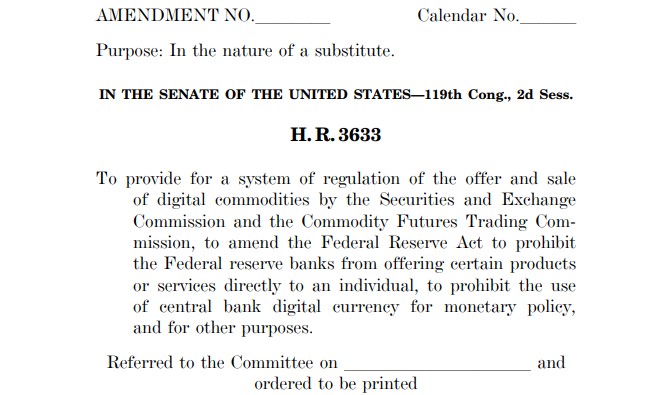
The bill introduced by Senator Tim Scott, Chairman of the Banking Committee, finally seeks to eliminate long-standing uncertainty in the US crypto market, protect investors, and offer clear rules for exchanges, brokers, and digital asset platforms.
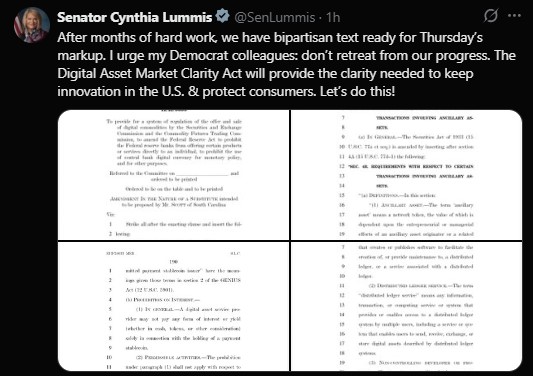
Ahead of the vote on markups, Senator Cynthia Lummis, a longstanding and vocal supporter of crypto, underlined bipartisan support of the draft as one that could finally allow innovation to remain in the U.S. while protecting the consumer.
The 278-page bipartisan draft, named Digital Asset Market Clarity Act of 2026, CLARITY Act for short, aims at defining how cryptocurrencies are regulated and splits oversight between the SEC and CFTC.
Key Provisions of the Crypto Market Structure Bill Draft
The Digital Asset Market Clarity Act of 2026 is an extension of the CLARITY ACT of 2025 that was passed in the House. This act defines and provides laws regarding digital assets, spot trading, consumer protection, and the registration of platforms. Some of the key points regarding this act include:
Roles of SEC and CFTC: The SEC will regulate securities-like virtual currencies, whereas the majority of non-securities like Bitcoins and Ethereum will be governed by CFTC as virtual commodities. This clear split ends years of regulatory ambiguity.
Stablecoin Rules: Certain stablecoin interest benefits and rewards are allowed keeping innovation intact with investor protection under certain stablecoin rules.
Anti-CBDC Provisions: The legislation blocks the Fed from using CBDCs for general monetary policy purposes but reserves them for individual services only.
DeFi & Developer Protections: Provides protection in the blockchain development field, staking programs, airdrops, and the bankruptcy treatment of digital assets.
The markup vote for the bill is scheduled for January 15, 2026, in the Senate Banking Committee, with potential input from the Agriculture Committee for CFTC-related matters.
How It Matters For Investors: Optimism On the Bill
The community saw the release as a bullish momentum for the broader marketplace. Many experts expect that this could set the US as a global crypto hub and fuel more adoption. Highlights include:
Reduced Regulatory Risk: Clear definitions and oversight reduce “regulation by enforcement” fears for major tokens.
Institutional Adoption: Banks, ETFs, and traditional funds may enter the market with confidence, increasing liquidity.
Innovation Boost: Legal pathways for exchanges, brokers, and DeFi platforms make staking, airdrops, and governance safer.
Marketplace Confidence: Clarity could stabilize volatility, attract capital, and drive sustained price growth for digital assets.
Potential Challenges and Risks
Nothing comes without challenges. Although the bill has received positive responses, there is certain amount of caution associated with it:
Compliance Costs: Smaller projects could see increased compliance costs.
Partial SEC Review: Some of these tokens may be assessed based on new maturity requirements.
Implementation Timeline: The complete implementation will take 1-2 years, with staged adoption beginning in 2027-2028.
Despite these factors, broader sentiment suggests that even the slightest momentum WOULD be perceived as entirely positive.
The Upcoming Crypto Market Picture
If finalized, the proposed US crypto market structure regulation could be a game-changer in the US digital asset industry. With regulatory clarity, investors face less risk, and institutional and mainstream adoption MOVE even faster.
As marketplace confidence is expected to strengthen, this will help support bitcoin and also support altcoins alongside innovation in the DeFi space and blockchain technology.
The present motivation that one should be watching is the upcoming markup vote scheduled for January 15, with broad bipartisan support possibly paving the way for massive adoption in 2026.
