Crypto Regulation Delayed Again: Senate Pushes CLARITY Act Vote to Late January 2026

Washington hits the snooze button—again. The Senate's much-hyped CLARITY Act markup, a pivotal moment for U.S. crypto regulation, just got punted to late January. Lawmakers are buying more time, leaving the industry in a familiar state of regulatory limbo.
The Waiting Game
This isn't the first delay, and seasoned crypto watchers aren't holding their breath. The move pushes a critical debate on digital asset frameworks—covering everything from token classification to exchange oversight—further into the new year. Markets, which often twitch on regulatory whispers, have so far responded with a collective shrug, treating it as just another chapter in the endless saga of political process.
Why The Hold-Up?
Insiders point to the usual suspects: last-minute jurisdictional squabbles, competing amendments, and the sheer complexity of drafting rules for a borderless, 24/7 asset class. Some see it as cautious diligence; others, as another symptom of legislative paralysis. One cynical take? It's classic D.C.—spending more time debating the rules of the game than actually letting anyone play, all while traditional finance quietly builds its own moats.
What's Next for Crypto?
The delay means more uncertainty for U.S. firms and investors. Every postponed vote is another quarter where innovation and capital face friction, potentially drifting to clearer shores overseas. The industry's message remains: clarity can't come soon enough. But in the halls of Congress, 'soon' is a relative term. The wait continues—check back in late January, maybe.
What the Crypto Bill Markup Delay Really Means?
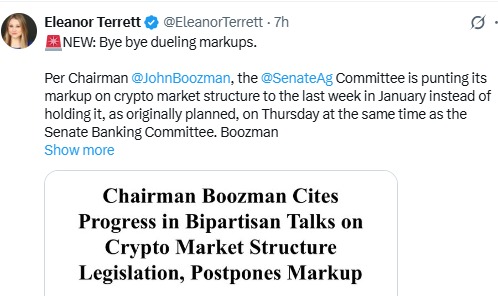
The Crypto Bill Markup Delay indicates that the Senate Agriculture Committee will not hold its scheduled discussion and vote this week. This will now occur in the later part of January.
A markup is when lawmakers review a draft, suggest changes, and prepare it for a full Senate vote.
As Tweeted by Eleanor Terrett, this decision also avoids what many called “dueling markups.”
Source: X (formerly Twitter)
Both the Agriculture and Banking Committees were set to review their own bills related to digital currencies on the same day.
That could have created two different versions of digital assets regulation.
Now, lawmakers have more time to align their plans and avoid confusion.
Chairman John Boozman said the delay is needed to protect bipartisan support. Since the Senate needs 60 votes to MOVE forward, Republicans must gain help from Democrats. Without this support, the draft would fail.
Why Is Bipartisan Support Critical for the CLARITY Act?
The CLARITY Act is one of the most important crypto laws being discussed in years. It aims to define which agency controls digital assets markets, the SEC or the CFTC. This clarity is necessary for exchanges, investors, and large financial institutions.
With only 53 Republican senators, at least 7 Democrats must vote yes. That is why this is not bad news. It improves the chances that the bill survives the Senate floor vote. Without Democratic backing, the CLARITY Act WOULD be dead on arrival.
Growing Pressure Inside the Senate
Some Democratic senators are already raising concerns. They asked for more time to review the bill’s text, which is expected to exceed 200 pages. Even Republican Senator John Kennedy earlier requested hearings. This shows how complex and sensitive digital assets regulation has become.
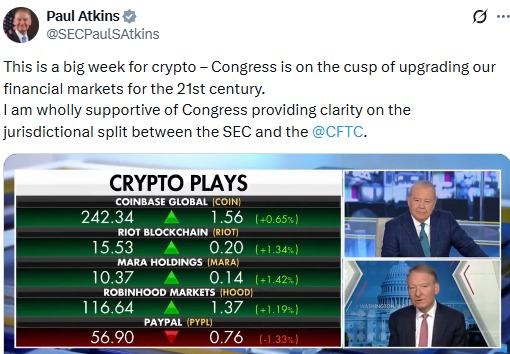
At the same time, SEC Chair Paul Atkins has shown full support for the bill. He believes the CLARITY Act can finally move the industry out of the “regulatory gray zone” and protect markets from unstable rules.
Source: X (formerly Twitter)
Coinbase Dispute Adds More Delay Risk
Another challenge behind the Crypto Bill Markup postponed is Coinbase’s opposition. The exchange warned it may withdraw support if stablecoin rewards are restricted. Banks want those rewards banned, while Coinbase argues they help users and keep the U.S. competitive.
This conflict is now weakening political unity. Lawmakers must balance banking interests with innovation and consumer benefits.
Crypto Market Reacts to Uncertainty
The crypto market declined by 0.95% in the last 24 hours and is now down by 3.08% in the current week. There have been $50.8M worth of liquidations in Bitcoin, with many margin traders being forced to close their positions. The volume in the perpetual contracts skyrocketed, but the funding rates plummeted.
Bitcoin dominance ROSE to 58.65%, which means traders are moving away from risky altcoins and toward safer assets. This behavior usually appears during regulatory uncertainty, like the current Clarity Act Markup Delay period.
What Happens Next?
This gives lawmakers time to align the Agriculture and Banking Committees, settle disputes over stablecoin rewards, and finalize bipartisan support. If successful, the CLARITY Act could be voted on by early 2026 and signed soon after.
This article is for informational purposes only and does not constitute financial, legal, or investment advice.
Readers should conduct their own research and consult professionals before making any financial decisions.
