VC Funding Craters as India’s Crypto Regulatory Storm Clouds Gather

Capital is fleeing. Venture funding for crypto startups in India has hit a wall—a direct consequence of mounting regulatory uncertainty that's turning investor optimism into cold feet.
The Chill Factor
It's not a market crash causing the freeze. The trigger is a looming regulatory framework that remains frustratingly opaque. Ambiguity around taxation, licensing, and outright bans on certain activities has created a classic 'wait-and-see' paralysis. Why deploy capital when the rules of the game could change overnight? Smart money hates surprises more than it loves potential.
A Global Domino Effect
India isn't an island. This pullback sends a signal to the broader emerging market crypto ecosystem. When a nation with such massive tech talent and adoption potential stumbles on regulation, it gives pause to VCs eyeing similar frontiers. Capital is global and fluid—it simply flows to the path of least resistance and clearest regulation.
The Innovation Exodus Risk
The real casualty here isn't just quarterly funding numbers. It's the long-term brain drain and stifled innovation. Founders with groundbreaking ideas may simply pack their bags for Dubai, Singapore, or Lisbon—jurisdictions that, while not perfect, have rolled out the welcome mat with clearer guidelines. India risks regulating its best and brightest out of the country.
A Necessary Correction or a Fatal Blow?
Some in traditional finance will call this a healthy correction, a washing out of the 'reckless' crypto speculators—as if their own industry is a paragon of prudent risk management. The truth is more nuanced. Regulation is inevitable and needed for mass adoption, but the method matters. Clarity fosters growth; ambiguity kills it.
The road to a mature digital asset ecosystem in India is getting steeper. The current VC freeze is a stark market referendum on policy indecision. The ball is now firmly in the regulator's court. Will they build a framework that harnesses this technology, or will they architect a cautionary tale for the rest of the world? The next funding round depends on it.
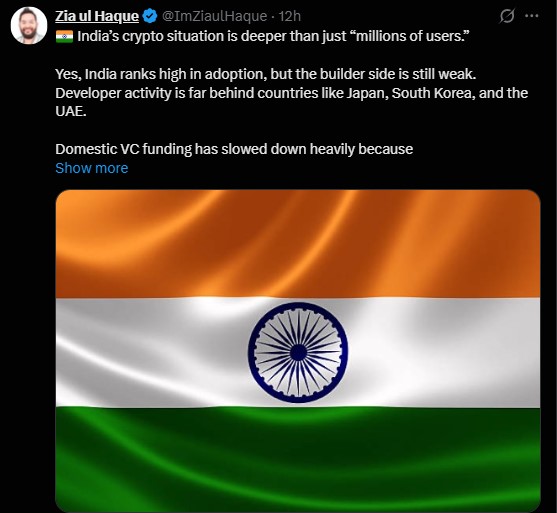
This is now at the center of rising India crypto Regulation concerns, as the government sees no urgent need to speed up the process.
India Crypto Regulation Concerns: More Users, But Few Builders
The nation often ranks high in global adoption reports and digital asset usage charts. But Zia says this is misleading, because Indian crypto adoption does not mean innovation.
Compared to Japan, South Korea, and the UAE, the diversified nation has:
-
Very low blockchain developer activity
-
Weak blockchain research
-
Fewer real Web3 products
-
Very limited global-level projects
This gap hurts the country’s long-term growth and deepens India Crypto Regulation Concerns, because regulators usually support industries that show strong innovation.
Indian Startup VC Funding Has Dropped: What Happened?
As per the latest India crypto news circulating in the industry, domestic VC funding in Web3 has almost stopped. VCs are waiting for clear rules, and without a transparent framework, they don’t want to invest.
Today, most cryptocurrency and Web3 funding in the country comes from:
-
Global VC funds
-
Foreign angels
-
Indian exchanges supporting small teams
This shows a deeper crisis: The Web3 startup ecosystem is growing, but not truly supported by investors. This adds to India Crypto Regulation Concerns, because without strong local backing, there is no pressure on the government to act fast.
Why the Government Isn’t Rushing Clear Framework
The main reason why government rules on cryptocurrency can be pushed is that the nation's digital assets industry is too small to impact the economy in terms of real value.
Government agencies and regulators usually introduce strong rules when an industry creates jobs, boosts the GDP, solves real problems, and improves everyday life.
But here, VIRTUAL tokens are mostly seen as a trading or investment activity, not a technology being used in daily life, this is why the regulatory body sees no urgent need to solve India Crypto Regulation Concerns right now.
Exchanges Also Agree: Real Use Cases Must Come First
Even exchanges support this view. They say regulation will only become a priority when it:
-
Supports payments
-
Reduces remittance costs
-
Helps identity verification
-
Powers micro-services
Right now, these solutions are limited and do not add any useful value, until the country builds more real-world utility, the framework will stay slow.
The Hard Reality: India Needs More Builders Before Better Rules
Zia ul Haque’s message is simple but powerful:
“If Indian investors want strong rules and a clear framework, we need more builders, better products, and real-world use cases that help millions of people.”
This truth explains why India Crypto Regulation Concerns continue to grow. The industry is large in users, but small in innovation. Now, the digital asset’s future in this nation simply depends on strong developer communities, better blockchain products, and more web-3 global projects.
Until this happens, traders and investors should watch out for the upcoming updates, to uncover the country’s future plans, and whether they align with what experts think or not.
Disclaimer: This article is for news purposes only. It does not promote any financial advice, so always do your own research investing in any cryptocurrency.
