Ethereum Tests New ZK Secret Santa Protocol for On-Chain Privacy

Ethereum just unwrapped an early holiday surprise—a stealth test of a new zero-knowledge privacy protocol that could reshape on-chain confidentiality.
The ZK Secret Santa Protocol
Forget clunky mixers and opaque tumblers. This protocol leverages cutting-edge zero-knowledge proofs to let users transact with complete privacy while staying entirely on-chain. It validates transactions without revealing a single detail—sender, receiver, or amount. Think of it as a cryptographic gift exchange where no one knows who gave what to whom, but everyone trusts the system worked.
Why This Cuts Through the Noise
Existing privacy solutions often come with trade-offs: moving assets off-chain, relying on centralized components, or creating regulatory headaches. This test suggests a path forward that bypasses those compromises. It's native, it's verifiable, and it runs on Ethereum's own infrastructure—a potential game-changer for DeFi and beyond.
The implications are massive. From shielding corporate treasury movements to enabling truly private NFT auctions, the protocol could unlock use cases that were previously too risky or impossible. It turns Ethereum's transparent ledger into a selective disclosure engine.
A Provocative Step Forward
This isn't just a tech demo. It's a direct challenge to the notion that blockchain transparency is an all-or-nothing proposition. The test shows that robust auditability and individual privacy can coexist—without relying on trusted third parties or off-chain promises.
Of course, the usual suspects will howl about compliance. Regulators love a transparent ledger they can surveil, and some institutional players have built entire business models on tracking your wallet—a cynical but profitable hobby. This protocol politely suggests there might be another way.
Ethereum's quiet test signals a serious push toward mature, built-in privacy. If successful, it won't just hide transactions; it could fundamentally redefine what's possible on a public blockchain. The future of finance might just be both open and confidential.
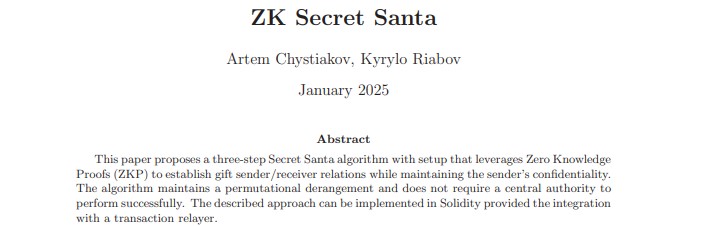
Solidity engineer Artem Chystiakov resurfaced the protocol, called Zero Knowledge Secret Santa (ZKSS), in a new post on the ethereum community forum this week. The research was originally published in January on arXiv and is now being prepared for real-world testing.
New Privacy Layer for Ethereum: What the Protocol Tries to Solve?
The blockhain is transparent by design – every wallet, transaction, and interaction is visible on the blockchain.
This creates three major problems for privacy-based apps:
No anonymity: Sender and receiver details are always public.
No true randomness: Ethereum can’t generate fair random pairings on its own.
Sybil attacks: Users could cheat by registering multiple times.
The new proposed Ethereum ZK Secret Santa system solves this by using two tools:
Zero-knowledge proofs (ZKPs) to verify actions without revealing identities
A transaction relayer to hide which wallet submits each step
Together, they allow private, anonymous matching on a public blockchain.
How the System Works (Simple Breakdown)
Users register their addresses in a smart contract and commit to a unique digital signature. This blocks duplicate registrations and prevents cheating.
Each participant sends a random number using a relayer, so the blockchain cannot LINK any number to any wallet. These numbers help recipients encrypt their delivery details.
Participants choose someone else’s random number. The ZK Secret Santa protocol reveals the receiver only to their assigned Santa – no one else can see the pairing.
This creates full anonymous matching on-chain using Zero-Knowledge cryptography.
Why Would Developers Care: Bigger Use Cases Ahead
The Secret-Santa use case is only the start. The same zero-knowledge privacy framework could be used for:
Anonymous voting and DAO governance
Private whistleblower submissions
Private airdrops and token allocations
Membership verification without identity exposure
Confidential coordination systems
As crypto interacts more with traditional finance, privacy-preserving tools are becoming essential.
Deployment Coming Soon: A New Step for Blockchain Privacy
With zero-knowledge proofs becoming one of the most important trends in blockchain, the ZK protocol represents a major step in improving anonymous transactions, secure coordination, and future privacy layers.
When asked about release timelines, Chystiakov said the team is actively working on open-source implementation. This indicates that the Ethereum privacy upgrade is moving closer as researchers are moving the zero-knowledge system closer to live testing or pilot deployments on-chain.
If implemented, the ZK Secret Santa protocol could become a foundational tool for anonymous on-chain interactions, offering a new way to coordinate privately without breaking the network's transparency or security model.
