Bitcoin Mining’s Perfect Storm: Navigating the Industry’s Worst Crisis in 15 Years

The digital gold rush hits a wall. Bitcoin mining—the backbone of the world's largest cryptocurrency—faces its most severe stress test since Satoshi's whitepaper dropped.
### The Squeeze Is Real
Rising energy costs chew through margins. Older hardware grinds toward obsolescence. Regulatory headwinds blow from multiple directions. The perfect storm isn't coming; it's here.
### Survival of the Fittest (and Most Efficient)
This isn't a dip—it's a Darwinian filter. Operations clinging to outdated tech or poor power contracts get flushed out. The survivors? Those with cutting-edge ASICs, locked-in energy deals, and balance sheets that can weather the volatility. It's a brutal efficiency drive, Wall Street-style, but with more computer fans and fewer suits.
### What's Next for the Hashrate?
Network security faces a moment of truth. A major miner exodus could temporarily dent the hashrate, but history shows this ecosystem is antifragile. Difficulty adjustments rebalance the ledger. Weaker hands fold, their assets get scooped up at a discount, and the network emerges leaner, meaner, and more decentralized. Consider it a forced upgrade.
The irony? Traditional finance panics over quarterly earnings; Bitcoin's infrastructure just stares down its worst crisis in a decade and a half without missing a block. Maybe the real 'digital gold' was the resilience we mined along the way.

The crisis stems from a perfect storm of factors: Bitcoin’s price dropped from a record high near $126,000 in October to below $80,000 in November, while mining difficulty reached record highs. This combination has created unprecedented challenges for an industry that secures the world’s largest cryptocurrency network.
Record-Low Mining Revenue Squeezes Operations
Mining profitability has hit structural lows that experts say represent more than just a temporary downturn. Hashprice, which measures how much miners earn per unit of computing power, crashed from $55 per petahash per second (PH/s) in the third quarter to roughly $35 PH/s by late 2024.
This represents the lowest level in Bitcoin’s history. The metric recently hit record lows below $35 PH/s on November 21, 2024. Currently, hashprice hovers around $38.3 PH/s per day, which sits dangerously close to the $40 PH/s break-even point where miners must consider shutting down operations.
Mining profitability has fallen to just 0.0334 USD per day for every terahash of computing power. This marks the lowest level since 2023, putting enormous pressure on operations of all sizes.
Payback Periods Stretch Beyond 1,000 Days
Perhaps the most alarming development is how long it now takes miners to recover their equipment costs. New ASIC mining machines now require more than 1,200 days to pay for themselves – the longest payback period in Bitcoin’s history.
This timeline is particularly concerning because Bitcoin’s next halving event, which will cut mining rewards in half again, is expected in roughly 850 days. This means miners may not even recover their equipment costs before the next major revenue reduction.
The extended payback periods reflect the harsh reality of increased competition. Mining difficulty has reached record highs as more computing power comes online, making it harder for individual miners to earn rewards.
Post-Halving Economics Create Perfect Storm
The April 2024 halving cut block rewards from 6.25 Bitcoin to 3.125 Bitcoin, instantly slashing miners’ primary revenue source in half. Despite this revenue cut, the network’s total computing power continued growing dramatically.
Bitcoin’s hashrate reached 831 exahashes per second by May 2024, representing a 60% increase from earlier 2024 lows. This growth shows continued investment in mining infrastructure, even as profitability collapsed.
The halving also changed the energy economics of mining. The energy required to mine one bitcoin increased to approximately 854,400 kilowatt-hours following the halving, nearly doubling from pre-halving levels. This surge in energy requirements per coin has pushed mining costs to about $112,000 per Bitcoin – roughly 1.3 times higher than Bitcoin’s current market value.
Mining Stocks Crash as Margins Disappear
Public mining companies have seen their stock values devastated since October 2024. MARA Holdings, one of the largest miners, dropped roughly 50% from its October peak. CleanSpark fell 37%, while Riot Platforms declined 32%. HIVE Digital Technologies suffered the worst decline, plunging 54% from its October highs.
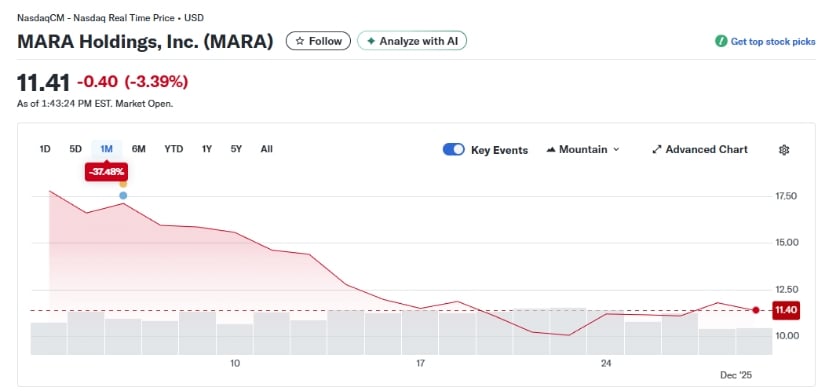
Source: finance.yahoo
The stock crashes reflect investor concerns about the industry’s ability to survive the current conditions. Many mining companies are responding by reducing debt and preserving cash. CleanSpark recently repaid its Bitcoin-backed credit line with Coinbase as part of broader deleveraging efforts across the sector.
Transaction fees, which typically provide supplementary income beyond block rewards, have fallen to multi-year lows. Fees now contribute less than 1% of total miner revenue, offering little relief from the compressed margins.
Industry Pivots to Artificial Intelligence for Survival
Facing unsustainable Bitcoin mining economics, many companies are diversifying into artificial intelligence and high-performance computing services. This strategy allows miners to use their existing power infrastructure and facilities for more stable revenue streams.
Some mining companies executing this pivot have seen positive market reception, though the broader sector continues facing significant challenges. AI revenues remain small compared to traditional mining operations and cannot fully offset the decline in Bitcoin mining profitability.
The geographic distribution of mining is also shifting toward regions with the cheapest electricity. Only operations with power costs below $0.05 per kilowatt-hour using the most efficient equipment remain highly profitable. This requirement has pushed mining toward Middle Eastern countries and other regions with subsidized energy.
Mining companies are also reducing hardware purchases. Many US-based firms scaled back equipment orders in late 2024, signaling reduced confidence in near-term profitability improvements.
The Mining Consolidation Reality Check
The current crisis represents more than temporary market volatility. It signals a fundamental shift toward industry consolidation where only the most efficient operators with access to the cheapest energy will survive.
Smaller miners and those with average electricity costs face an impossible equation: their daily operating expenses exceed their daily revenue. This mathematical reality is forcing widespread exits from the industry, concentrating mining power among fewer, larger operators.
While this consolidation may strengthen individual companies that survive, it raises questions about Bitcoin network decentralization – a Core principle of the cryptocurrency’s design. The industry that once welcomed participants worldwide is increasingly becoming the domain of industrial-scale operations with preferential energy access.
