Citi Forecasts Bank-Issued Tokens to Outshine Stablecoins in Adoption Race

Traditional finance giants are waking up to blockchain's potential—and they're bringing their own tokens to the party.
The Institutional Advantage
Bank-issued digital tokens leverage existing regulatory frameworks and customer trust, positioning them as formidable competitors to decentralized stablecoins. Citi's analysis suggests regulated financial institutions could capture market share faster than their crypto-native counterparts.
Regulatory Momentum Builds
With central banks worldwide exploring digital currencies and financial authorities clarifying tokenization rules, the infrastructure for bank-issued tokens is rapidly maturing. The same institutions that once dismissed crypto are now racing to tokenize everything from bonds to settlement systems.
Market Impact
This shift could reshape the $150B+ stablecoin market, potentially redirecting institutional flows toward bank-issued alternatives. Because nothing says innovation like letting banks create the digital assets they previously warned clients against buying.
The tokenization wave is coming—and traditional finance intends to ride it all the way to the blockchain.
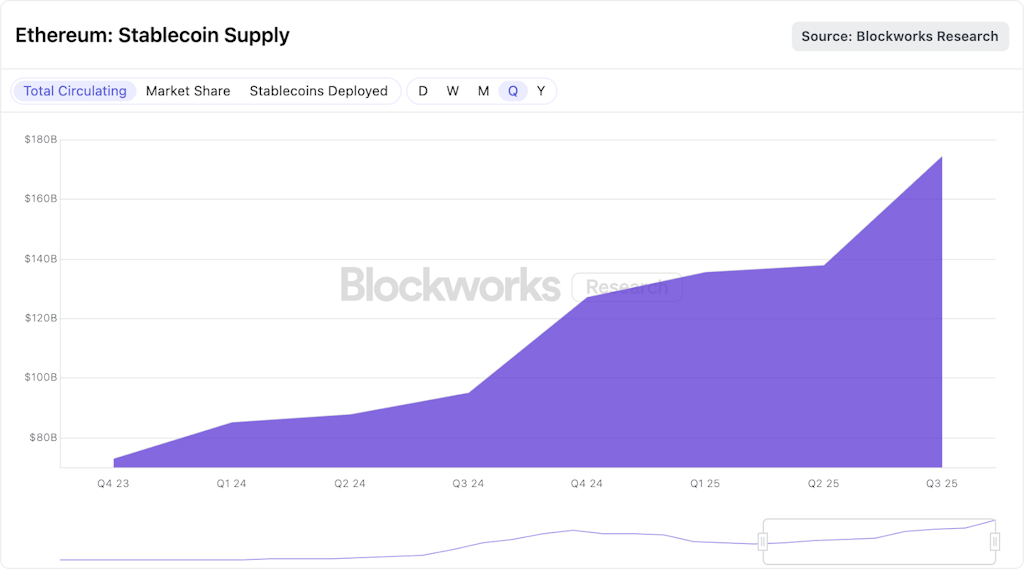 Ethereum holds roughly $177b of the $306 billion total stablecoin supply | Source: Blockworks Research
Beyond growth in supply, Citi’s updated outlook projects even more eye-popping numbers for transaction volume. Since stablecoins “can circulate with really high velocity,” Bantanidis said the base case implies roughly $100 trillion in annual stablecoin transaction volume by 2030, or even double in the bull scenario.
But there’s a caveat, she told the London audience: “Stablecoins are not going to be the only game in town.”
Loading Tweet..“We envision a multi-format, monetary ecosystem,” Bantanidis said, predicting that “bank tokens…will outpace stablecoins in transaction volume by 2030.”
The report models $100–$140 trillion in annual bank-token turnover at modest penetration of large-value payment rails.
On adoption, corporate treasurers “can optimize liquidity management globally” via programmability, embedded compliance and conditional settlement — but many “are likely going to prefer bank tokens and tokenized deposits because of their risk appetite [and] regulatory considerations,” Bantanidis said.
Geopolitically, Citi believes dollar-backed stablecoins could extend USD dominance, with Hong Kong and the UAE among jurisdictions likely to embrace local-currency rails but, Bantanidis cautioned, “there are multiple regulatory loopholes that still need to be filled.” Risks include interoperability and fragmentation, the quality of the reserve assets, transparency and auditability.
Despite lingering uncertainties, one thing is clear, Bantanidis said: “Stablecoins are shifting from a niche decentralized finance experiment into a viable rail for moving money.”
- The Breakdown: Decoding crypto and the markets. Daily.
- 0xResearch: Alpha in your inbox. Think like an analyst.
- Empire: Crypto news and analysis to start your day.
- Forward Guidance: The intersection of crypto, macro and policy.
- The Drop: Apps, games, memes and more.
- Lightspeed: All things Solana.
- Supply Shock: Bitcoin, bitcoin, bitcoin.
