Bitcoin Plunges to $86K as Senate Stalls Crypto Market Structure Bill

Regulatory limbo sends shockwaves through digital asset markets.
Bitcoin's price took a sharp dive, tumbling to $86,000 after the U.S. Senate delayed a crucial vote on the long-awaited crypto market structure bill. The move throws cold water on investor hopes for near-term regulatory clarity—a classic case of Washington's 'hurry up and wait' approach to finance.
The Hold-Up in the Halls of Power
The Senate's decision to push back the bill sidelines what many saw as a foundational framework for digital asset regulation. The delay creates immediate uncertainty, forcing markets to price in extended ambiguity. Traders reacted swiftly, with sell-offs accelerating as the news broke.
Markets Don't Wait for Bureaucrats
While lawmakers debate timelines, the crypto ecosystem keeps evolving at breakneck speed. This disconnect between technological pace and legislative speed is nothing new—just ask anyone who lived through the early internet days, or more recently, watched traditional finance scramble to understand DeFi.
The $86,000 Question
The drop to $86,000 marks a significant pullback from recent highs, testing key support levels. It's a stark reminder that in crypto, regulatory headlines can be as powerful as any technical indicator or macroeconomic report. The market's message is clear: it wants rules of the road, even if it hates being told where to drive.
A cynical take? The delay is a feature, not a bug—it gives traditional funds more time to build positions before the 'official' green light. After all, why let a little thing like market structure get in the way of a good old-fashioned accumulation phase?

Bitcoin dropped over 4% in the past 24 hours after the U.S. Senate Banking Committee confirmed on Monday that it would delay markup of long-awaited crypto market structure legislation until early 2026, extending regulatory uncertainty that has weighed on institutional sentiment.
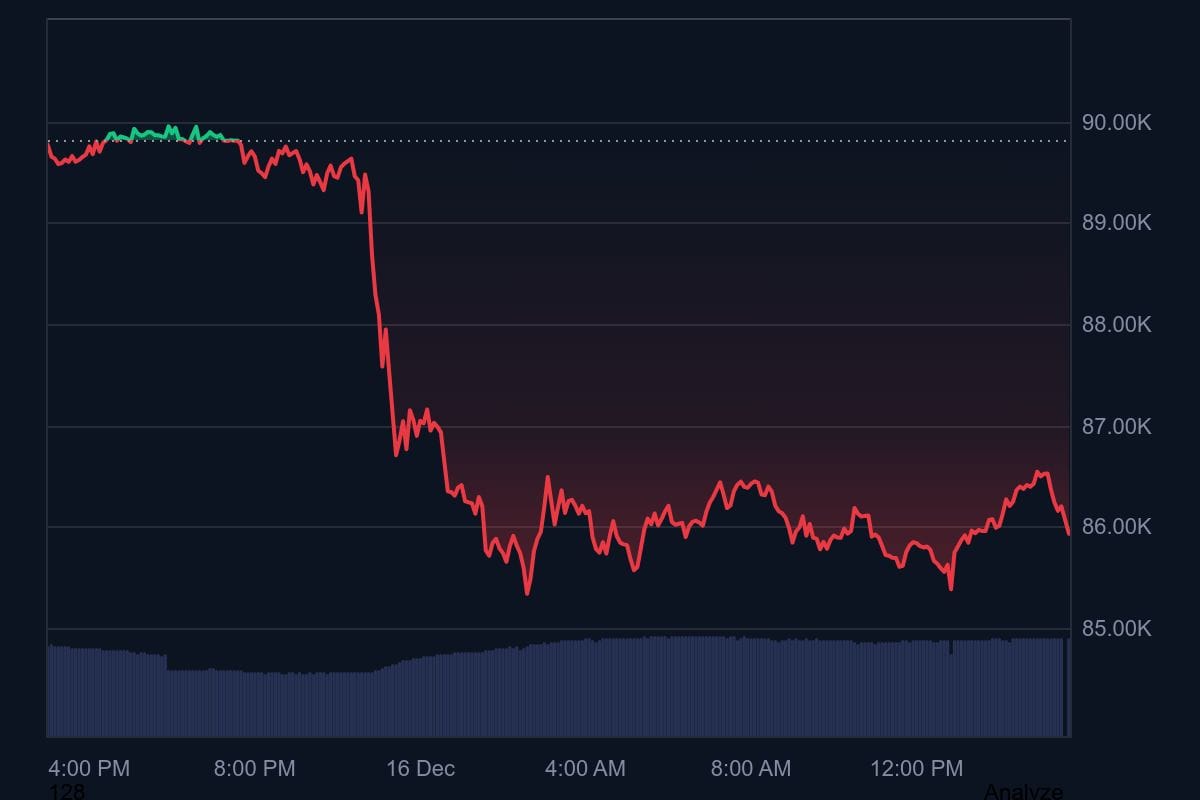
The benchmark cryptocurrency briefly touched $84,000 before stabilizing near $85,800 in Asian trading hours, while Ethereum declined over 6% to $2,900. Total cryptocurrency market capitalization fell below $3 trillion to $2.93 trillion as the sell-off rippled across major tokens.
The Senate Banking Committee said it ran out of time to advance the bill before Congress adjourns for the holiday recess, despite nearly two months of active bipartisan negotiations. Chairman Tim Scott's office said discussions WOULD continue, with a markup now targeted for early 2026.
🚨NEW: In a statement, a Senate Banking Committee spokesperson confirmed my reporting from this AM that @BankingGOP will not hold a market structure markup this year:
“Chairman Scott and the Senate Banking Committee have made strong progress with Democratic counterparts on… pic.twitter.com/op5rIyMn3d
"Chairman Scott and the Senate Banking Committee have made strong progress with Democratic counterparts on bipartisan digital asset market structure legislation," the committee's GOP statement read, adding that Scott "has consistently and patiently engaged in good-faith discussions to produce a strong bipartisan product."
The postponement leaves unresolved how the SEC and CFTC will divide oversight of spot markets and digital asset securities, a jurisdictional question that has created compliance challenges for U.S.-based crypto firms.
Exchange-traded fund flows reflected the defensive shift in positioning. Bitcoin spot ETFs recorded $358 million in outflows, while ethereum ETFs shed $225 million, according to market data. Combined outflows totaled $582 million across the two largest crypto assets.
In contrast, solana and XRP ETFs remained positive with inflows of $35 million and $11 million respectively, suggesting selective appetite for specific tokens rather than wholesale risk-off behavior.
The Senate Agriculture Committee, which has jurisdiction over CFTC-related crypto legislation, has not scheduled its own markup, further reducing the likelihood of comprehensive digital asset rules being finalized before mid-2026.
The delay reintroduces policy uncertainty at a time when institutional crypto adoption has accelerated ahead of regulatory clarity. For asset allocators, the gap between market development and legislative frameworks creates friction that translates into higher risk premiums and faster de-risking when sentiment deteriorates.
➢ Stay ahead of the curve. Join Blockhead on Telegram today for all the latest in crypto.+ Follow Blockhead on Google News