Cardano Community Backs Core Upgrades in Landmark Governance Vote

Cardano just leveled up its decentralized cred—without begging VCs for cash.
The blockchain's community overwhelmingly funded critical protocol upgrades through its on-chain treasury system, marking a rare case of crypto governance that actually works. No corporate overlords, no shadowy dev taxes—just stakeholders putting ADA where their mouths are.
This isn't some meme-coin DAO voting on pizza parties. We're talking core protocol upgrades that could finally silence the 'ghost chain' trolls. The exact funding amount? Doesn't matter—what counts is the precedent: a top-10 crypto project letting its users control the purse strings.
Of course, Wall Street will call this 'reckless.' Because nothing says 'financial responsibility' like bailing out banks every decade, right?
A Historic Approval For The Cardano Developer
Input Output publicly framed the vote as a structural shift in how Cardano evolves. In a company statement, Tim Harrison, EVP Community & Ecosystem, called it “a milestone moment for Cardano,” emphasizing that, “for the first time, core protocol development is being funded directly by the community.” He said the mandate enables the team to proceed “with full transparency [and] shared responsibility.”
Accountability is central to the new model. Intersect, Cardano’s member-based organization, will act as an independent administrator, with milestone-based disbursements released only upon verified delivery. Oversight is to be enforced through smart contracts and a dedicated committee, complemented by monthly public updates, engineering timesheets, and quarterly budget reports.
On social channels, the message was one of collective ownership. Input Output said, “The cardano community just made history… core development funding has been directly approved by the community,” adding that the decision is “more than a vote of confidence, it’s a shared commitment to progress.” Cardano founder Charles Hoskinson amplified the sentiment: “Thank you everyone for your support and trust. Let’s get it done.”
The ratified roadmap targets throughput, developer experience, and interoperability across several fronts. IOE highlighted Ouroboros Leios as a foundational performance upgrade intended to raise throughput without trading off security or decentralization; Hydra for ultra-low-latency, low-cost transactions to support real-time uses; Mithril enhancements to cut bootstrap time and enable lightweight clients; nested transactions to extend smart-contract expressivity and cross-chain behavior; and Project Acropolis, a modular re-architecture of the Cardano node designed to make core contributions more accessible. Performance optimizations—faster sync, lower RAM, reduced operator costs—round out the near-term engineering agenda.
Ricky Rand, General Manager at Input Output Engineering, cast the vote as both mandate and test: “Securing this funding is just the start… a model for how decentralized funding and delivery can work at scale. The real work begins now—delivering with integrity [and] reporting with transparency.”
The on-chain decision arrives amid a broader governance cadence. Intersect noted in mid-July that dozens of treasury withdrawal actions were being advanced for community decision, with DReps—delegate representatives—tasked to vote on each. IOE’s roadmap sits within that slate but stands out as the first community-authorized core protocol funding, a role historically filled by centralized stewards in many networks.
Beyond execution by IOE, the process explicitly anticipates wider participation. Input Output said it will onboard external vendors, many from the Cardano Developer Ecosystem Coalition, to expand delivery capacity and help those contributors mature into independent proposers in future rounds—an approach intended to harden decentralization over time.
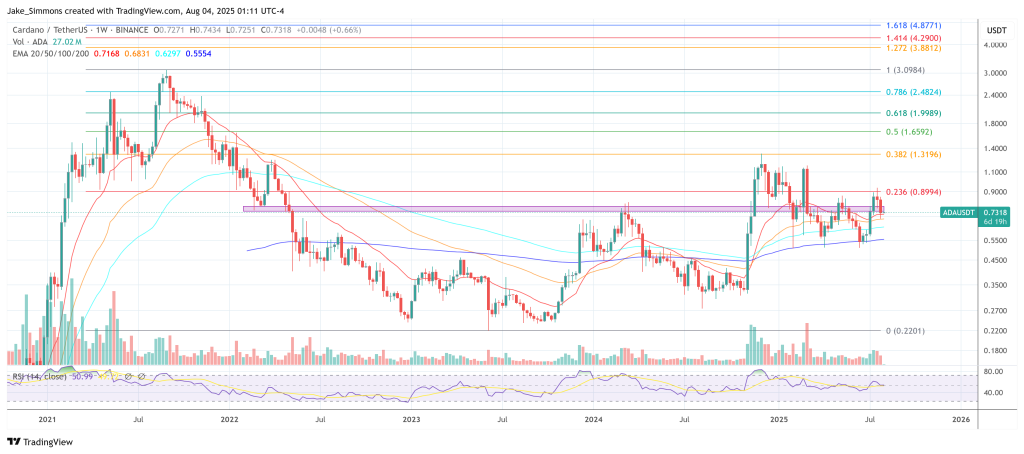
At press time, ADA traded at $0.73.